Okamoto Alexander, Senevirathne Gayani, Muthuirulan Pushpanathan, Rolian Campbell, Glass Ian, Capellini Terence
Harvard University.
McGill University.
Res Sq. 2025 Aug 18:rs.3.rs-7124496. doi: 10.21203/rs.3.rs-7124496/v1.
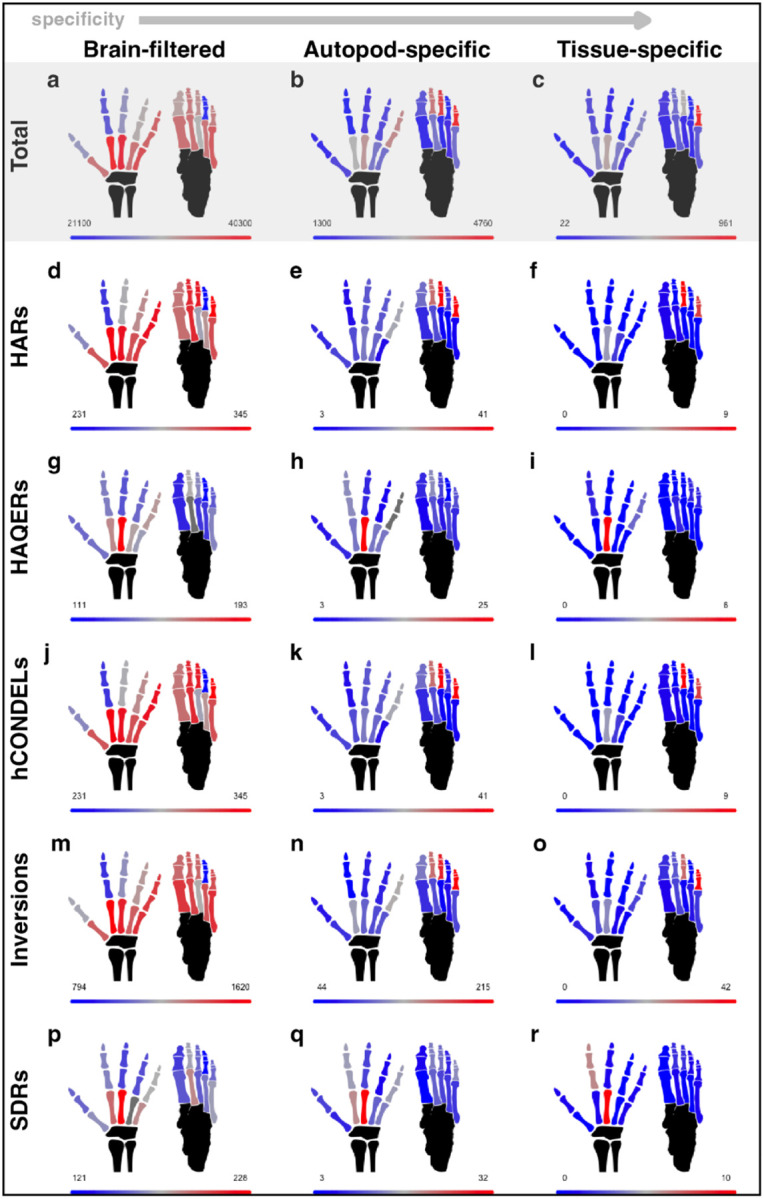
The transition to bipedal locomotion is a key event in human evolution, involving substantial changes to the skeleton, including the bones of the hands and feet (autopods). Hominins evolved a more muscular and opposable thumb while the other fingers are relatively shorter, enhancing manipulative capacity. The feet evolved robust first toes and short lateral toes to meet the challenges of bipedal walking and running. While adaptations in the hand and foot have often been considered separately, the fore- and hind limbs of primates are morphologically integrated, serially homologous structures, raising the possibility that natural selection on either autopod may have driven corresponding changes in the other. To explore the genetic architecture underlying human autopod evolution, we used functional genomics methods to identify regulatory elements and gene expression patterns in the developing phalanges and metacarpals of the human hand and foot. We find that gene expression and regulation differ along the proximal-distal axis and between timepoints but not between limb types or individual digits. We show that thousands of human-specific genomic features fall within autopod regulatory elements, some accessible in multiple tissues, others with tissue-specific accessibility. Our results highlight the complex genomic basis of human autopod evolution.
向两足行走的转变是人类进化中的一个关键事件,涉及骨骼的重大变化,包括手和脚(手足部)的骨骼。人族进化出了更强壮且可对握的拇指,而其他手指相对较短,从而增强了操作能力。脚进化出了粗壮的大脚趾和短小的外侧脚趾,以应对两足行走和奔跑的挑战。虽然手部和足部的适应性变化通常是分开考虑的,但灵长类动物的前肢和后肢在形态上是整合的、系列同源的结构,这就增加了一个可能性,即对任何一个手足部的自然选择可能驱动了另一个的相应变化。为了探索人类手足部进化的遗传结构,我们使用功能基因组学方法来识别发育中的人类手部和足部指骨及掌骨中的调控元件和基因表达模式。我们发现,基因表达和调控在近端 - 远端轴上以及不同时间点之间存在差异,但在肢体类型或单个手指之间没有差异。我们表明,数千个人类特有的基因组特征存在于手足部调控元件内,一些在多种组织中可及,另一些具有组织特异性可及性。我们的结果突出了人类手足部进化的复杂基因组基础。