Sarker Souvic, Yu Jin-Jia, Pan Xiaodan, Hamilton Robert G, Cooper Richard, Wang Changlu
Department of Entomology, Rutgers-The State University of New Jersey, New Brunswick, NJ.
Department of Medicine, Division of Allergy and Clinical Immunology, Johns Hopkins University School of Medicine, Baltimore, Md.
J Allergy Clin Immunol Glob. 2025 Jul 21;4(4):100539. doi: 10.1016/j.jacig.2025.100539. eCollection 2025 Nov.
Recent studies have suggested that the effectiveness of environmental intervention is crucial in reducing levels of the mouse allergen (Mus m 1) in inner-city homes. However, the impact of mouse control alone on mouse allergen reduction has not been studied.
Our aim was to evaluate the effectiveness of 3 house mouse control programs on mouse allergen reduction.
A total of 18 buildings in 3 cities in New Jersey were randomly divided and assigned to 1 of 3 treatment groups: (1) trapping and baiting (T&B); (2) trapping, baiting, and rodent exclusion (T&B+E); and (3) existing pest control service with no or limited use of bait or glue boards (control). Dust samples from kitchen floors, bedroom floors, and beds were collected and analyzed for Mus m 1 levels at baseline, at 6 months, and at 12 or 24 months after the intervention. The T&B and T&B+E groups were combined for Mus m 1 analyses because there were no differences in mouse infestation rates after intervention between these groups.
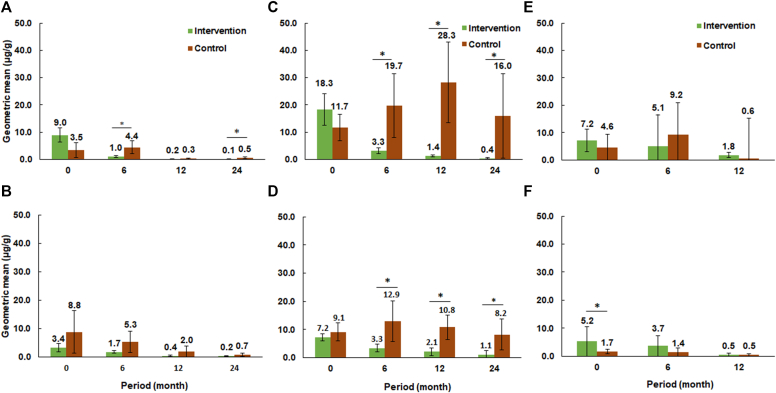
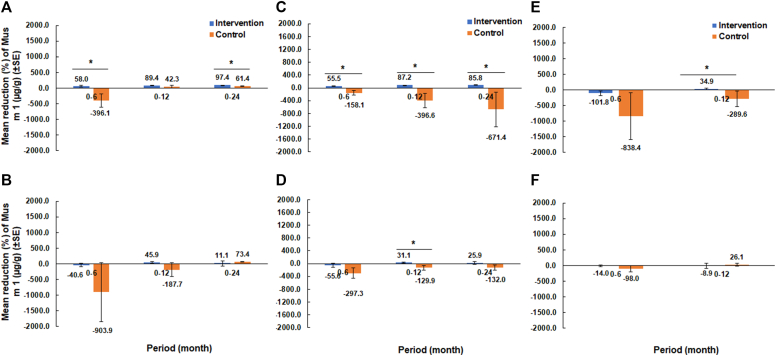
Compared with the control, T&B and T&B+E caused greater reduction in Mus m 1 allergen levels in the kitchens in all 3 cities ( < .05). After T&B and T&B+E, kitchen levels of Mus m 1 in New Brunswick, Trenton, and Paterson were reduced by 97.4%, 85.8%, and 34.9%, respectively. In contrast, the kitchen levels of Mus m 1 in the control were reduced by 61.4%, -671.4%, and -289.6%, respectively. However, no significant reduction was observed in the bedroom in the intervention group versus in the control group in any of the 3 cities at the end of the study period.
Effective mouse control alone greatly reduced mouse allergen levels compared with conventional pest control.
最近的研究表明,环境干预措施对于降低城市中心家庭中的小鼠过敏原(Mus m 1)水平至关重要。然而,单独进行灭鼠对降低小鼠过敏原的影响尚未得到研究。
我们的目的是评估三种家鼠控制方案对降低小鼠过敏原的效果。
新泽西州三个城市的18栋建筑物被随机划分并分配到三个治疗组中的一组:(1)诱捕和投饵(T&B);(2)诱捕、投饵和啮齿动物排除(T&B+E);(3)现有的害虫控制服务,不使用或有限使用诱饵或粘鼠板(对照组)。在干预前、干预后6个月以及干预后12或24个月,收集厨房地板、卧室地板和床铺的灰尘样本,并分析其中Mus m 1的水平。由于干预后这两组的小鼠侵扰率没有差异,因此将T&B组和T&B+E组合并进行Mus m 1分析。
与对照组相比,T&B组和T&B+E组在所有三个城市的厨房中导致Mus m 1过敏原水平的降低幅度更大(P<0.05)。经过T&B和T&B+E处理后,新不伦瑞克、特伦顿和帕特森的厨房中Mus m 1水平分别降低了97.4%、85.8%和34.9%。相比之下,对照组厨房中的Mus m 1水平分别降低了61.4%、-671.4%和-289.6%。然而,在研究期结束时,在任何一个城市的干预组与对照组的卧室中,均未观察到Mus m 1水平有显著降低。
与传统的害虫控制相比,单独进行有效的灭鼠能大大降低小鼠过敏原水平。