Midala Chahari A, Kyari Falmata, Thekisoe Oriel, Onyiche ThankGod E
Department of Veterinary Parasitology and Entomology, Faculty of Veterinary Medicine, University of Maiduguri, Maiduguri, Nigeria.
Unit for Environmental Sciences and Management, North-West University, Potchefstroom, 2531 South Africa.
J Parasit Dis. 2025 Sep;49(3):523-547. doi: 10.1007/s12639-025-01792-5. Epub 2025 Mar 6.
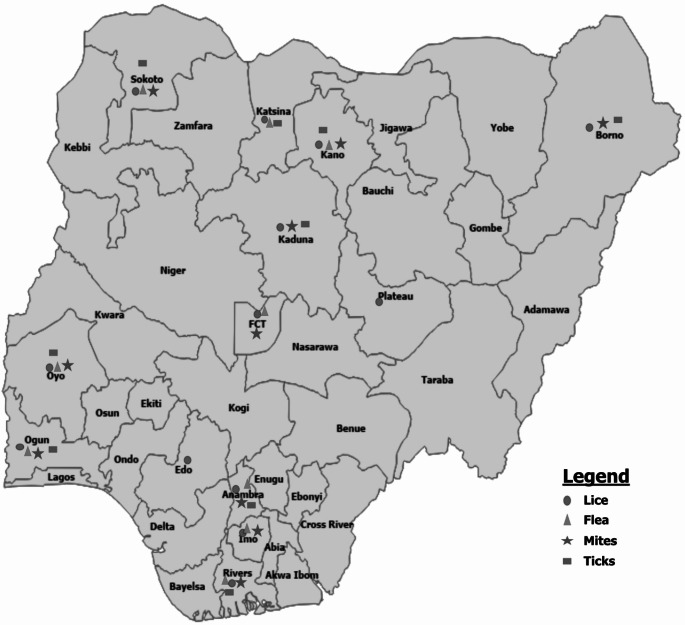
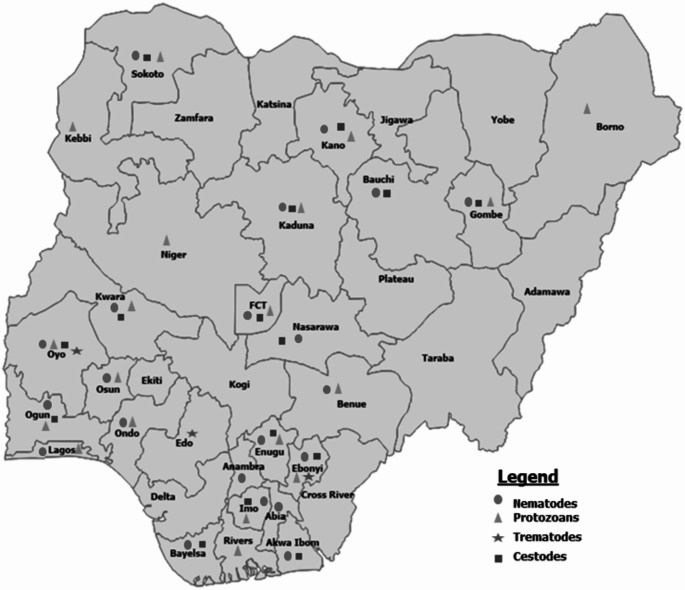
Poultry production is crucial for food and nutrition security level through the provision of eggs and meat and it also generates income. However, parasitic diseases are among the major constraints to the poultry industry across the world as they can affect the health, welfare, and production performance. These parasitic diseases can be broadly classified as endo-, ecto- and haemoparasites and they occur as single infection or in combination and affect productivity of poultry in Nigeria. This review focuses on summarizing all the major classes of parasitic diseases of poultry in Nigeria from 1980 to 2022. We search two electronic databases (Google Scholar and AJOL) to retrieve relevant articles published from 1980 to 2022 across the six geopolitical zones of Nigeria comprising both North and South. Our findings regarding endo-parasites, indicates that the major species of nematodes registered includes , , and species. As per cestodes, some of the documented species from published literature were species (specifically , and ) and . was the only documented trematodes infecting poultry in Nigeria. On the side of ecto-parasites, almost all the major groups which include ticks (, and ), mites ( and ), fleas () and lice (, , and ) have all been documented infesting poultry across the country. Lastly, protozoan parasites including haemoparasites ( spp., spp. and spp.) and coccidian ( spp. and spp.) were observed to infect poultry in Nigeria. In conclusion, this review has provided available information on the occurrence and distribution of the ecto-, endo- and haemoparasites in different types of poultry in Nigeria.
家禽生产对于通过提供蛋类和肉类保障粮食与营养安全至关重要,同时还能创造收入。然而,寄生虫病是全球家禽业面临的主要制约因素之一,因为它们会影响家禽的健康、福利和生产性能。这些寄生虫病大致可分为体内寄生虫、体外寄生虫和血液寄生虫,它们可单独感染或混合感染,影响尼日利亚家禽的生产力。本综述着重总结1980年至2022年尼日利亚家禽主要寄生虫病的类别。我们检索了两个电子数据库(谷歌学术和非洲期刊在线),以获取1980年至2022年在尼日利亚包括北部和南部的六个地缘政治区发表的相关文章。我们关于体内寄生虫的研究结果表明,记录在册的主要线虫种类包括 、 、 和 种。就绦虫而言,已发表文献中记录的一些种类为 种(特别是 、 和)以及 。 是尼日利亚唯一记录在案的感染家禽的吸虫。在体外寄生虫方面,几乎所有主要类别,包括蜱( 、 和)、螨( 和)、跳蚤()和虱( 、 、 和),都有记录在全国范围内侵扰家禽。最后,观察到原生动物寄生虫,包括血液寄生虫( 属、 属和 属)和球虫( 属和 属)在尼日利亚感染家禽。总之,本综述提供了关于尼日利亚不同类型家禽体内、体外和血液寄生虫的发生和分布的现有信息。