Qin Jiarun, Zhang Jialei, Bo Jianing, Ma Xiaoyan, He Xiaofeng
Department of Anesthesiology, Changzhi People's Hospital Affiliated to Changzhi Medical College, Changzhi, China.
Department of Pain Management, Changzhi People's Hospital Affiliated to Changzhi Medical College, Changzhi, China.
Front Med (Lausanne). 2025 Aug 18;12:1639968. doi: 10.3389/fmed.2025.1639968. eCollection 2025.
This study aimed to examine the effect of opioid-free anesthesia (OFA) on postoperative outcome indicators and explore its application in thoracoscopic or laparoscopic as well as non-thoracoscopic or laparoscopic surgeries, providing a scientific basis for clinical decision-making.
A systematic search was conducted for clinical studies comparing OFA and opioid-based anesthesia (OBA) published from the establishment of the databases to May 2025 using databases such as PubMed, Web of Science, Embase, and Cochrane Library. The primary outcome was the incidence of postoperative nausea and vomiting (PONV). Secondary outcomes included perioperative recovery indicators, the need for postoperative emergency analgesia, postoperative pain score (VAS, NRS), and adverse reactions.
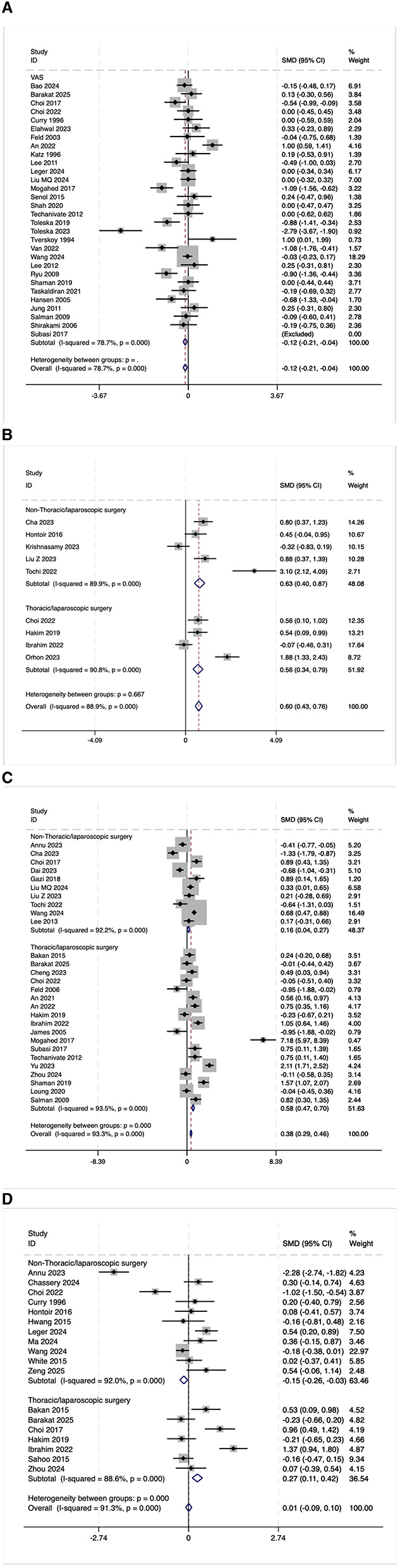
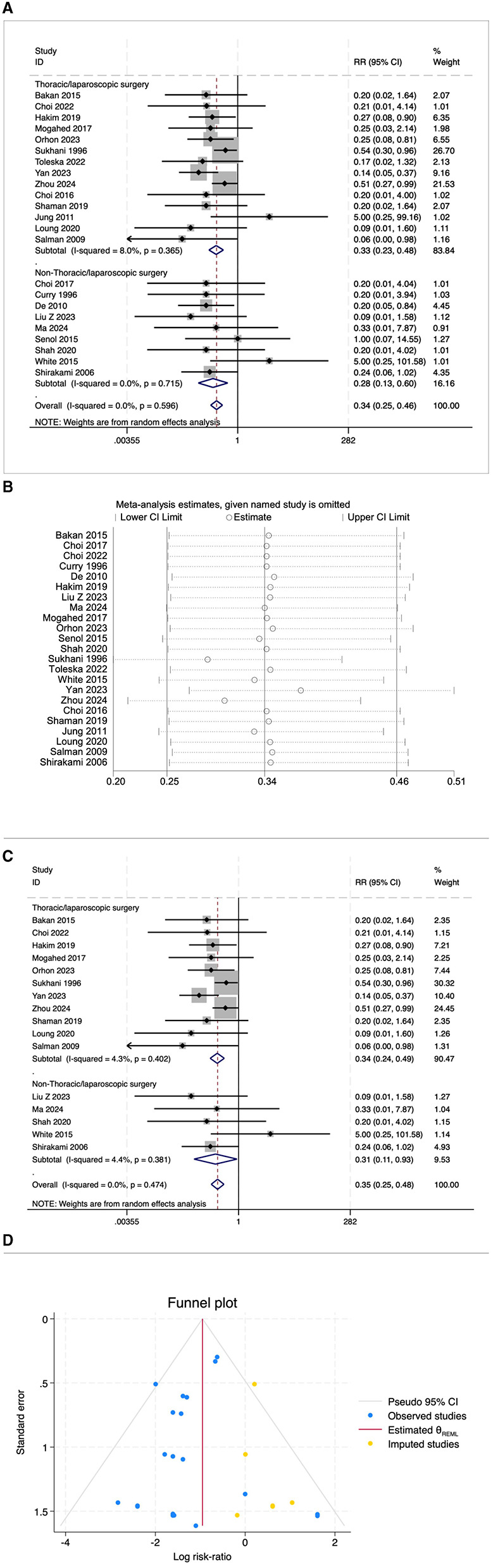
A total of 3,766 relevant studies were initially identified, and 68 randomized controlled trials involving 5,426 patients were ultimately included. Compared with OBA, OFA significantly reduced the risks of PONV (RR = 0.50, 95% CI: 0.39-0.64), nausea alone (RR = 0.34, 95% CI: 0.25-0.46), vomiting alone (RR = 0.34, 95% CI: 0.25-0.46), and the need for postoperative emergency analgesia (RR = 0.61, 95% CI: 0.51-0.72). OFA was also associated with lower 24 h postoperative NRS pain scores (SMD = -0.32, 95% CI: -0.53 to -0.10). For outcomes with high heterogeneity ( > 75%), the systematic review showed that most studies did not find a significant reduction in postoperative VAS pain scores with OFA. However, over two-thirds of the studies have shown that OFA can improve the quality of postoperative recovery (QoR-40). Approximately half of the studies suggested that OFA may prolong extubation time, while most found no significant difference in PACU stay time.
In summary, OFA not only significantly reduces postoperative PONV, but also lowers the demand for analgesic drugs and improves the quality of postoperative recovery. However, its effect on some postoperative recovery indicators is limited, and further high-quality studies are required to confirm these findings. OFA is expected to serve as a safe and effective anesthesia strategy to optimize the perioperative outcomes of patients.
本研究旨在探讨无阿片类药物麻醉(OFA)对术后结局指标的影响,并探索其在胸腔镜或腹腔镜以及非胸腔镜或腹腔镜手术中的应用,为临床决策提供科学依据。
使用PubMed、Web of Science、Embase和Cochrane图书馆等数据库,对从数据库建立至2025年5月发表的比较OFA和基于阿片类药物麻醉(OBA)的临床研究进行系统检索。主要结局是术后恶心呕吐(PONV)的发生率。次要结局包括围手术期恢复指标、术后紧急镇痛的需求、术后疼痛评分(VAS、NRS)和不良反应。
最初共识别出3766项相关研究,最终纳入68项涉及5426例患者的随机对照试验。与OBA相比,OFA显著降低了PONV风险(RR = 0.50,95% CI:0.39 - 0.64)、单独恶心风险(RR = 0.34,95% CI:0.25 - 0.46)、单独呕吐风险(RR = 0.34,95% CI:0.25 - 0.46)以及术后紧急镇痛的需求(RR = 0.61,95% CI:0.51 - 0.72)。OFA还与术后24小时较低的NRS疼痛评分相关(SMD = -0.32,95% CI:-0.53至-0.10)。对于异质性较高(>75%)的结局,系统评价表明大多数研究未发现OFA能显著降低术后VAS疼痛评分。然而,超过三分之二的研究表明OFA可改善术后恢复质量(QoR-40)。约一半的研究表明OFA可能延长拔管时间,而大多数研究发现PACU停留时间无显著差异。
总之,OFA不仅显著降低术后PONV,还降低了镇痛药物需求并改善了术后恢复质量。然而,其对一些术后恢复指标的影响有限,需要进一步的高质量研究来证实这些发现。OFA有望作为一种安全有效的麻醉策略来优化患者的围手术期结局。