Li Xinping, Thieringer Kyle, Gao Yiqin, Murthy Mala
Princeton Neuroscience Institute, Princeton University.
Present Address: Graduate Program in Neuroscience, University of Washington.
bioRxiv. 2025 Aug 25:2025.08.21.671456. doi: 10.1101/2025.08.21.671456.
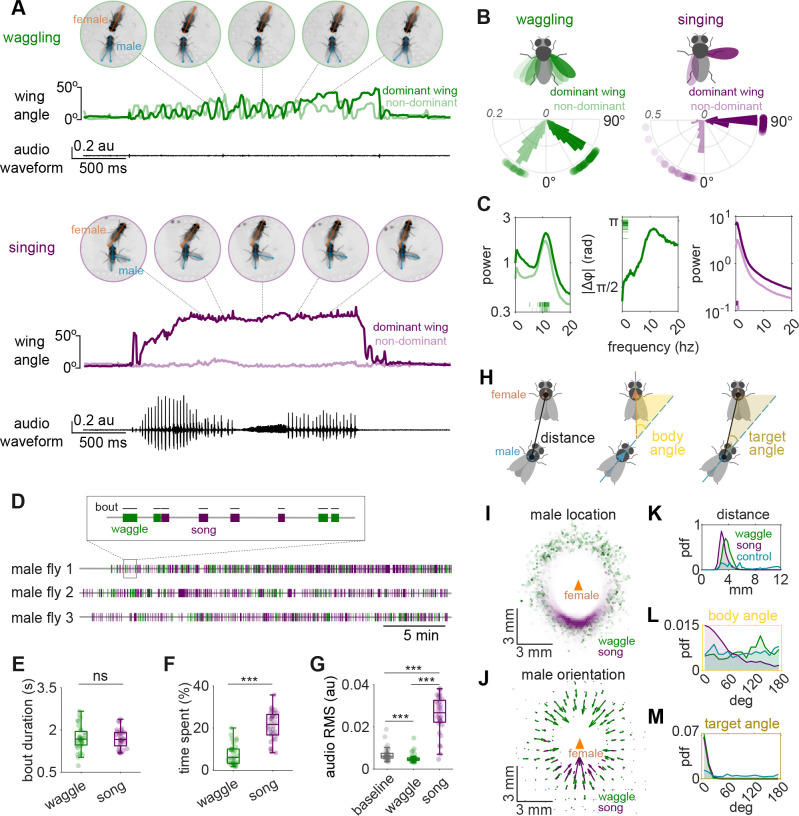
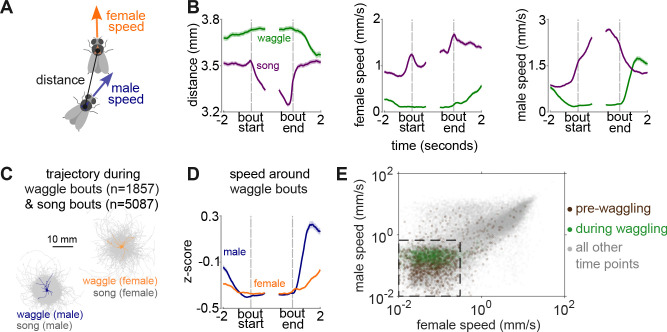
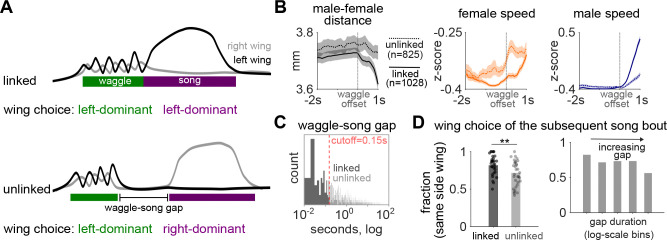
Some behaviors, like biting followed by chewing and then swallowing, unfold in stereotyped sequences, while others, such as limb movements during defensive maneuvers, can be flexibly combined as needed. During courtship, male flies produce a series of actions, including orientation, tapping, singing, licking, and copulation, that follow an ordered but temporally variable sequence [1,2]. At shorter timescales, however, individual actions remain highly dynamic. For example, courtship songs are composed of variable sequences of distinct syllables, with their patterning and amplitude actively shaped by female cues [3-5]. Leveraging recent advances in behavioral quantification [6], we discover a new courtship wing behavior that we term "waggling", which is present across multiple species and characterized by rhythmic, anti-phase wing movements. We identify an intermediate level of stereotyped behavioral structure: a directional three-part motif where males and females first decelerate to near-complete stillness, followed by male-initiated waggling, which then transitions into courtship song. Wing kinematics during waggle bouts are predictive of wing choice in subsequent songs, suggesting waggling may serve as a preparatory behavior. We then focus on P1/pC1 neurons, known to promote courtship [5,7-11]. Optogenetic activation of specific P1/pC1 neuron subsets in solitary males, without any female cues, is sufficient to recapitulate the entire stillness-to-waggling-to-singing progression. These findings reveal a new layer of stereotyped structure within a flexible courtship display and demonstrate that P1/pC1 neurons can orchestrate multi-action behavioral programs through internal dynamics.
一些行为,如先咬然后咀嚼再吞咽,以刻板的顺序展开,而其他行为,如防御动作中的肢体运动,则可以根据需要灵活组合。在求偶过程中,雄蝇会产生一系列动作,包括定位、轻敲、鸣叫、舔舐和交配,这些动作遵循有序但时间可变的顺序[1,2]。然而,在更短的时间尺度上,单个动作仍然高度动态。例如,求偶鸣叫由不同音节的可变序列组成,其模式和幅度会受到雌性线索的积极影响[3-5]。利用行为量化方面的最新进展[6],我们发现了一种新的求偶翅膀行为,我们将其称为“摆动”,这种行为在多个物种中都存在,其特征是翅膀有节奏的反相运动。我们确定了一种刻板行为结构的中间层次:一种定向的三部分模式,即雄性和雌性首先减速至几乎完全静止,然后是雄性发起的摆动,接着过渡到求偶鸣叫。摆动期间的翅膀运动学可以预测后续鸣叫中的翅膀选择,这表明摆动可能是一种预备行为。然后我们聚焦于已知能促进求偶的P1/pC1神经元[5,7-11]。在没有任何雌性线索的情况下,对独居雄性中特定的P1/pC1神经元亚群进行光遗传学激活,足以重现从静止到摆动再到鸣叫的整个过程。这些发现揭示了灵活求偶展示中刻板结构的新层次,并表明P1/pC1神经元可以通过内部动态协调多动作行为程序。