Zhu Lin, Li Xinrui, Liu Elaine Zhiqing, Siu Philip T, Zhai Shumenghui, Pan Chun, Cao Nikki, Ma Grace X
Temple University.
Vanderbilt University.
Res Sq. 2025 Aug 27:rs.3.rs-7221867. doi: 10.21203/rs.3.rs-7221867/v1.
This study aimed to identify provider- and practice-level factors influencing human papillomavirus (HPV) vaccine uptake among Chinese American (CA) adolescents. Despite increasing public health efforts, HPV vaccination rates in this population remain suboptimal, and knowledge on the link between provider/practice characteristics and vaccine uptake is limited.
We analyzed data from 1,272 CA adolescents (aged 13-17) using the National Immunization SurveyTeen (2015-2019) datasets. Key measures included HPV vaccine initiation and completion (based on proxy reporting and verification), accompanied by various multilevel factors: provider-level (recommendation, specialty), practice-level (facility type, vaccine acquisition, well-child exam), parentlevel (mother's education, marital status), and adolescent-level characteristics. Weighted descriptive statistics and stepwise multivariate logistic regression were used to examine associations.
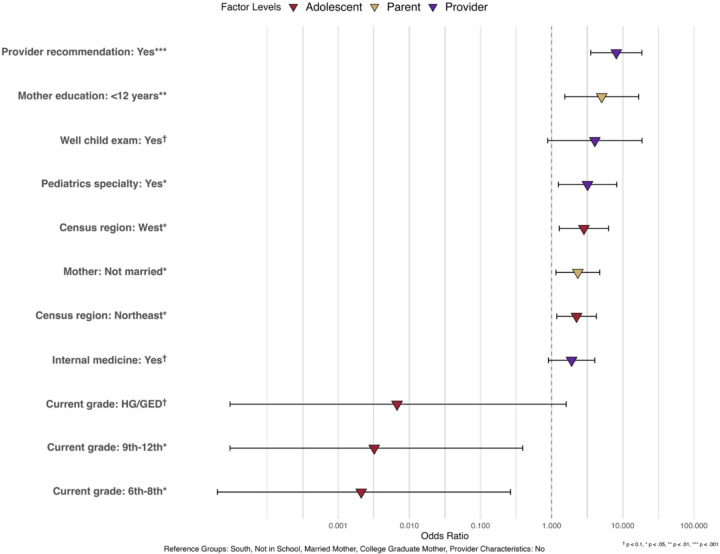
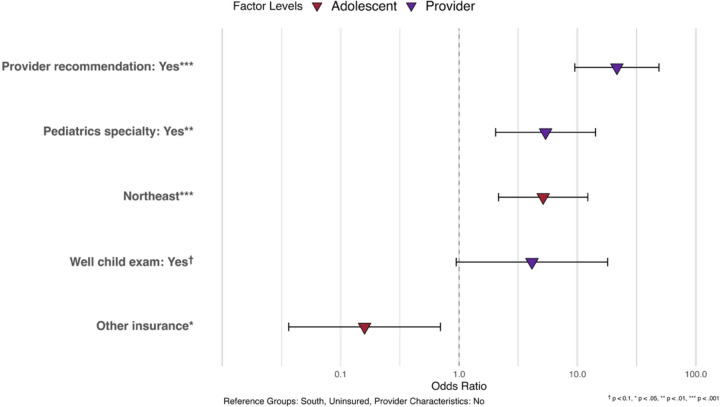
Overall, 71.22% of CA adolescents initiated at least one HPV vaccine dose, while 48.14% completed the regimen. Provider's recommendation (initiation OR = 21.50, completion OR = 8.12), having a pediatrician (initiation OR = 5.37, completion OR = 3.20), and receiving the 11-12-year-old well-child exams significantly predict both initiation and completion. Regional disparities were observed, with adolescents in the Northeast and West showing higher completion rates than those in the South. Unexpectedly, adolescents not enrolled in school and those with mothers who had less than 12 years of education or were unmarried showed higher completion rates.
Provider recommendations and pediatric care are crucial for improving HPV vaccination rates among CA adolescents. Addressing regional disparities and implementing targeted interventions, including enhanced provider training focused on culturally sensitive communication, are essential to dismantle systemic barriers and improve comprehensive vaccination coverage in this underserved population.
本研究旨在确定影响华裔美国(CA)青少年人乳头瘤病毒(HPV)疫苗接种率的医疗服务提供者及医疗机构层面的因素。尽管公共卫生方面的努力不断增加,但该人群的HPV疫苗接种率仍不尽人意,且关于医疗服务提供者/医疗机构特征与疫苗接种率之间联系的了解有限。
我们使用全国免疫调查青少年(2015 - 2019年)数据集,分析了1272名CA青少年(年龄在13 - 17岁)的数据。关键指标包括HPV疫苗起始接种和全程接种(基于代理报告和核实),同时伴有各种多层次因素:医疗服务提供者层面(建议、专业)、医疗机构层面(机构类型、疫苗采购、健康儿童检查)、家长层面(母亲教育程度、婚姻状况)以及青少年层面特征。采用加权描述性统计和逐步多变量逻辑回归分析来检验相关性。
总体而言,71.22%的CA青少年至少接种了一剂HPV疫苗,而48.14%的青少年完成了全程接种。医疗服务提供者的建议(起始接种优势比 = 21.50,全程接种优势比 = 8.12)、有儿科医生(起始接种优势比 = 5.37,全程接种优势比 = 3.20)以及接受11 - 12岁健康儿童检查显著预测了起始接种和全程接种。观察到地区差异,东北部和西部的青少年全程接种率高于南部。出乎意料的是,未入学的青少年以及母亲教育年限少于12年或未婚的青少年全程接种率更高。
医疗服务提供者的建议和儿科护理对于提高CA青少年的HPV疫苗接种率至关重要。解决地区差异并实施有针对性的干预措施,包括加强针对文化敏感沟通的医疗服务提供者培训,对于消除系统性障碍以及提高这一服务不足人群的全面疫苗接种覆盖率至关重要。