Caviedes-Triana Katerine, Duque-Granda Daniela, Cadavid-Restrepo Gloria, Moreno-Herrera Claudia X, Vivero-Gomez Rafael
Grupo de Microbiodiversidad y Bioprospección, Faculty of Sciences, Universidad Nacional de Colombia, Medellín, Colombia.
PECET (Programa de Estudio y control de enfermedades tropicales), Facultad de Medicina, Universidad de Antioquia, Medellín, Colombia.
PLoS Negl Trop Dis. 2025 Sep 5;19(9):e0013445. doi: 10.1371/journal.pntd.0013445. eCollection 2025 Sep.
The Amazon region is home to more than 30% of the sand flies species in Colombia, including vectors of Leishmania mainly in the genus Lutzomyia and Psychodopygus. Advances in morphological and molecular taxonomy of sand flies facilitate the development of updated and robust species inventories in understudied areas, such as the departments of Amazonas and Caquetá. Currently, integrating the detection of blood meal sources and Leishmania DNA represents a key approach under the "One Health" concept by providing insights into human and animal health and the dynamics of different ecosystems.
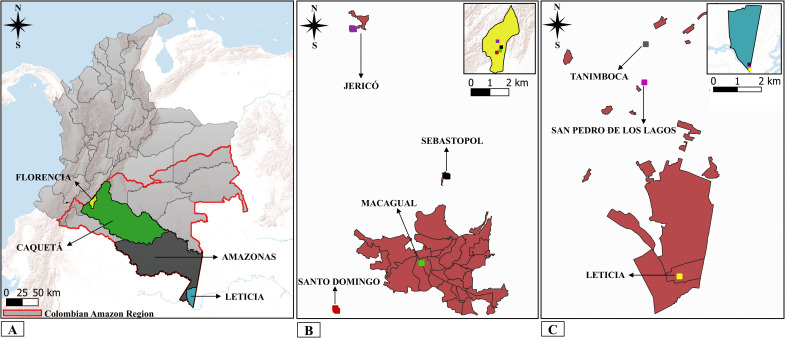
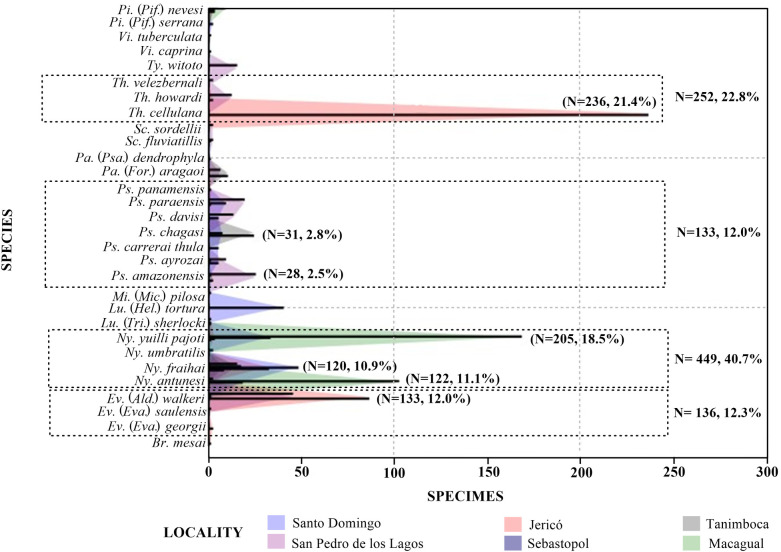
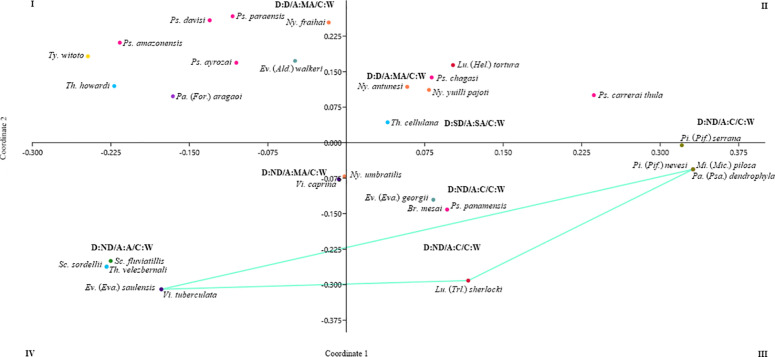
METHODOLOGY/PRINCIPAL FINDINGS: This study characterized the sand flies fauna in Amazonas and Caquetá using an integrative taxonomic approach that included DNA detection from blood meal and Leishmania sources. Sand flies were collected using CDC, Shannon, Prokopack traps and mouth aspirators. DNA was analyzed by conventional PCR targeting COI, Cytb, 12S rDNA and HSP-70N markers, respectively. A total of 1,104 specimens were collected, representing 12 genera and 30 species, 10 are recognized vectors of Leishmania, including Nyssomyia antunesi and Psychodopygus amazonensis. Our findings include new reports of regional distribution, particularly the first report of Sciopemyia fluviatilis in Colombia. Homo sapiens (28.8% Cytb; 18.6% 12S) and Sus scrofa (16.9% Cytb; 6.8% 12S) were the main food sources detected. While Nyssomyia fraihai (2.6%), Trichophoromyia cellulana (1.3%), Nyssomyia yuilli pajoti (1.3%) and Evandromyia (Aldamyia) walkeri (1.0%) grouped the highest detection rate of Leishmania DNA (9.0%).
CONCLUSIONS/SIGNIFICANCE: The integration of molecular tools for the confirmation of phlebotomine species allowed the resolution of taxonomic conflicts, especially in the genus Trichophoromyia. These findings provide key information on ecological interactions (vectors-ingesta-Leishmania) related to leishmaniasis in the Colombian Amazon, suggesting a high diversity of sand flies and a significant zoonotic potential.
亚马逊地区是哥伦比亚30%以上白蛉物种的栖息地,包括主要为罗蛉属和灵蛉属的利什曼原虫传播媒介。白蛉形态学和分子分类学的进展有助于在研究较少的地区,如亚马孙省和卡克塔省,编制最新且可靠的物种名录。目前,结合血餐来源检测和利什曼原虫DNA检测是“同一健康”概念下的一种关键方法,可深入了解人类和动物健康以及不同生态系统的动态。
方法/主要发现:本研究采用综合分类学方法对亚马孙省和卡克塔省的白蛉动物区系进行了特征描述,该方法包括从血餐和利什曼原虫来源进行DNA检测。使用疾控中心诱捕器、香农诱捕器、普罗科帕克诱捕器和吸蚊器收集白蛉。分别通过靶向COI、Cytb、12S rDNA和HSP - 70N标记的常规PCR分析DNA。共收集到1104个标本,代表12个属和30个物种,其中10种是公认的利什曼原虫传播媒介,包括安图内斯罗蛉和亚马孙灵蛉。我们的发现包括区域分布的新报告,特别是哥伦比亚首次报告的河流嗜蛉。人类(28.8%的Cytb;18.6%的12S)和野猪(16.9%的Cytb;6.8%的12S)是检测到的主要食物来源。而弗氏罗蛉(2.6%)、细胞毛罗蛉(1.3%)、尤伊利帕霍蒂罗蛉(1.3%)和沃克伊蚊(1.0%)的利什曼原虫DNA检测率最高(9.0%)。
结论/意义:整合用于确认白蛉物种的分子工具有助于解决分类学冲突,尤其是在毛罗蛉属中。这些发现提供了与哥伦比亚亚马逊地区利什曼病相关的生态相互作用(传播媒介 - 摄食物 - 利什曼原虫)的关键信息,表明白蛉具有高度多样性和显著的人畜共患病潜力。