Kotcher Rebecca E, Rosengart Matthew R, La Colla Luca, Lin Hsing-Hua Sylvia, Vogt Keith M, Xu Yan, Neal Matthew D
Department of Surgery, University of Pittsburgh, Pittsburgh, Pennsylvania, USA
Department of Anesthesiology & Perioperative Medicine, University of Pittsburgh, Pittsburgh, Pennsylvania, USA.
BMJ Open. 2025 Sep 5;15(9):e097462. doi: 10.1136/bmjopen-2024-097462.
Blue light (peak wavelength 442 nm) has been shown to modulate the immune response in preclinical models of intra-abdominal sepsis and pneumonia. pathways involve optic nerve stimulation with transmission to the central nervous system, activation of parasympathetic pathways terminating at the spleen, and downstream immune effects including decreased inflammatory tissue damage and improved pathogen clearance. Related effects on pain mediators including proinflammatory cytokines (interleukin 6, TNF- α) and autonomic tone (increased parasympathetic outflow) suggest possible analgesic properties that would be highly relevant to a trauma population.
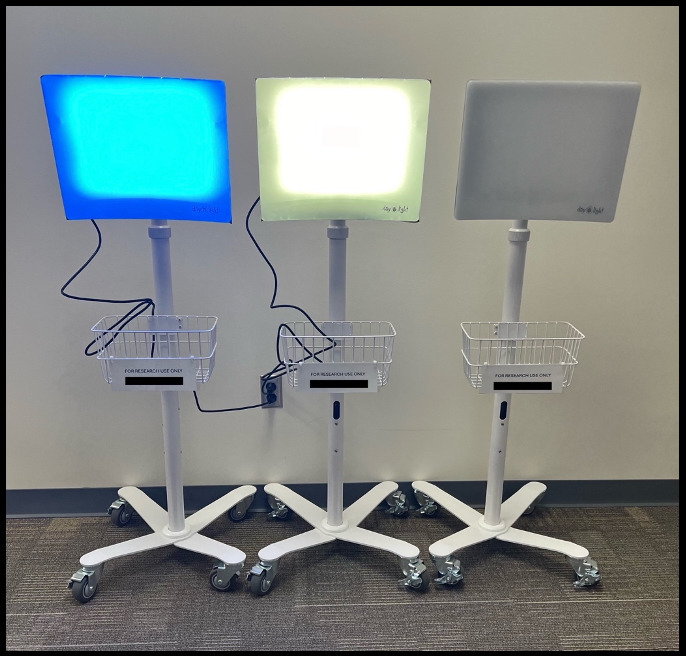
This is a randomised controlled trial in which adult trauma inpatients (18 years) with painful rib fractures will be allocated 1:1:1 to three arms: bright blue light intervention (peak 442 nm, 1400 lux), bright full-spectrum light comparison (1400 lux) and usual ambient light control. Bright light exposures will be administered for 4 consecutive hours daily for up to 3 days. The primary outcome will be any measurable changes in chest wall pain intensity during deep breathing, quantified using an 11-point Numerical Rating Scale. Secondary outcomes will assess chest wall pain intensity at rest, opioid requirements, delirium incidence, pulmonary complication incidence, hospital-free and intensive care unit-free days, and physiological markers of autonomic nervous system, circadian, and immune activation. Sample size analysis yields a total of 75 participants needed to detect a 2-point difference in pain scores with >80% power and assuming a 20% non-completion rate.
Full ethical approval for this trial has been granted by the University of Pittsburgh Institutional Review Board. On study completion, results will be published in the peer-reviewed literature and at ClinicalTrials.gov.
NCT06626334.
蓝光(峰值波长442纳米)已被证明可在腹腔内脓毒症和肺炎的临床前模型中调节免疫反应。其途径包括视神经刺激并传导至中枢神经系统,激活终止于脾脏的副交感神经途径,以及下游免疫效应,包括减少炎症组织损伤和改善病原体清除。对疼痛介质的相关影响,包括促炎细胞因子(白细胞介素6、肿瘤坏死因子-α)和自主神经张力(副交感神经输出增加),提示可能具有镇痛特性,这对于创伤人群具有高度相关性。
这是一项随机对照试验,将成年创伤住院患者(≥18岁)伴有疼痛性肋骨骨折的患者按1:1:1比例分配至三个组:蓝光干预组(峰值442纳米,1400勒克斯)、全光谱强光对照组(1400勒克斯)和常规环境光对照组。强光照射将每天连续进行4小时,最长持续3天。主要结局将是深呼吸时胸壁疼痛强度的任何可测量变化,使用11点数字评分量表进行量化。次要结局将评估静息时胸壁疼痛强度、阿片类药物需求、谵妄发生率、肺部并发症发生率、无住院和无重症监护病房天数,以及自主神经系统、昼夜节律和免疫激活的生理指标。样本量分析得出,假设20%的未完成率,共需要75名参与者来检测疼痛评分有2分的差异,检验效能>80%。
本试验已获得匹兹堡大学机构审查委员会的全面伦理批准。研究完成后,结果将发表在同行评审文献和ClinicalTrials.gov上。
NCT06626334。