Rivadeneira Pablo S, Mira Alejandro
Universidad Nacional de Colombia, Facultad de Minas, Grupo GITA, Cra. 80#65-223, Colombia.
HardwareX. 2025 Aug 19;23:e00684. doi: 10.1016/j.ohx.2025.e00684. eCollection 2025 Sep.
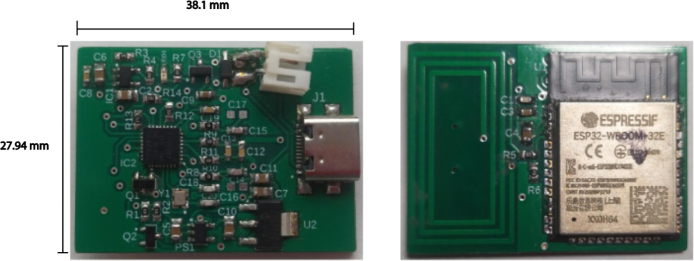
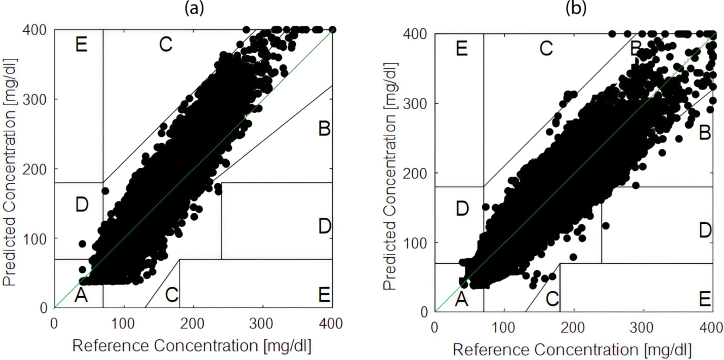
This paper presents the development of a transmitter that transforms intermittent glucose sensors (isCGM) into a continuous and real-time glucose monitoring system (c-rtCGM), a key component in automated insulin delivery systems. The transmitter enhances the capabilities of conventional intermittent sensors by leveraging Near Field Communication (NFC) technology to capture raw glucose value and automatically transmit it via Bluetooth Low Energy (BLE-Bluetooth 4.2 Dual-Mode) to a smart device every five minutes. A specialized glucose monitoring application converts the raw values to blood glucose by applying a calibration based on a static linear model and a capillary blood glucose measurement. The accuracy and performance of the c-rtCGM were validated through a study involving 37 participants with type 1 diabetes, demonstrating its reliability compared to commercial transmitters. Values reported by the c-rtCGM system compared with the isCGM monitor system resulted in an overall mean average relative difference (MARD) around 9%. During the trial, the c-rtCGM system achieved a data transmission success rate of 96%, and only 2316 connection failures were recorded from the 66525 total connection attempts, indicating a high level of communication stability. The transmitter battery life lasted an average of 6.5 days, showing that it is necessary to recharge only once for the duration of the sensor (14 days). The main advantages of this customized transmitter, in contrast with the commercial versions, are reliability, cost, and the flexibility of its software, since its processor (an ESP32) can be easily programmed to fulfill other helpful tasks in managing glucose levels with automated insulin delivery systems.
本文介绍了一种发射器的研发情况,该发射器可将间歇性葡萄糖传感器(isCGM)转变为连续实时葡萄糖监测系统(c-rtCGM),这是自动胰岛素输送系统的关键组件。该发射器通过利用近场通信(NFC)技术来捕获原始葡萄糖值,并每隔五分钟通过低功耗蓝牙(BLE-蓝牙4.2双模)自动将其传输到智能设备,从而增强了传统间歇性传感器的功能。一款专门的葡萄糖监测应用程序通过基于静态线性模型和毛细血管血糖测量进行校准,将原始值转换为血糖值。通过一项涉及37名1型糖尿病患者的研究,对c-rtCGM的准确性和性能进行了验证,证明了其与商用发射器相比的可靠性。c-rtCGM系统报告的值与isCGM监测系统相比,总体平均相对差异(MARD)约为9%。在试验期间,c-rtCGM系统的数据传输成功率达到96%,在总共66525次连接尝试中,仅记录到2316次连接失败,表明通信稳定性很高。发射器的电池续航时间平均为6.5天,这表明在传感器的使用期间(14天)只需充电一次。与商用版本相比,这种定制发射器的主要优点在于可靠性、成本及其软件的灵活性,因为其处理器(ESP32)可以轻松编程,以在自动胰岛素输送系统中执行其他有助于管理血糖水平的任务。