Almeida Juliana, Perez-Fons Laura, Drapal Margit, Liew Kit, Enfissi Eugenia M A, Fraser Paul D
Department of Biological Sciences, Royal Holloway University of London, Egham, Surrey, TW20 0EX, UK.
Plant J. 2025 Sep;123(5):e70447. doi: 10.1111/tpj.70447.
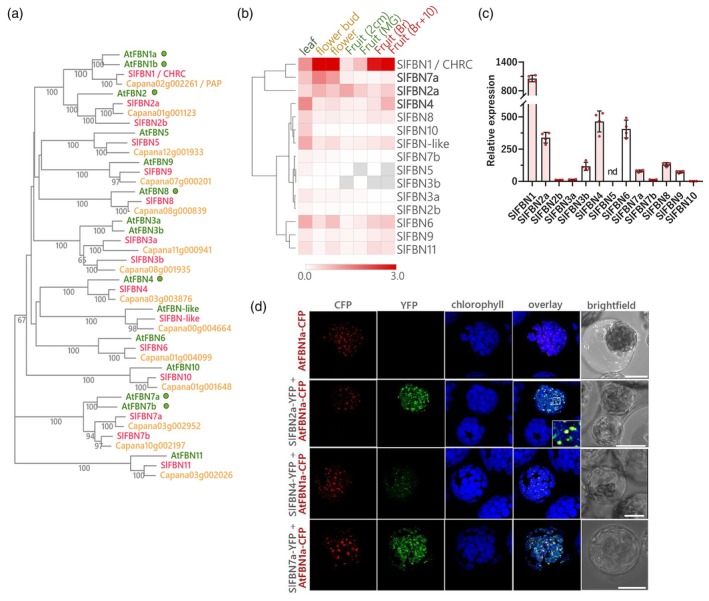
Plastoglobuli (PG) are plant lipoprotein compartments, present in plastid organelles. They are involved in the formation and/or storage of lipophilic metabolites. FIBRILLINs (FBNs) are one of the main PG-associated proteins and are particularly abundant in carotenoid-enriched chromoplasts found in ripe fruits and flowers. To address the contribution of different FBNs, independently and in combination, to isoprenoid formation and sequestration, a multiplex gene editing approach was undertaken in tomato. This approach generated a suite of single and high-order fbn mutants that were shown to lack transcripts and respective protein products. The major PG-related FBNs in tomato chosen for this study are SlFBN1, SlFBN2a, SlFBN4 and SlFBN7a. When knocked out independently, functional redundancy was revealed. However, paralog-specific roles were detected regulating specific isoprenoids (e.g. plastochromanol 8) or plastidial esterification capability. In addition, high-order fbn mutants displayed altered isoprenoid chromoplast sequestration patterns, notably with a significant reduction in carotenes (phytoene and phytofluene) in the PG fraction. Proteomic analysis confirmed the absence of PG-core associated proteins, including NAD(P)H-ubiquinone oxidoreductase C1, tocopherol cyclase (VTE1) and phytol esterase (PES1/PYP). Perturbations to the ultrastructure of the plastid were revealed, with aberrant PG formation and morphology predominating in high-order mutants. Global lipidome profiles also highlighted broader changes directly affecting storage and plastid membrane lipids, for example, tri- and diacylglycerides and galactolipid species. Collectively, these results support both structural and metabolic roles of SlFBNs in PGs. The findings expose fundamental aspects of metabolic compartmentalisation in plant cells and the importance of lipoprotein particles for plastid integrity and functionality.
质体小球(PG)是存在于质体细胞器中的植物脂蛋白区室。它们参与亲脂性代谢物的形成和/或储存。原纤蛋白(FBN)是与PG相关的主要蛋白质之一,在成熟果实和花朵中富含类胡萝卜素的有色体中尤为丰富。为了研究不同FBN单独或组合对类异戊二烯形成和隔离的贡献,在番茄中采用了多重基因编辑方法。该方法产生了一系列单基因和高阶fbn突变体,这些突变体被证明缺乏转录本和相应的蛋白质产物。本研究选择的番茄中与PG相关的主要FBN是SlFBN1、SlFBN2a、SlFBN4和SlFBN7a。当它们被独立敲除时,发现了功能冗余。然而,检测到旁系同源物特异性作用调节特定的类异戊二烯(如质体色素醇8)或质体酯化能力。此外,高阶fbn突变体显示类异戊二烯有色体隔离模式发生改变,特别是PG部分中的胡萝卜素(八氢番茄红素和六氢番茄红素)显著减少。蛋白质组学分析证实了PG核心相关蛋白的缺失,包括NAD(P)H-泛醌氧化还原酶C1、生育酚环化酶(VTE1)和植醇酯酶(PES1/PYP)。揭示了质体超微结构的扰动,高阶突变体中异常的PG形成和形态占主导。整体脂质组谱还突出了直接影响储存和质体膜脂质的更广泛变化,例如甘油三酯和甘油二酯以及半乳糖脂种类。总的来说,这些结果支持了SlFBN在PG中的结构和代谢作用。这些发现揭示了植物细胞中代谢区室化的基本方面以及脂蛋白颗粒对质体完整性和功能的重要性。