Zhu Deyu, Guo Limin, Liu Yang
Department of Sports Tourism and Foreign Languages, Henan Sport University, Zhengzhou, Henan, China.
Institute of Psychology Education, Shaanxi Normal University, Xi'an City, Shaanxi Province, China.
PeerJ. 2025 Sep 3;13:e19817. doi: 10.7717/peerj.19817. eCollection 2025.
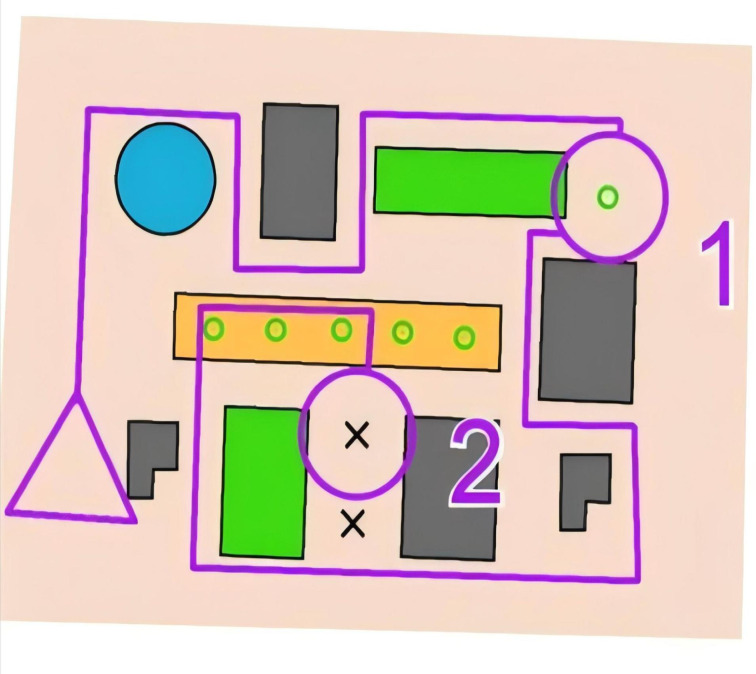
Through maps, the objects on the Earth's surface are abstracted and represented on a plane, achieving the integration of physical entities and conceptual representations, thereby facilitating individuals' rapid understanding and profound cognition of their surroundings. As a system for the storing and processing of visual and spatial information, visuospatial working memory (VSWM) provides individuals with the capacity to temporarily store and process map-related information within a spatial framework. To explore the temporal features of storing and retrieving in VSWM during map-related tasks among orienteers with varying skill levels, 22 orienteers were enrolled in the expert group, while 22 members from orienteering training teams were placed in the novice group. Employing electroencephalography (EEG) technology, this study developed a set of VSWM tasks to examine behavioral performance variations and EEG characteristics between experts and novices. The results revealed that experts exhibited enhanced rationality and superior response efficiency during the map cognition task relative to novices. Neurophysiological evidence further indicated distinct neural resource management patterns in experts, characterized by reduced θ neural oscillations in the frontal regions coupled with enhanced α oscillations in both the frontal and temporal lobes. The empirical outcomes confirm competitive advantages in expert athletes' map processing, response speed, and optimized neural resource allocation. These findings not only deepen insights into the neural mechanisms underlying orienteers' map cognition, but also provide strong theoretical support for orienteering training practices.
通过地图,地球表面的物体被抽象出来并呈现在平面上,实现了物理实体与概念表征的整合,从而便于个体快速理解和深刻认知周围环境。作为一种存储和处理视觉与空间信息的系统,视觉空间工作记忆(VSWM)为个体提供了在空间框架内临时存储和处理与地图相关信息的能力。为了探究不同技能水平的定向运动员在与地图相关任务中视觉空间工作记忆存储和检索的时间特征,22名定向运动员被纳入专家组,同时将22名来自定向运动训练队的成员置于新手组。本研究采用脑电图(EEG)技术,开发了一套视觉空间工作记忆任务,以检验专家和新手之间的行为表现差异及脑电图特征。结果显示,相对于新手,专家在地图认知任务中表现出更强的理性和更高的反应效率。神经生理学证据进一步表明,专家具有独特的神经资源管理模式,其特征是额叶区域的θ神经振荡减少,同时额叶和颞叶的α振荡增强。实证结果证实了专家运动员在地图处理、反应速度和优化神经资源分配方面的竞争优势。这些发现不仅加深了对定向运动员地图认知潜在神经机制的理解,也为定向运动训练实践提供了有力的理论支持。