Antonara Lefkothea, Triantafyllopoulou Efstathia, Chountoulesi Maria, Pippa Natassa, Dallas Paraskevas P, Rekkas Dimitrios M
Section of Pharmaceutical Technology, Department of Pharmacy, School of Health Sciences, National and Kapodistrian University of Athens, 15784 Athens, Greece.
Nanomaterials (Basel). 2025 Aug 28;15(17):1326. doi: 10.3390/nano15171326.
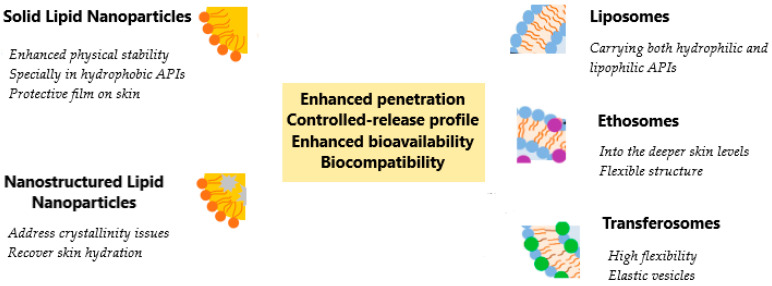
Lipid-based nanocarriers are ideal drug delivery systems for transdermal administration due to their biocompatibility and biodegradability. Their lipophilicity and/or similarity to the natural lipids of the epidermis enable intermolecular interactions with the lipid membrane and therefore result in effective passage through the skin. The purpose of this review is to focus on lipid-based drug delivery nanoplatforms administered via the transdermal route by summarizing the most recent developments with the intention of fast clinical translation. Liposomes, solid lipid nanoparticles (SLNs), nanostructured lipid carriers (NLCs), ethosomes, and transfersomes exhibit ideal physicochemical characteristics and encapsulation efficiency to enhance the effectiveness of the incorporated Active Pharmaceutical Ingredients (APIs). The state of the art for fabricating transcutaneous lipid drug delivery nanoparticles and the strategies for overcoming the current obstacles, as well as the added value of novel formulations, will be discussed within the scope of Quality by Design applications. The limitations and challenges that still exist will also be considered.
基于脂质的纳米载体由于其生物相容性和可生物降解性,是用于经皮给药的理想药物递送系统。它们的亲脂性和/或与表皮天然脂质的相似性能够与脂质膜发生分子间相互作用,从而有效地透过皮肤。本综述的目的是通过总结最新进展,着眼于快速临床转化,聚焦于经皮给药的基于脂质的药物递送纳米平台。脂质体、固体脂质纳米粒(SLN)、纳米结构脂质载体(NLC)、醇质体和传递体具有理想的物理化学特性和包封效率,可提高所载入活性药物成分(API)的有效性。将在质量源于设计应用的范围内讨论制备经皮脂质药物递送纳米粒的技术现状、克服当前障碍的策略以及新型制剂的附加价值。还将考虑仍然存在的局限性和挑战。