Abdelrahim Maen, Connor Ashton A, Esmail Abdullah, Elaileh Ahmed, Farhat Souha, Kodali Sudha, Victor David W, Brombosz Elizabeth W, Saharia Ashish, Moore Linda W, Ghobrial R Mark
Section of GI Oncology, Houston Methodist Neal Cancer Center, Houston Methodist Hospital, Houston, TX, USA.
Cockrell Center of Advanced Therapeutics Phase I Program, Houston Methodist Research Institute, Houston, TX, USA.
J Gastrointest Oncol. 2025 Aug 30;16(4):1573-1585. doi: 10.21037/jgo-24-791. Epub 2025 Aug 27.
Liver transplantation (LT) for primary liver cancers achieves excellent patient outcomes, but a minority recur with poor prognosis. Survival may be improved by earlier recurrence detection. This study aims to evaluate the feasibility and performance of a personalized tumor-informed assay utilizing circulating tumor DNA (ctDNA) from peripheral blood for surveillance after LT in patients with hepatocellular carcinoma (HCC) or cholangiocarcinoma (CCA).
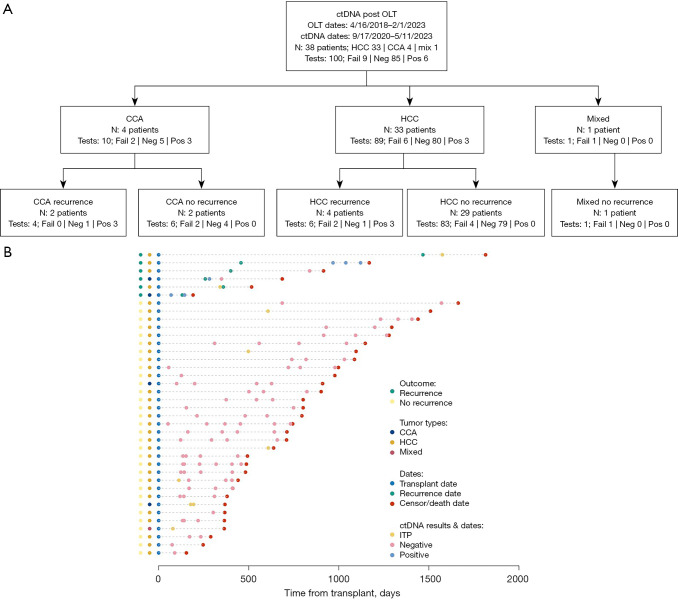
Here, we test whether a personalized tumor-informed assay utilizing ctDNA from peripheral blood informs post-LT surveillance. Personalized ctDNA assays were employed for surveillance in 38 LT recipients, alongside standard-of-care imaging and peripheral tumor biomarkers [alpha-fetoprotein (AFP), carbohydrate antigen 19-9 (CA19-9)].
Recurrence was detected radiologically in 6 patients, with positive ctDNA assays in 3 and negative/insufficient to process (ITP) in 3. Nine ITP ctDNA assays were due to insufficient primary tumor tissue. In 31 patients without ITP ctDNA tests, the sensitivity and specificity of ctDNA were 75% [95% confidence interval (CI): 19-99%] and 100% (95% CI: 87-100%). Standard-of-care tumor biomarkers had sensitivity and specificity of 75% (95% CI: 19-99%) and 93% (95% CI: 76-99%), respectively (P>0.99 and P=0.16; McNemar χ). Only 1 patient had ctDNA positive prior to imaging-based diagnosis.
This study corroborates the feasibility of ctDNA assays for recurrence surveillance in LT recipients. The results imply that ctDNA assays show promise in confirming recurrence and minimizing the need for invasive biopsy. However, additional prospective studies are needed to confirm ctDNA test utility in surveillance protocols.
原发性肝癌的肝移植(LT)可使患者获得良好预后,但少数患者会复发,预后较差。早期复发检测可能会提高生存率。本研究旨在评估利用外周血循环肿瘤DNA(ctDNA)进行个性化肿瘤信息检测在肝细胞癌(HCC)或胆管癌(CCA)患者LT术后监测中的可行性和性能。
在此,我们测试利用外周血ctDNA进行的个性化肿瘤信息检测是否有助于LT术后监测。38例LT受者采用个性化ctDNA检测进行监测,同时进行标准护理成像和外周肿瘤生物标志物[甲胎蛋白(AFP)、糖类抗原19-9(CA19-9)]检测。
6例患者经影像学检查发现复发,其中3例ctDNA检测呈阳性,3例呈阴性/无法处理(ITP)。9例ITP ctDNA检测是由于原发性肿瘤组织不足。在31例未进行ITP ctDNA检测的患者中,ctDNA的敏感性和特异性分别为75%[95%置信区间(CI):19-99%]和100%(95%CI:87-100%)。标准护理肿瘤生物标志物的敏感性和特异性分别为75%(95%CI:19-99%)和93%(95%CI:76-99%)(P>0.99和P=0.16;McNemarχ)。只有1例患者在基于成像的诊断之前ctDNA呈阳性。
本研究证实了ctDNA检测在LT受者复发监测中的可行性。结果表明,ctDNA检测在确认复发和减少侵入性活检需求方面显示出前景。然而,需要更多的前瞻性研究来证实ctDNA检测在监测方案中的效用。