Haskell Erin, Sigmarsdottir Berglind, Thorisdottir Ingibjorg Eva, Valborgarson Audun, Bonilla Aparicio Elena, Kiviruusu Olli, Suvisaari Jaana, Chang Zheng, Ystrom Eivind, Butwicka Agnieszka, Asgeirsdottir Bryndis Bjork, Valdimarsdottir Heiddis Bjork, Sigfusdottir Inga Dora, Allegrante John Philip, Halldorsdottir Thorhildur
Department of Psychology, Reykjavik University, Reykjavik, Iceland.
Planet Youth, Reykjavik, Iceland.
Lancet Reg Health Eur. 2025 Apr 29;53:101301. doi: 10.1016/j.lanepe.2025.101301. eCollection 2025 Jun.
Adolescents' mental health declined during the COVID-19 pandemic, yet little is known about the long-term outcomes after the pandemic's declassification as a global health emergency (5 May 2023). This study examined changes in adolescent mental health in Iceland from 2016 to 2023, using a bioecological framework to identify risk and protective factors.
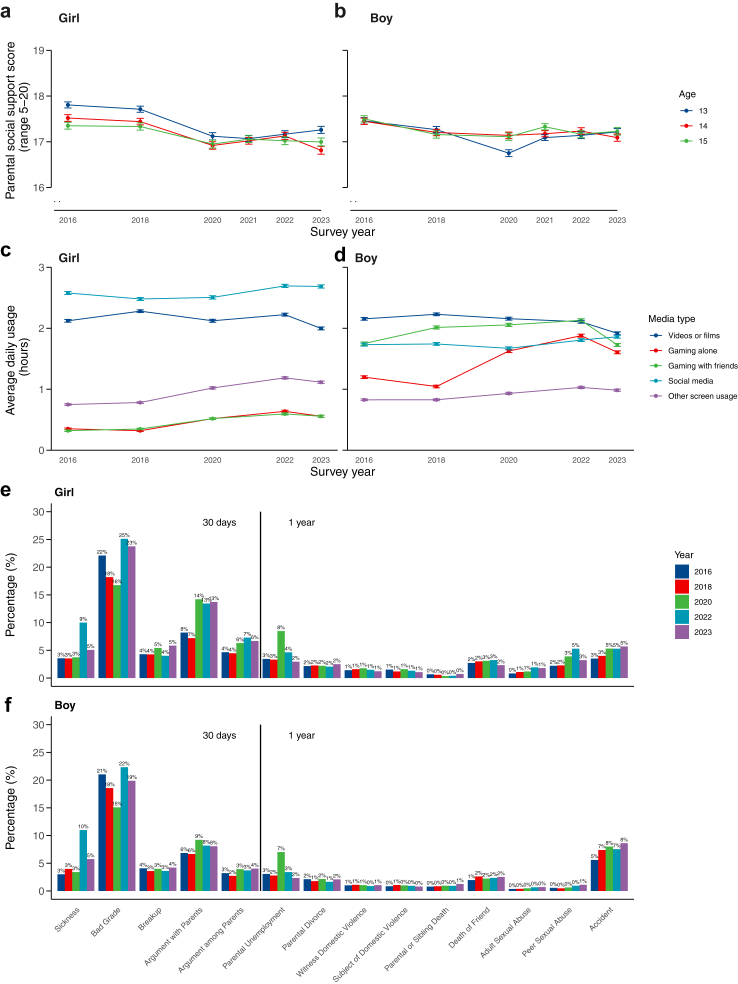
Youth in Iceland surveys were administered nationwide to 13-15-year-olds in 2016, 2018, 2020, 2021, 2022 and 2023, with an average 75% response rate across the years. The surveys included measures on depressive symptoms, anxiety and hostility (Symptom Checklist-90), parental social support (Perceived Parental Support Scale), screen time, and stress/trauma exposure (Negative Life Events Scale). Stepwise-reduced mixed-effects models assessed the association of age, gender, time and risk/protective factors and their effect on mental health. Multiple imputation addressed missing data, and Bonferroni corrections adjusted for multiple testing.
62,011 adolescents participated: 48.2% female (n = 29,890), 50.0% male (n = 31,002), 1.8% non-binary (n = 1119). Depressive symptoms showed signs of improvement post-pandemic (2023) compared to 2021 (β 0.19, 95% CI 0.13-0.24), yet remained higher than pre-pandemic levels (2016: β -0.38, 95% CI -0.44 to -0.33; 2018: β -0.26, 95% CI -0.31 to -0.20). Anxiety and hostility also increased and remained higher than pre-pandemic levels in 2023 (anxiety: 2016 β -0.29, 95% CI -0.35 to -0.24, 2018 β -0.20, 95% CI -0.26 to -0.15; hostility: 2016 β -0.26, 95% CI -0.31 to -0.20, 2018 β -0.12, 95% CI -0.18 to -0.07). Across all the models examining the predictors from diverse bioecological spheres, low parental social support, high social media use, and bad grades were consistently associated with poor mental health, regardless of mental health outcome and gender.
The COVID-19 pandemic has had a serious and continuing negative effect on adolescents' mental health. Targeted interventions are needed to address the increase in mental health problems during the COVID-19 pandemic, with a focus on enhancing parental support and managing screen use.
Icelandic Research Fund (217612-051); NordForsk (147386).
在新冠疫情期间,青少年的心理健康状况有所下降,但对于疫情不再被列为全球卫生紧急事件(2023年5月5日)后的长期影响,我们知之甚少。本研究利用生物生态框架来识别风险和保护因素,调查了2016年至2023年冰岛青少年心理健康的变化情况。
2016年、2018年、2020年、2021年、2022年和2023年,冰岛在全国范围内对13至15岁的青少年进行了调查,多年来平均回复率为75%。调查内容包括抑郁症状、焦虑和敌意(症状自评量表-90)、父母的社会支持(感知父母支持量表)、屏幕使用时间以及压力/创伤暴露(负面生活事件量表)。逐步简化的混合效应模型评估了年龄、性别、时间以及风险/保护因素之间的关联及其对心理健康的影响。多重填补法处理缺失数据,邦费罗尼校正用于多重检验的调整。
共有62011名青少年参与:48.2%为女性(n = 29890),50.0%为男性(n = 31002),1.8%为非二元性别(n = 1119)。与2021年相比,疫情后(2023年)抑郁症状有所改善(β = 0.19,95%置信区间0.13 - 0.24),但仍高于疫情前水平(2016年:β = -0.38,95%置信区间 -0.44至 -0.33;2018年:β = -0.26,95%置信区间 -0.31至 -0.20)。焦虑和敌意也有所增加,且在2023年仍高于疫情前水平(焦虑:2016年β = -0.29,95%置信区间 -0.35至 -0.24,2018年β = -0.20,95%置信区间 -0.26至 -0.15;敌意:2016年β = -0.26,95%置信区间 -0.31至 -0.20,2018年β = -0.12,95%置信区间 -0.18至 -0.07)。在所有从不同生物生态领域检验预测因素的模型中,无论心理健康结果和性别如何,父母社会支持低、社交媒体使用频率高以及成绩差都始终与心理健康状况不佳相关。
新冠疫情对青少年心理健康产生了严重且持续的负面影响。需要有针对性的干预措施来应对新冠疫情期间心理健康问题的增加,重点是加强父母支持和管理屏幕使用。
冰岛研究基金(217612 - 051);北欧研究理事会(147386)。