• 文献检索
  • 文档翻译
  • 深度研究
  • 学术资讯
  • Suppr Zotero 插件Zotero 插件
  • 邀请有礼
  • 套餐&价格
  • 历史记录
应用&插件
Suppr Zotero 插件Zotero 插件浏览器插件Mac 客户端Windows 客户端微信小程序
定价
高级版会员购买积分包购买API积分包
服务
文献检索文档翻译深度研究API 文档MCP 服务
关于我们
关于 Suppr公司介绍联系我们用户协议隐私条款
关注我们

Suppr 超能文献

核心技术专利:CN118964589B侵权必究
粤ICP备2023148730 号-1Suppr @ 2026

文献检索

告别复杂PubMed语法,用中文像聊天一样搜索,搜遍4000万医学文献。AI智能推荐,让科研检索更轻松。

立即免费搜索

文件翻译

保留排版,准确专业,支持PDF/Word/PPT等文件格式,支持 12+语言互译。

免费翻译文档

深度研究

AI帮你快速写综述,25分钟生成高质量综述,智能提取关键信息,辅助科研写作。

立即免费体验

镰状细胞病造血细胞移植结局个体化预测的机器学习预测工具:基于登记处的研究

Machine-Learning Predictive Tool for the Individualized Prediction of Outcomes of Hematopoietic Cell Transplantation for Sickle Cell Disease: Registry-Based Study.

作者信息

Chandrasekar Rajagopal Subramaniam, Kane Michael, Krishnamurti Lakshmanan

机构信息

Section of Pediatric Hematology/Oncology/BMT, Yale School of Medicine, 2073 A, LMP Builidng 330 Cedar Streeet, New Haven, CT, United States, 1 412-612-4761.

School of Data Science and AI, Indian Institute of Technology, Madras, Chennai, India.

出版信息

JMIR AI. 2025 Sep 15;4:e64519. doi: 10.2196/64519.

DOI:10.2196/64519
PMID:40952774
原文链接:https://pmc.ncbi.nlm.nih.gov/articles/PMC12435087/
Abstract

BACKGROUND

Disease-modifying therapies ameliorate disease severity of sickle cell disease (SCD), but hematopoietic cell transplantation (HCT), and more recently, autologous gene therapy are the only treatments that have curative potential for SCD. While registry-based studies provide population-level estimates, they do not address the uncertainty regarding individual outcomes of HCT. Computational machine learning (ML) has the potential to identify generalizable predictive patterns and quantify uncertainty in estimates, thereby improving clinical decision-making. There is no existing ML model for SCD, and ML models for HCT for other diseases focus on single outcomes rather than all relevant outcomes.

OBJECTIVE

This study aims to address the existing knowledge gap by developing and validating an individualized ML prediction model SPRIGHT (Sickle Cell Predicting Outcomes of Hematopoietic Cell Transplantation), incorporating multiple relevant pre-HCT features to make predictions of key post-HCT clinical outcomes.

METHODS

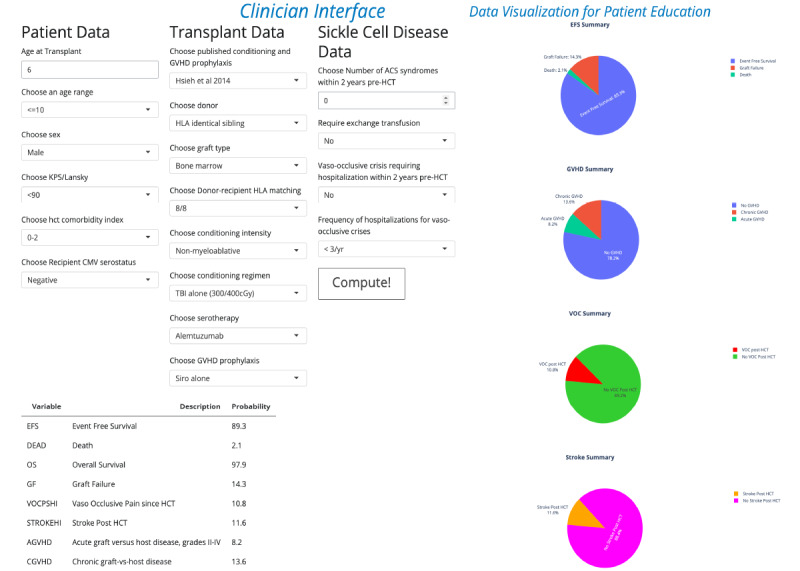
We applied a supervised random forest ML model to clinical parameters in a deidentified Center for International Blood and Marrow Transplant Research (CIBMTR) dataset of 1641 patients who underwent HCT between 1991 and 2021 and were followed for a median of 42.5 (IQR 52.5;range 0.3-312.9) months. We applied forward and reverse feature selection methods to optimize a set of predictive variables. To counter the imbalance bias toward predicting positive outcomes due to the small number of negative outcomes, we constructed a training dataset, taking each outcome as variable of interest, and performed 2-times repeated 10-fold cross-validation. SPRIGHT is a web-based individualized prediction tool accessible by smartphone, tablet, or personal computer. It incorporates predictive variables of age, age group, Karnofsky or Lansky score, comorbidity index, recipient cytomegalovirus seropositivity, history of acute chest syndrome, need for exchange transfusion, occurrence and frequency of vaso-occlusive crisis (VOC) before HCT, and either a published or custom chemotherapy or radiation conditioning, serotherapy, and graft-versus-host disease prophylaxis. SPRIGHT makes individualized predictions of overall survival (OS), event-free survival, graft failure, acute graft-versus-host disease (AGVHD), chronic graft-versus-host disease (CGVHD), and occurrence of VOC or stroke post-HCT.

RESULTS

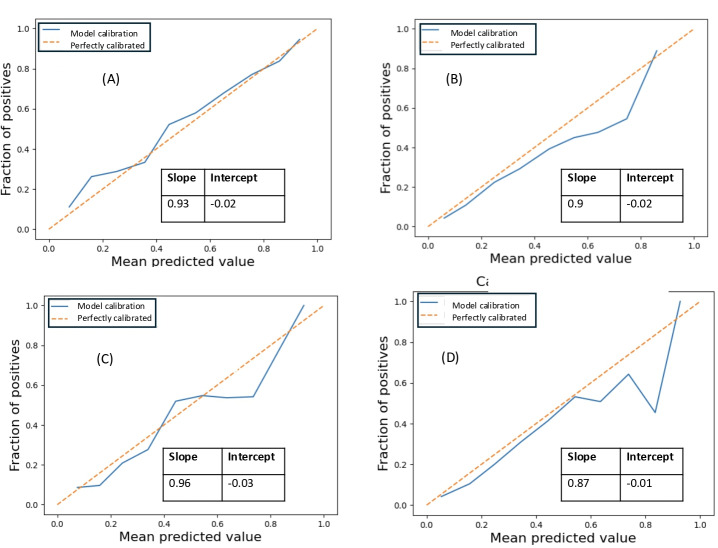
The model's ability to distinguish between positive and negative classes, that is, discrimination, was evaluated using the area under the curve, accuracy, and balanced accuracy. Discrimination met or exceeded published predictive benchmarks with area under the curve for OS (0.7925), event-free survival (0.7900), graft failure (0.8024), acute graft-versus-host disease (0.6793), chronic graft-versus-host disease (0.7320), and VOC post-HCT (0.8779). SPRIGHT revealed good calibration with a slope of 0.87-0.96, with small negative intercepts (-0.01 to 0.03), for 4 out of the 5 outcomes. However, OS exhibits nonideal calibration, which may be reflective of the overall high OS in all subgroups.

CONCLUSIONS

A web-based ML prediction tool incorporating multiple clinically relevant variables predicts key clinical outcomes with a high level of discrimination and calibration and has potential in shared decision-making.

https://cdn.ncbi.nlm.nih.gov/pmc/blobs/11f7/12435087/4bc0497ffc72/ai-v4-e64519-g003.jpg
https://cdn.ncbi.nlm.nih.gov/pmc/blobs/11f7/12435087/84e5c3995ae9/ai-v4-e64519-g001.jpg
https://cdn.ncbi.nlm.nih.gov/pmc/blobs/11f7/12435087/b23dcb5c9128/ai-v4-e64519-g002.jpg
https://cdn.ncbi.nlm.nih.gov/pmc/blobs/11f7/12435087/4bc0497ffc72/ai-v4-e64519-g003.jpg
https://cdn.ncbi.nlm.nih.gov/pmc/blobs/11f7/12435087/84e5c3995ae9/ai-v4-e64519-g001.jpg
https://cdn.ncbi.nlm.nih.gov/pmc/blobs/11f7/12435087/b23dcb5c9128/ai-v4-e64519-g002.jpg
https://cdn.ncbi.nlm.nih.gov/pmc/blobs/11f7/12435087/4bc0497ffc72/ai-v4-e64519-g003.jpg
摘要

背景

疾病修饰疗法可改善镰状细胞病(SCD)的疾病严重程度,但造血细胞移植(HCT)以及最近的自体基因疗法是仅有的具有治愈SCD潜力的治疗方法。虽然基于登记处的研究提供了人群水平的估计,但它们并未解决HCT个体结果的不确定性问题。计算机器学习(ML)有潜力识别可推广的预测模式并量化估计中的不确定性,从而改善临床决策。目前尚无针对SCD的ML模型,而针对其他疾病的HCT的ML模型侧重于单一结果而非所有相关结果。

目的

本研究旨在通过开发和验证个体化ML预测模型SPRIGHT(镰状细胞造血细胞移植结果预测模型)来填补现有知识空白,该模型纳入多个相关的HCT前特征以预测关键的HCT后临床结果。

方法

我们将监督随机森林ML模型应用于国际血液和骨髓移植研究中心(CIBMTR)的一个去识别化数据集的临床参数,该数据集包含1641例在1991年至2021年间接受HCT且中位随访时间为42.5(四分位间距52.5;范围0.3 - 312.9)个月的患者。我们应用向前和向后特征选择方法来优化一组预测变量。为了应对由于阴性结果数量少而导致的预测阳性结果的不平衡偏差,我们构建了一个训练数据集,将每个结果作为感兴趣的变量,并进行2次重复的10折交叉验证。SPRIGHT是一个基于网络的个体化预测工具,可通过智能手机、平板电脑或个人计算机访问。它纳入了年龄、年龄组、卡诺夫斯基或兰斯基评分、合并症指数、受者巨细胞病毒血清学阳性、急性胸综合征病史、换血需求、HCT前血管闭塞性危机(VOC)发生情况及频率,以及已发表的或定制的化疗或放疗预处理、血清疗法和移植物抗宿主病预防等预测变量。SPRIGHT可对总生存期(OS)、无事件生存期、移植物失败、急性移植物抗宿主病(AGVHD)、慢性移植物抗宿主病(CGVHD)以及HCT后VOC或中风的发生情况进行个体化预测。

结果

使用曲线下面积、准确性和平衡准确性评估了模型区分阳性和阴性类别的能力,即辨别力。辨别力达到或超过已发表的预测基准,OS的曲线下面积为0.7925,无事件生存期为0.7900,移植物失败为0.8024,急性移植物抗宿主病为0.6793,慢性移植物抗宿主病为0.7320,HCT后VOC为0.8779。SPRIGHT显示出良好的校准,5个结果中的4个结果的斜率为0.87 - 0.96,截距为小的负值(-0.01至0.03)。然而,OS表现出不理想的校准,这可能反映了所有亚组中总体较高的OS。

结论

一个纳入多个临床相关变量的基于网络的ML预测工具能够以较高的辨别力和校准度预测关键临床结果,并在共同决策中具有潜力。

相似文献

1
Machine-Learning Predictive Tool for the Individualized Prediction of Outcomes of Hematopoietic Cell Transplantation for Sickle Cell Disease: Registry-Based Study.镰状细胞病造血细胞移植结局个体化预测的机器学习预测工具:基于登记处的研究
JMIR AI. 2025 Sep 15;4:e64519. doi: 10.2196/64519.
2
Prescription of Controlled Substances: Benefits and Risks管制药品的处方:益处与风险
3
Comparison of Two Modern Survival Prediction Tools, SORG-MLA and METSSS, in Patients With Symptomatic Long-bone Metastases Who Underwent Local Treatment With Surgery Followed by Radiotherapy and With Radiotherapy Alone.两种现代生存预测工具 SORG-MLA 和 METSSS 在接受手术联合放疗和单纯放疗治疗有症状长骨转移患者中的比较。
Clin Orthop Relat Res. 2024 Dec 1;482(12):2193-2208. doi: 10.1097/CORR.0000000000003185. Epub 2024 Jul 23.
4
Are Current Survival Prediction Tools Useful When Treating Subsequent Skeletal-related Events From Bone Metastases?当前的生存预测工具在治疗骨转移后的骨骼相关事件时有用吗?
Clin Orthop Relat Res. 2024 Sep 1;482(9):1710-1721. doi: 10.1097/CORR.0000000000003030. Epub 2024 Mar 22.
5
Does the Presence of Missing Data Affect the Performance of the SORG Machine-learning Algorithm for Patients With Spinal Metastasis? Development of an Internet Application Algorithm.缺失数据的存在是否会影响 SORG 机器学习算法在脊柱转移瘤患者中的性能?开发一种互联网应用算法。
Clin Orthop Relat Res. 2024 Jan 1;482(1):143-157. doi: 10.1097/CORR.0000000000002706. Epub 2023 Jun 12.
6
Development of Machine Learning-based Algorithms to Predict the 2- and 5-year Risk of TKA After Tibial Plateau Fracture Treatment.基于机器学习的算法用于预测胫骨平台骨折治疗后2年和5年全膝关节置换风险的研究进展
Clin Orthop Relat Res. 2025 Mar 12. doi: 10.1097/CORR.0000000000003442.
7
Sex and gender as predictors for allograft and patient-relevant outcomes after kidney transplantation.性别作为肾移植后同种异体移植及患者相关预后的预测因素。
Cochrane Database Syst Rev. 2024 Dec 19;12(12):CD014966. doi: 10.1002/14651858.CD014966.pub2.
8
Pilot Study of Donor-Engrafted Clonal Hematopoiesis Evolution and Clinical Outcomes in Allogeneic Hematopoietic Cell Transplantation Recipients Using a National Registry.供者嵌合性造血的演变及其在异基因造血细胞移植受者中的临床结局的初步研究:基于国家注册库的研究
Transplant Cell Ther. 2023 Oct;29(10):640.e1-640.e8. doi: 10.1016/j.jtct.2023.07.021. Epub 2023 Jul 28.
9
Mycophenolate mofetil versus methotrexate for prevention of graft-versus-host disease in people receiving allogeneic hematopoietic stem cell transplantation.霉酚酸酯与甲氨蝶呤预防接受异基因造血干细胞移植患者移植物抗宿主病的比较
Cochrane Database Syst Rev. 2014 Jul 25;2014(7):CD010280. doi: 10.1002/14651858.CD010280.pub2.
10
Cost-effectiveness of using prognostic information to select women with breast cancer for adjuvant systemic therapy.利用预后信息为乳腺癌患者选择辅助性全身治疗的成本效益
Health Technol Assess. 2006 Sep;10(34):iii-iv, ix-xi, 1-204. doi: 10.3310/hta10340.

本文引用的文献

1
Consolidated Reporting Guidelines for Prognostic and Diagnostic Machine Learning Models (CREMLS).预测和诊断机器学习模型的综合报告指南 (CREMLS)。
J Med Internet Res. 2024 May 2;26:e52508. doi: 10.2196/52508.
2
Incidence and risk factors of pain crisis after hematopoietic cell transplantation for sickle cell disease.镰状细胞病造血细胞移植后疼痛危象的发生率及危险因素。
Blood Adv. 2024 Apr 23;8(8):1908-1919. doi: 10.1182/bloodadvances.2023010749.
3
Longitudinal clinical data improve survival prediction after hematopoietic cell transplantation using machine learning.
使用机器学习改善造血细胞移植后纵向临床数据的生存预测。
Blood Adv. 2024 Feb 13;8(3):686-698. doi: 10.1182/bloodadvances.2023011752.
4
Improving the Robustness of Variable Selection and Predictive Performance of Regularized Generalized Linear Models and Cox Proportional Hazard Models.提高正则化广义线性模型和Cox比例风险模型变量选择的稳健性及预测性能。
Mathematics (Basel). 2023 Feb;11(3). doi: 10.3390/math11030557. Epub 2023 Jan 20.
5
Artificial Intelligence based wrapper for high dimensional feature selection.基于人工智能的高维特征选择包装器。
BMC Bioinformatics. 2023 Oct 18;24(1):392. doi: 10.1186/s12859-023-05502-x.
6
Machine learning applications and challenges in graft-versus-host disease: a scoping review.机器学习在移植物抗宿主病中的应用及挑战:综述
Curr Opin Oncol. 2023 Nov 1;35(6):594-600. doi: 10.1097/CCO.0000000000000996. Epub 2023 Sep 1.
7
A pilot study of implication of machine learning for relapse prediction after allogeneic stem cell transplantation in adults with Ph-positive acute lymphoblastic leukemia.一项关于机器学习在成人 Ph 阳性急性淋巴细胞白血病异基因干细胞移植后复发预测中应用的初步研究。
Sci Rep. 2023 Oct 5;13(1):16790. doi: 10.1038/s41598-023-43950-w.
8
Machine Learning for the Prediction of Survival Post-Allogeneic Hematopoietic Cell Transplantation: A Single-Center Experience.机器学习在异基因造血细胞移植后生存预测中的应用:单中心经验。
Acta Haematol. 2024;147(3):280-291. doi: 10.1159/000533665. Epub 2023 Sep 28.
9
Predicting Patient Death after Allogeneic Stem Cell Transplantation for Inborn Errors Using Machine Learning (PREPAD): A European Society for Blood and Marrow Transplantation Inborn Errors Working Party Study.利用机器学习预测异基因造血干细胞移植治疗遗传性疾病患者的死亡风险(PREPAD):欧洲血液和骨髓移植学会遗传性疾病工作组研究。
Transplant Cell Ther. 2023 Dec;29(12):775.e1-775.e8. doi: 10.1016/j.jtct.2023.09.007. Epub 2023 Sep 13.
10
Causal isotonic calibration for heterogeneous treatment effects.针对异质性治疗效果的因果等渗校准
Proc Mach Learn Res. 2023 Jul;202:34831-34854.