Wu Caihong, Han Dongmei, Li Xin, Wang Dan, Jin Hao
Center for Precision Cancer Medicine & Translational Research, Tianjin Cancer Hospital Airport Hospital, Center for Precision Cancer Medicine & Translation Research, Tianjin Cancer Hospital Airport Hospital, Tianjin, China.
Pathology Department, Tianjin Cancer Hospital Airport Hospital, Tianjin, China.
J Obstet Gynaecol Res. 2025 Sep;51(9):e70077. doi: 10.1111/jog.70077.
Endometrial cancer (EC) is a genomically heterogeneous malignancy with diverse immune microenvironment profiles. Although POLE mutations and MSI-H status are established predictors of immunotherapy response, additional composite biomarkers that integrate mutational burden and immune activation are needed. PCLO and SYNE1 are frequently mutated structural genes in EC, yet their cooperative significance remains unknown.
We analyzed 505 EC cases from The Cancer Genome Atlas (TCGA) and 95 additional samples from the Clinical Proteomic Tumor Analysis Consortium (CPTAC), stratifying tumors based on PCLO and SYNE1 mutation status. Genomic, transcriptomic, immunologic, and clinical features were compared between co-mutation and non-co-mutation groups. Differential expression gene and pathway enrichment were conducted to identify immune-related transcriptional programs. Survival analysis and nomogram were performed to assess prognostic impact.
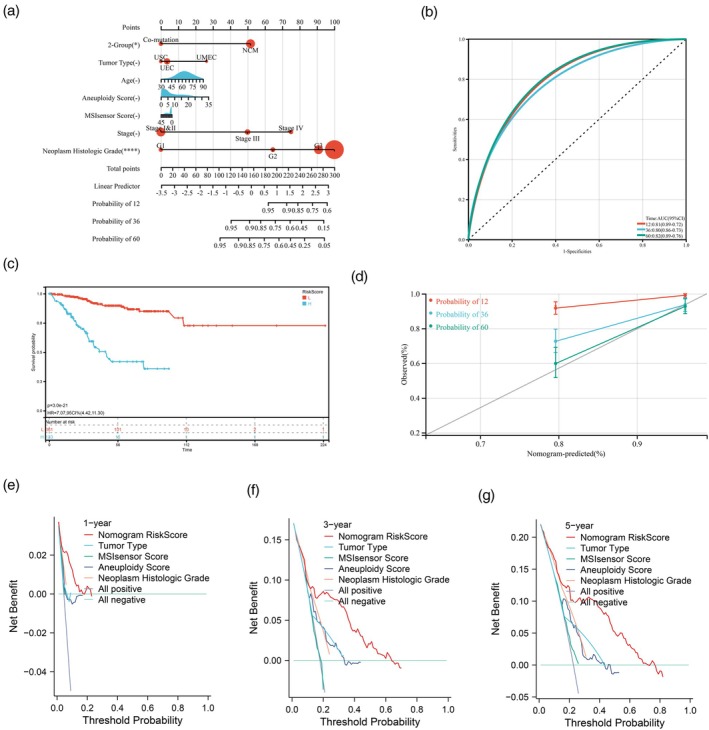
PCLO and SYNE1 co-mutation defined a notable EC subtype with significant enrichment of POLE mutations, high tumor mutation burden (TMB), reduced aneuploidy, and elevated MSIsensor scores. Clinically, the overall survival (OS), progression-free survival (PFS), and disease-free survival (DFS) of the co-mutation group was significantly improved. Moreover, the co-mutation group exhibited increased infiltration of CD8 T cells, M1 macrophages, and activated CD4 memory T cells, as well as upregulation of immune checkpoint genes and chemokine signaling pathways. Finally, a nomogram incorporating co-mutation status outperformed conventional prognosticators and demonstrated high accuracy in survival prediction.
PCLO and SYNE1 co-mutation identifies a biologically distinct EC subset with heightened immunogenicity and superior prognosis. The co-mutation may serve as a robust, integrative biomarker for immune responsiveness and risk stratification in EC.
子宫内膜癌(EC)是一种基因组异质性恶性肿瘤,具有多种免疫微环境特征。尽管POLE突变和微卫星高度不稳定(MSI-H)状态是免疫治疗反应的既定预测指标,但仍需要整合突变负担和免疫激活的其他复合生物标志物。PCLO和SYNE1是EC中经常发生突变的结构基因,但其协同意义仍不清楚。
我们分析了来自癌症基因组图谱(TCGA)的505例EC病例以及来自临床蛋白质组肿瘤分析联盟(CPTAC)的另外95个样本,根据PCLO和SYNE1突变状态对肿瘤进行分层。比较了共突变组和非共突变组之间的基因组、转录组、免疫学和临床特征。进行差异表达基因和通路富集分析以识别免疫相关的转录程序。进行生存分析和列线图以评估预后影响。
PCLO和SYNE1共突变定义了一种显著的EC亚型,其POLE突变显著富集、肿瘤突变负担(TMB)高、非整倍性降低且MSIsensor评分升高。临床上,共突变组的总生存期(OS)、无进展生存期(PFS)和无病生存期(DFS)显著改善。此外,共突变组表现出CD8 T细胞、M1巨噬细胞和活化的CD4记忆T细胞浸润增加,以及免疫检查点基因和趋化因子信号通路的上调。最后,纳入共突变状态的列线图优于传统的预后指标,并在生存预测中显示出高准确性。
PCLO和SYNE1共突变识别出一个生物学上不同的EC亚组,其免疫原性增强且预后良好。该共突变可能作为EC免疫反应性和风险分层的强大综合生物标志物。