Harris Ethan R, Li Steve S, Mousavi Seyedeh Zahra, Saha Prasenjit, Haft Mark A, Weisberg-Tannenbaum Miriam D, Srikumaran Umasuthan
Division of Shoulder Surgery, Department of Orthopaedic Surgery, The Johns Hopkins University School of Medicine, Baltimore, MD, USA.
JSES Int. 2025 Apr 9;9(4):1282-1285. doi: 10.1016/j.jseint.2025.03.013. eCollection 2025 Jul.
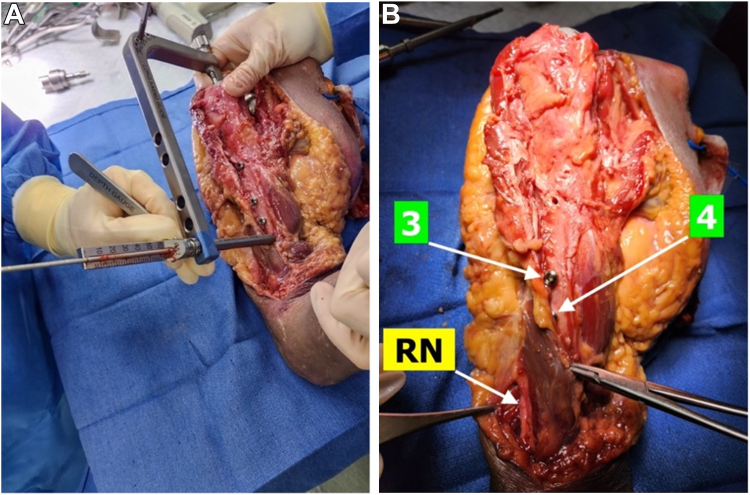
Long-stem reverse total shoulder arthroplasty (rTSA) with interlocking screws is indicated for trauma and revision shoulder arthroplasty and enables fixation of the prosthesis without cement or a plate while maintaining rotational stability. We investigated the distance of the radial nerve from the distal interlocking screws of the long-stem rTSA to recommend a safe approach in placement of this prosthesis. The 3 distal 4.5-mm cortical interlocking screws of a 200-mm long-stem rTSA (FX Shoulder) were inserted with the humeral prosthesis at 0° and 20° of retroversion in 8 cadaveric specimens. A curvilinear incision from the anterolateral cubital fossa extending superolaterally along the humerus was made to expose the radial nerve between the brachialis and brachioradialis. The shortest distance from each screw to the radial nerve at 90° of elbow flexion was measured, and mean and standard deviations were calculated. At 0° of retroversion of the humeral prosthesis, the most distal 3 screws were a mean 9.5, 4.2, and 0.93 mm away from the radial nerve, respectively, whereas 20° of retroversion yielded mean screw-to-radial-nerve distances of 20, 15, and 8.7 mm, respectively. The mean distance to the radial nerve increased with increasing retroversion of the stem. We recommend using at least 20° of retroversion and making an incision anteriorly with careful retraction of soft tissues posteriorly on the humeral shaft to enable direct visualization during placement of the most distal interlocking screws to protect neurovascular structures.
带锁钉的长柄反向全肩关节置换术(rTSA)适用于创伤性和翻修性肩关节置换术,能够在不使用骨水泥或钢板的情况下固定假体,同时保持旋转稳定性。我们研究了长柄rTSA远端锁钉与桡神经之间的距离,以推荐该假体置入的安全方法。在8具尸体标本中,将一个200毫米长柄rTSA(FX Shoulder)的3枚远端4.5毫米皮质骨锁钉与肱骨假体一起在肱骨后倾0°和20°时插入。沿肱骨从肘前外侧窝向上外侧做一条曲线切口,以暴露肱肌和肱桡肌之间的桡神经。测量在肘关节屈曲90°时每枚螺钉与桡神经之间的最短距离,并计算平均值和标准差。在肱骨假体后倾0°时,最远端的3枚螺钉与桡神经的平均距离分别为9.5、4.2和0.93毫米,而在20°后倾时,螺钉与桡神经的平均距离分别为20、15和8.7毫米。随着柄的后倾增加,与桡神经的平均距离也增加。我们建议至少使用20°的后倾,并在肱骨干部位向前做切口,同时小心地将软组织向后牵开,以便在置入最远端锁钉时能直接观察,从而保护神经血管结构。