• 文献检索
  • 文档翻译
  • 深度研究
  • 学术资讯
  • Suppr Zotero 插件Zotero 插件
  • 邀请有礼
  • 套餐&价格
  • 历史记录
应用&插件
Suppr Zotero 插件Zotero 插件浏览器插件Mac 客户端Windows 客户端微信小程序
定价
高级版会员购买积分包购买API积分包
服务
文献检索文档翻译深度研究API 文档MCP 服务
关于我们
关于 Suppr公司介绍联系我们用户协议隐私条款
关注我们

Suppr 超能文献

核心技术专利:CN118964589B侵权必究
粤ICP备2023148730 号-1Suppr @ 2026

文献检索

告别复杂PubMed语法,用中文像聊天一样搜索,搜遍4000万医学文献。AI智能推荐,让科研检索更轻松。

立即免费搜索

文件翻译

保留排版,准确专业,支持PDF/Word/PPT等文件格式,支持 12+语言互译。

免费翻译文档

深度研究

AI帮你快速写综述,25分钟生成高质量综述,智能提取关键信息,辅助科研写作。

立即免费体验

日语失读症和失写症的认知与神经解剖学评估:对欧洲语言的启示

Cognitive and neuroanatomical assessment of alexia and agraphia in Japanese: implications for the European languages.

作者信息

Sakurai Yasuhisa

机构信息

Department of Health Care, Mitsui Memorial Hospital, Tokyo, Japan.

Takuma Neurology Clinic, Tokyo, Japan.

出版信息

Front Hum Neurosci. 2025 Sep 4;19:1664803. doi: 10.3389/fnhum.2025.1664803. eCollection 2025.

DOI:10.3389/fnhum.2025.1664803
PMID:40977856
原文链接:https://pmc.ncbi.nlm.nih.gov/articles/PMC12445170/
Abstract

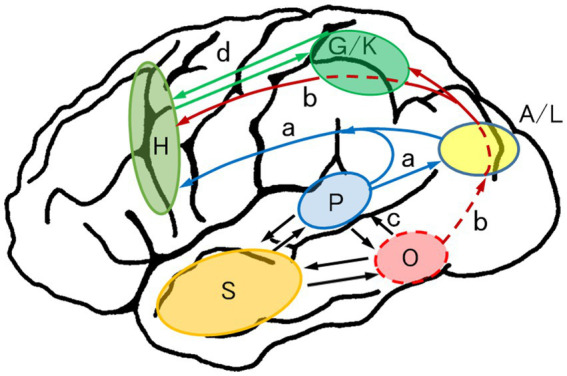
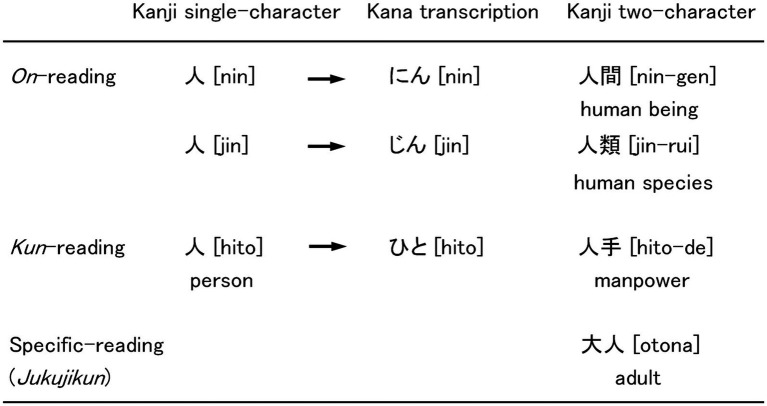
The Japanese language has a unique writing system that consists of (morphograms, derived from Chinese characters) and (phonograms, a simplified form of kanji representing syllables). A kanji character has two distinct ways of reading: -reading (Chinese-style pronunciation) and -reading (native Japanese pronunciation). Some kanji words have irregular -reading called . Furthermore, kana characters have two script forms: (cursive form) and (square form), each of which is used for different purposes. Because of these features, Japanese individuals with alexia and agraphia show characteristic symptoms. Lesion-to-symptom analyses and functional imaging studies developed beginning in the 1970s have reported the following findings: (1) kanji-kana dissociation in alexia/agraphia: pure alexia for kanji or kana, lexical agraphia for kanji, and phonological agraphia for kana; (2) dissociation in alexia: predominant -reading and reading impairment in semantic dementia and selective -reading impairment in the extensive posterior middle temporal gyrus lesion; and (3) allographic agraphia between and .

摘要

日语有一套独特的书写系统,它由(表意文字,源自汉字)和(表音文字,汉字的一种简化形式,代表音节)组成。一个汉字有两种不同的读法:音读(中国式发音)和训读(日语本土发音)。一些汉字词有不规则的音读,称为熟字训。此外,假名有两种书写形式:平假名(草书形式)和片假名(方形形式),每种形式用于不同的目的。由于这些特点,患有失读症和失写症的日本人表现出特征性症状。从20世纪70年代开始的病变与症状分析以及功能成像研究报告了以下发现:(1)失读症/失写症中的汉字-假名分离:对汉字或假名的纯失读症、对汉字的词汇性失写症以及对假名的语音性失写症;(2)失读症中的诵读困难分离:在语义性痴呆中主要是音读和训读受损,而在广泛的颞中回后部病变中是选择性音读受损;以及(3)平假名和片假名之间的全字性失写症。
https://cdn.ncbi.nlm.nih.gov/pmc/blobs/008f/12445170/3089b1006131/fnhum-19-1664803-g007.jpg
https://cdn.ncbi.nlm.nih.gov/pmc/blobs/008f/12445170/826936eadf8b/fnhum-19-1664803-g001.jpg
https://cdn.ncbi.nlm.nih.gov/pmc/blobs/008f/12445170/8d175e91d4bc/fnhum-19-1664803-g002.jpg
https://cdn.ncbi.nlm.nih.gov/pmc/blobs/008f/12445170/592c75c41535/fnhum-19-1664803-g003.jpg
https://cdn.ncbi.nlm.nih.gov/pmc/blobs/008f/12445170/e302227d45e8/fnhum-19-1664803-g004.jpg
https://cdn.ncbi.nlm.nih.gov/pmc/blobs/008f/12445170/3ed9cfb8bf5e/fnhum-19-1664803-g005.jpg
https://cdn.ncbi.nlm.nih.gov/pmc/blobs/008f/12445170/b0bf937317c8/fnhum-19-1664803-g006.jpg
https://cdn.ncbi.nlm.nih.gov/pmc/blobs/008f/12445170/3089b1006131/fnhum-19-1664803-g007.jpg
https://cdn.ncbi.nlm.nih.gov/pmc/blobs/008f/12445170/826936eadf8b/fnhum-19-1664803-g001.jpg
https://cdn.ncbi.nlm.nih.gov/pmc/blobs/008f/12445170/8d175e91d4bc/fnhum-19-1664803-g002.jpg
https://cdn.ncbi.nlm.nih.gov/pmc/blobs/008f/12445170/592c75c41535/fnhum-19-1664803-g003.jpg
https://cdn.ncbi.nlm.nih.gov/pmc/blobs/008f/12445170/e302227d45e8/fnhum-19-1664803-g004.jpg
https://cdn.ncbi.nlm.nih.gov/pmc/blobs/008f/12445170/3ed9cfb8bf5e/fnhum-19-1664803-g005.jpg
https://cdn.ncbi.nlm.nih.gov/pmc/blobs/008f/12445170/b0bf937317c8/fnhum-19-1664803-g006.jpg
https://cdn.ncbi.nlm.nih.gov/pmc/blobs/008f/12445170/3089b1006131/fnhum-19-1664803-g007.jpg

相似文献

1
Cognitive and neuroanatomical assessment of alexia and agraphia in Japanese: implications for the European languages.日语失读症和失写症的认知与神经解剖学评估:对欧洲语言的启示
Front Hum Neurosci. 2025 Sep 4;19:1664803. doi: 10.3389/fnhum.2025.1664803. eCollection 2025.
2
Kanji (Morphogram) and Kana (Phonogram) Problem in Japanese Alexia and Agraphia.日语失读症和失写症中的汉字(意符)和假名(音符)问题。
Front Neurol Neurosci. 2019;44:53-63. doi: 10.1159/000494952. Epub 2019 Apr 30.
3
Selective impairment of On-reading (Chinese-style pronunciation) in alexia with agraphia for kanji due to subcortical hemorrhage in the left posterior middle temporal gyrus.左颞叶后中回皮质下出血导致的汉字失写伴失读症中对汉字的读字障碍选择性损伤。
Neurocase. 2020 Aug;26(4):220-226. doi: 10.1080/13554794.2020.1788608. Epub 2020 Jul 16.
4
Spatiotemporal dynamics of reading Kana (syllabograms) and Kanji (morphograms).阅读假名(音节文字)和汉字(语素文字)的时空动态。
Neuroimage. 2025 Aug 15;317:121316. doi: 10.1016/j.neuroimage.2025.121316. Epub 2025 Jun 7.
5
Alexia and agraphia with lesions of the angular and supramarginal gyri: evidence for the disruption of sequential processing.角回和缘上回病变所致的失读伴失写:序列加工破坏的证据。
J Neurol Sci. 2010 Jan 15;288(1-2):25-33. doi: 10.1016/j.jns.2009.10.015. Epub 2009 Nov 6.
6
Agraphia for kanji resulting from a left posterior middle temporal gyrus lesion.左侧颞中回后部病变导致的汉字失写症。
Behav Neurol. 2008;19(3):93-106. doi: 10.1155/2008/393912.
7
Alexia caused by a fusiform or posterior inferior temporal lesion.由梭形或颞叶后下部病变引起的失读症。
J Neurol Sci. 2000 Sep 1;178(1):42-51. doi: 10.1016/s0022-510x(00)00363-4.
8
Pure alexia in Japanese and agraphia without alexia in kanji. The ability dissociation between reading and writing in kanji vs kana.日语中的纯失读症与汉字失写症而非失读症。汉字与假名读写能力的分离。
Arch Neurol. 1988 Oct;45(10):1157-9. doi: 10.1001/archneur.1988.00520340111020.
9
On-Reading (Chinese-Style Pronunciation) Predominance Over Kun-Reading (Native Japanese Pronunciation) in Japanese Semantic Dementia.日本语义性痴呆中汉字音读(中国式发音)相对于训读(日语固有发音)占优势。
Front Hum Neurosci. 2021 Aug 5;15:700181. doi: 10.3389/fnhum.2021.700181. eCollection 2021.
10
Varieties of alexia from fusiform, posterior inferior temporal and posterior occipital gyrus lesions.梭状回、颞下回后部和枕叶下回病变导致的各种失读症。
Behav Neurol. 2004;15(1-2):35-50. doi: 10.1155/2004/305194.

本文引用的文献

1
Case of Pure Agraphia in Kana and Romaji Without Sensorimotor Deficits After a Small Infarct of the Posterior Limb of the Internal Capsule.内囊后肢小梗死灶后出现的无感觉运动障碍的纯假名及罗马字失写症病例。
Neurology. 2025 Apr 8;104(7):e210254. doi: 10.1212/WNL.0000000000210254. Epub 2025 Mar 11.
2
Postencephalitic Proper- and Common-name Anomia, Alexia With Agraphia, and Mild Semantic Deficit due to Left Anterior Temporal Lobe Lesion.左侧颞叶前部病变所致脑炎后专名和通名命名障碍、失读伴失写以及轻度语义缺陷
Cogn Behav Neurol. 2025 Mar 1;38(1):21-32. doi: 10.1097/WNN.0000000000000386.
3
Frontal allographic agraphia in a patient with behavioral variant frontotemporal dementia.
一名行为变异型额颞叶痴呆患者的额叶异体失写症
Neurocase. 2024 Feb;30(1):32-38. doi: 10.1080/13554794.2024.2353936. Epub 2024 May 16.
4
Apraxia of speech due to the left postcentral gyrus lesion.左侧中央后回病变所致的言语失用症。
Clin Case Rep. 2024 Feb 9;12(2):e8499. doi: 10.1002/ccr3.8499. eCollection 2024 Feb.
5
Tactually-related cognitive impairments: sharing of neural substrates across associative tactile agnosia, agraphesthesia, and kinesthetic reading difficulty.触觉相关认知障碍:跨联想性触觉失认症、体表感觉失认症和动觉阅读困难的神经基质共享
Acta Neurol Belg. 2023 Oct;123(5):1893-1902. doi: 10.1007/s13760-022-02130-9. Epub 2022 Nov 7.
6
Agraphia with Mild Alexia Following Left Thalamic Infarction.左侧丘脑梗死继发轻度失读症的失写症
Intern Med. 2022 Mar 1;61(5):763-764. doi: 10.2169/internalmedicine.8112-21. Epub 2021 Aug 24.
7
On-Reading (Chinese-Style Pronunciation) Predominance Over Kun-Reading (Native Japanese Pronunciation) in Japanese Semantic Dementia.日本语义性痴呆中汉字音读(中国式发音)相对于训读(日语固有发音)占优势。
Front Hum Neurosci. 2021 Aug 5;15:700181. doi: 10.3389/fnhum.2021.700181. eCollection 2021.
8
Asymmetric Bálint's syndrome with multimodal agnosia, bilateral agraphesthesia, and ineffective kinesthetic reading due to subcortical hemorrhage in the left parieto-occipito-temporal area.左侧顶枕颞叶皮质下区脑出血导致的非对称巴尔金氏综合征伴多种形式感觉缺失、双侧失写症和无效运动性阅读。
Neurocase. 2020 Dec;26(6):328-339. doi: 10.1080/13554794.2020.1831546. Epub 2020 Oct 26.
9
Identification of a distinct association fiber tract "IPS-FG" to connect the intraparietal sulcus areas and fusiform gyrus by white matter dissection and tractography.通过对白质切割和示踪术的研究,鉴定出一条独特的关联纤维束“IPS-FG”,连接顶内沟区域和梭状回。
Sci Rep. 2020 Sep 23;10(1):15475. doi: 10.1038/s41598-020-72471-z.
10
Dorsal type letter-by-letter reading accompanying alexia with agraphia due to a lesion of the lateral occipital gyri.顶叶字母型失读伴失写症,病变位于外侧枕叶回。
Neurocase. 2020 Oct;26(5):285-292. doi: 10.1080/13554794.2020.1803922. Epub 2020 Aug 17.