Jakobsson Johan, De Brandt Jana, Hedlund Mattias, Rullander Anna-Clara, Sandström Thomas, Nyberg André
Department of Community Medicine and Rehabilitation, Umeå University, Umeå, Sweden.
These authors contributed equally.
ERJ Open Res. 2025 Sep 22;11(5). doi: 10.1183/23120541.01321-2024. eCollection 2025 Sep.
Extrapulmonary manifestations, including cognitive impairment and reduced muscle and cardiovascular function is common in COPD. While high-intensity exercise offers extrapulmonary benefits, its implementation in COPD is challenging. This randomised crossover trial examined the feasibility and physiological responses of a novel supramaximal high-intensity interval-training (SupraHIIT) protocol compared with moderate-intensity continuous training (MICT) in people with COPD and matched healthy controls (HCs).
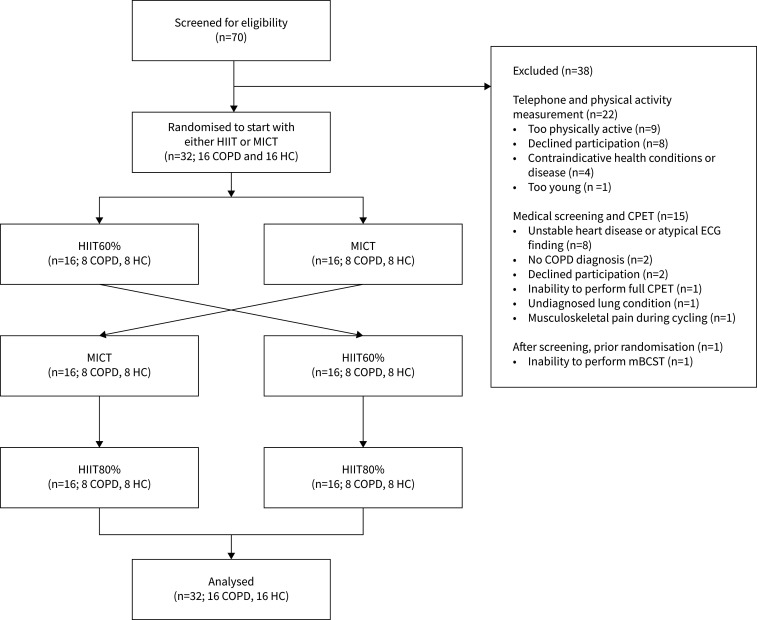
16 people with COPD and 16 HCs performed SupraHIIT and MICT. SupraHIIT consisted of ten 6-s intervals at ≈150% and ≈200% of maximum aerobic power (MAP), while MICT was performed for 20 min at 60% of MAP. Outcomes were exercise intensity, change in exerkines, feasibility and cardiorespiratory demand of the modalities.
SupraHIIT was feasible and enabled up to a 3.5-fold increase in external exercise intensity compared with MICT (184±66 and 245±88 71±22 W in COPD; p<0.001). All participants could complete SupraHIIT, which was the preferred modality in both groups (p<0.01), whereas 5 of 16 participants with COPD interrupted MICT due to intolerable dyspnoea or exhaustion (p=0.005). Both modalities increased plasma brain-derived neurotrophic factor (pBDNF) by an average of 59% (range 30-87%; p<0.05). When normalised for duration at target power, SupraHIIT produced a 5-10-fold greater increase than MICT. Both modalities lead to a variable response in other exerkines including clusterin, lactate, hepatocyte growth factor and interleukin-6.
In COPD, short-duration SupraHIIT is more feasible and enables markedly higher external exercise intensities than MICT. By elevating pBDNF and other potentially beneficial exerkines, it shows potential for extrapulmonary benefits.
肺外表现,包括认知障碍以及肌肉和心血管功能下降,在慢性阻塞性肺疾病(COPD)中很常见。虽然高强度运动能带来肺外益处,但在COPD患者中实施却具有挑战性。这项随机交叉试验比较了一种新型超最大强度间歇训练(SupraHIIT)方案与中等强度持续训练(MICT)在COPD患者及匹配的健康对照者(HCs)中的可行性和生理反应。
16名COPD患者和16名HCs进行了SupraHIIT和MICT。SupraHIIT包括十个6秒的间歇,强度约为最大有氧功率(MAP)的150%和约200%,而MICT以MAP的60%进行20分钟。观察指标包括运动强度、运动因子的变化、可行性以及两种训练方式的心肺需求。
SupraHIIT是可行的,与MICT相比,其外部运动强度可提高3.5倍(COPD患者中分别为184±66和245±88、71±22W;p<0.001)。所有参与者都能完成SupraHIIT,这是两组中更受欢迎的训练方式(p<0.01),而16名COPD患者中有5人因难以忍受的呼吸困难或疲劳而中断了MICT(p=0.005)。两种训练方式均使血浆脑源性神经营养因子(pBDNF)平均增加59%(范围为30 - 87%;p<0.05)。以目标功率下的持续时间进行标准化后,SupraHIIT的增加幅度比MICT大5至10倍。两种训练方式在其他运动因子(包括簇集蛋白、乳酸、肝细胞生长因子和白细胞介素-6)上均导致了不同的反应。
在COPD患者中,短时间的SupraHIIT比MICT更可行,且能使外部运动强度显著更高。通过提高pBDNF和其他潜在有益的运动因子,它显示出具有肺外益处的潜力。