Deng Xueqiong, Liu Yiming
Department Of Gastroenterology, Longyan First Hospital Affiliated to Fujian Medical University, No.105 Jiuyi North Road, Xinluo District, Fujian, 364000, Longyan, China.
Discov Oncol. 2025 Sep 24;16(1):1695. doi: 10.1007/s12672-025-03095-w.
Esophageal cancer (EC) has a high incidence and is highly invasive. It is meaningful to employ invasion-related genes (IRGs) to predict patients' prognosis.
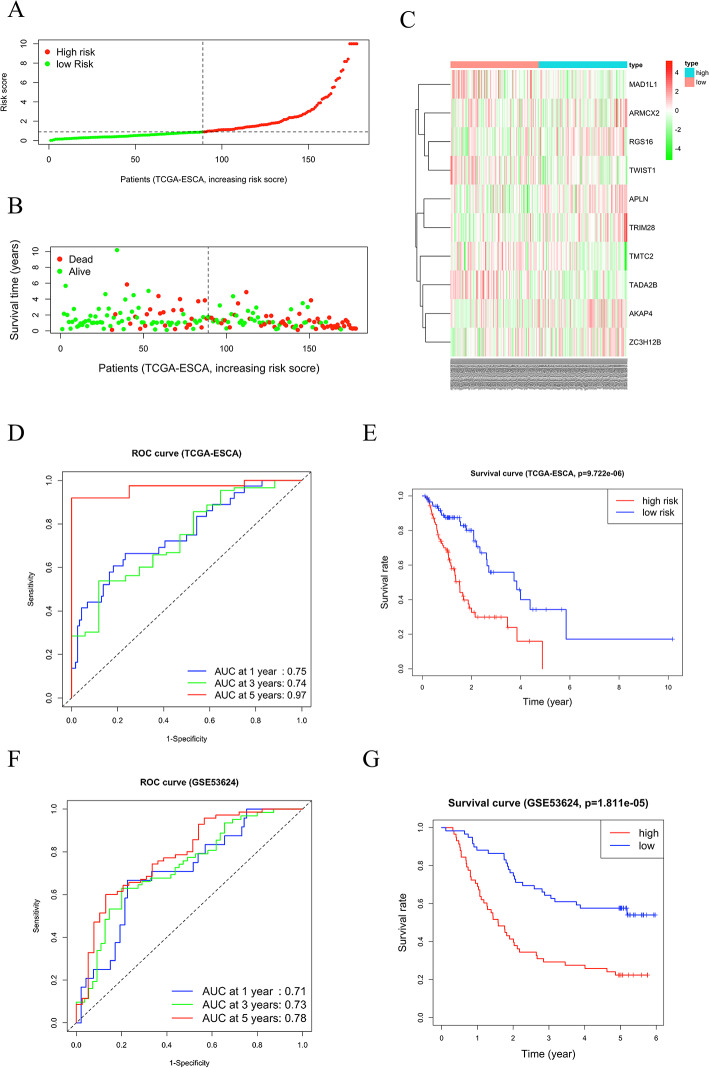
We launched a weighted correlation network analysis to screen for EC tumor differentially expressed IRGs (module genes) from the TCGA-ESCA dataset. By executing univariate-LASSO-multivariate Cox regression analyses, we stepwise selected module genes to obtain prognostic feature genes and create a model. We validated the model using the external GEO dataset GSE53624. We assessed the model's independent prognosis prediction ability. A nomogram was plotted and further validated later. GSEA was undertaken on high-risk groups (Group H). We compared immunity and tumor mutations in Group H and the low-risk group (Group L) and made small molecular drug predictions on prognostic genes.
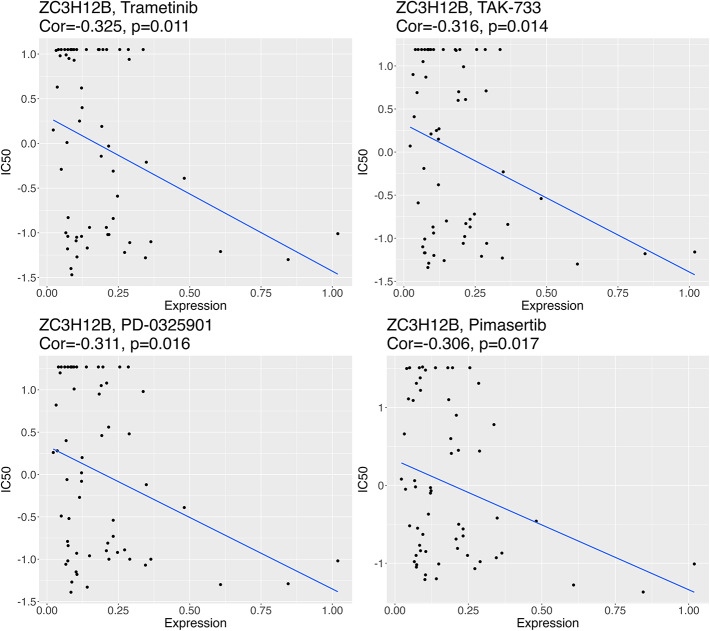
A risk prognostic model consisting of 10 genes (ARMCX2, RGS16, APLN, TRIM28, AKAP4, ZC3H12B, MAD1L1, TWIST1, TMTC2, and TADA2B) was created. ZC3H12B was significantly linked with TADA 2B, AKAP4, and TWIST1 (P < 0.01). The model exhibited a good predictive performance, functioning as an independent prognostic factor. The predictive accuracy of the nomogram was relatively high. Pathways that were significantly enriched in Group H included base excision repair, cysteine and methionine metabolism, and porphyrin and chlorophyll metabolism (P < 0.05). Compared with Group L, Group H had higher expression of relevant immune genes and a higher degree of tumor mutation (P < 0.05). ZC3H12B was significantly linked with immune cells (macrophages and iDCs), showing a high degree of mutation. The IC values of Lomustine, Dexrazoxane, Batracylin, and Buthioninesulphoximine were significantly positively linked with the expression of ZC3H12B (P < 0.01).
The 10-gene prognostic model can independently predict patients' prognosis. The great correlation between ZC3H12B and multiple feature genes and immune cells may be tightly linked to EC progression.
食管癌(EC)发病率高且具有高度侵袭性。利用侵袭相关基因(IRGs)预测患者预后具有重要意义。
我们开展了加权相关网络分析,从TCGA-ESCA数据集中筛选出EC肿瘤差异表达的IRGs(模块基因)。通过进行单变量-LASSO-多变量Cox回归分析,我们逐步选择模块基因以获得预后特征基因并创建模型。我们使用外部GEO数据集GSE53624验证了该模型。我们评估了该模型的独立预后预测能力。绘制了列线图并随后进行了进一步验证。对高风险组(H组)进行了基因集富集分析(GSEA)。我们比较了H组和低风险组(L组)的免疫情况和肿瘤突变情况,并对预后基因进行了小分子药物预测。
创建了一个由10个基因(ARMCX2、RGS16、APLN、TRIM28、AKAP4、ZC3H12B、MAD1L1、TWIST1、TMTC2和TADA2B)组成的风险预后模型。ZC3H12B与TADA 2B、AKAP4和TWIST1显著相关(P < 0.01)。该模型表现出良好的预测性能,可作为独立的预后因素。列线图的预测准确性相对较高。在H组中显著富集的通路包括碱基切除修复、半胱氨酸和甲硫氨酸代谢以及卟啉和叶绿素代谢(P < 0.05)。与L组相比,H组相关免疫基因的表达较高,肿瘤突变程度也较高(P < 0.05)。ZC3H12B与免疫细胞(巨噬细胞和未成熟树突状细胞)显著相关,显示出高度突变。洛莫司汀、右雷佐生、杆菌肽和丁硫氨酸亚砜胺的IC值与ZC3H12B的表达显著正相关(P < 0.01)。
该10基因预后模型可独立预测患者预后。ZC3H12B与多个特征基因和免疫细胞之间的高度相关性可能与EC进展密切相关。