Yang Guangjun, Shillito Georgina E, Seeber Phillip, Wenger Oliver S, Kupfer Stephan
Institute of Physical Chemistry, Friedrich Schiller University Jena Lessingstraße 4 07743 Jena Germany.
University Computer Centre, Friedrich Schiller University Jena Am Johannesfriedhof 2 07743 Jena Germany.
Chem Sci. 2025 Sep 10;16(39):18113-18125. doi: 10.1039/d5sc05170c. eCollection 2025 Oct 8.
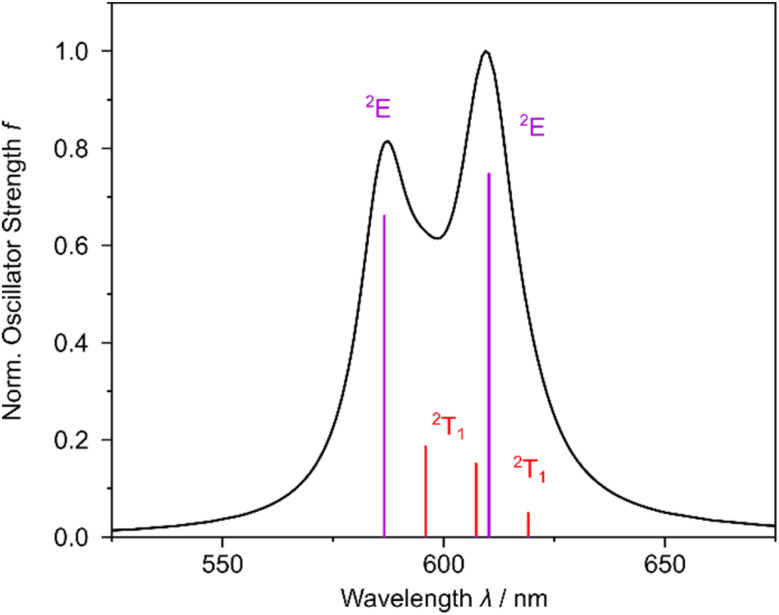
In contrast to well-studied 4d and 5d transition metal complexes such as the modern-day drosophila of photochemistry, Ru(ii)-tris(bipyridine), which often feature a typical triplet metal-to-ligand charge transfer emission in the nanosecond timescale, the photophysics of Cr(iii) complexes are drastically different. The 3d configuration of the chromium(iii) allows for an unusual spin-flip emission from the low-lying metal-centered (MC; T and E) states, exhibiting lifetimes up to the milliseconds to seconds timescale. In this fully computational contribution, the photophysical properties as well as the application of such long-lived excited states in the context of photoredox chemical transformations are investigated for the recently introduced [Cr(dqp)] [Cr(iii)-(2,6-bis(8'-quinolinyl)pyridine)], otherwise known as a type of molecular ruby. Our in-depth theoretical characterization of the complicated electronic structure of this 3d system relies on state-of-the-art multiconfigurational methods, the restricted active space self-consistent field (RASSCF) method followed by second-order perturbation theory (RASPT2). This way, the light-driven processes associated with the initial absorption from the quartet ground state, intersystem crossing to the doublet manifold as well as the spin-flip emission were elucidated. Furthermore, the applicability of the long-lived excited state in [Cr(dqp)] in photoredox chemistry, reductive quenching by ,-dimethylaniline, was investigated by molecular dynamics (AIMD). Finally, the thermodynamics and kinetics of these underlying intermolecular electron transfer processes were analyzed in the context of semiclassical Marcus theory.
与研究充分的4d和5d过渡金属配合物(如光化学领域的现代果蝇——Ru(ii)-三(联吡啶),其在纳秒时间尺度上通常具有典型的三重态金属到配体的电荷转移发射)形成对比的是,Cr(iii)配合物的光物理性质截然不同。铬(iii)的3d构型允许从低能级的以金属为中心的(MC;T和E)态进行异常的自旋翻转发射,其寿命可达毫秒到秒的时间尺度。在这项完全基于计算的研究中,针对最近引入的[Cr(dqp)] [Cr(iii)-(2,6-双(8'-喹啉基)吡啶)](也被称为一种分子红宝石),研究了其光物理性质以及这种长寿命激发态在光氧化还原化学转化中的应用。我们对这个3d体系复杂电子结构的深入理论表征依赖于最先进的多组态方法,即受限活性空间自洽场(RASSCF)方法,随后是二阶微扰理论(RASPT2)。通过这种方式,阐明了与从四重基态的初始吸收、系间窜越到二重态以及自旋翻转发射相关的光驱动过程。此外,通过分子动力学(AIMD)研究了[Cr(dqp)]中长寿命激发态在光氧化还原化学中的适用性,即通过N,N-二甲基苯胺进行还原猝灭。最后,在半经典马库斯理论的背景下分析了这些潜在分子间电子转移过程的热力学和动力学。