
厌氧肠道真菌的非靶向气相色谱-质谱代谢谱分析揭示了推定的萜类化合物和菌株特异性代谢产物。
Untargeted GC-MS Metabolic Profiling of Anaerobic Gut Fungi Reveals Putative Terpenoids and Strain-Specific Metabolites.
作者信息
Butkovich Lazarina V, Swift Candice L, Clendinen Chaevien S, Olson Heather M, Purvine Samuel O, Vining Oliver B, O'Malley Michelle A
机构信息
Department of Chemical Engineering, University of California, Santa Barbara, Santa Barbara, CA 93106, USA.
Earth and Biological Sciences Division, Pacific Northwest National Laboratory, Richland, WA 99352, USA.
出版信息
Metabolites. 2025 Aug 29;15(9):578. doi: 10.3390/metabo15090578.
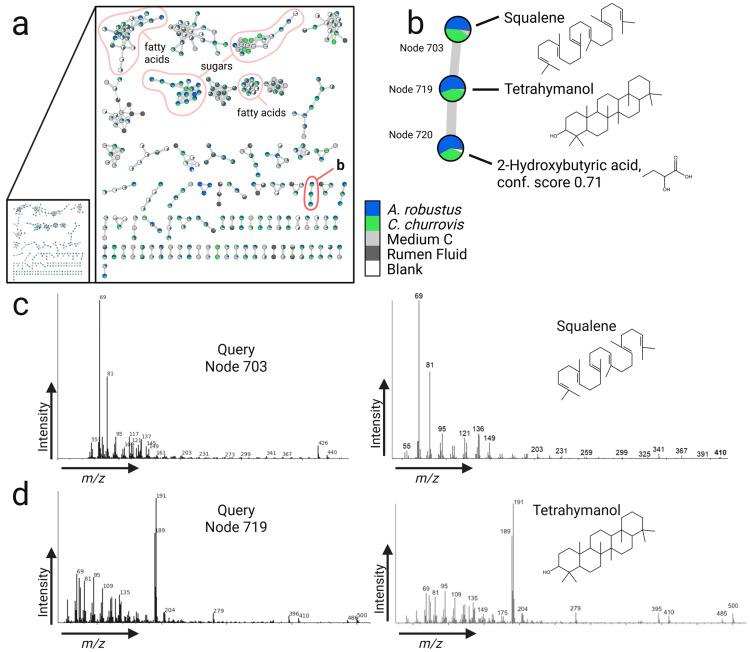
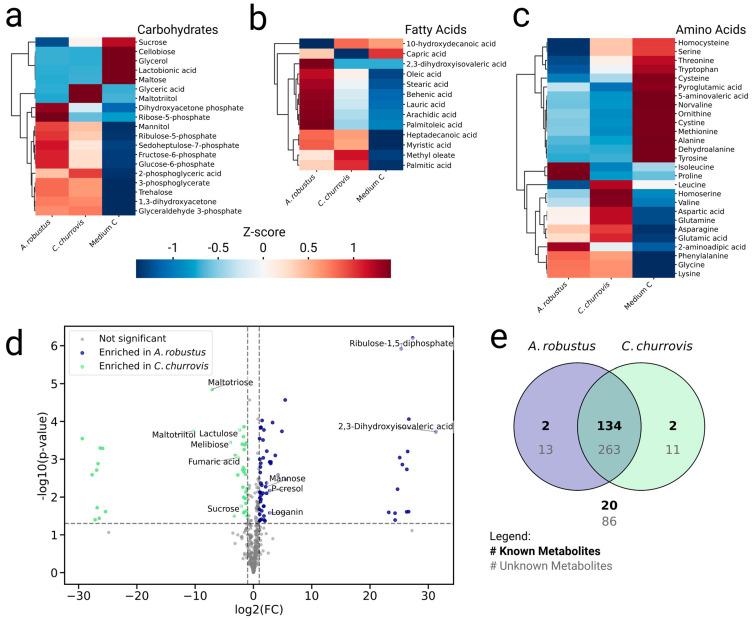
: Anaerobic gut fungi (Neocallimastigomycota) are biotechnologically relevant, lignocellulose-degrading microbes with under-explored biosynthetic potential for secondary metabolites. Untargeted metabolomic profiling with gas chromatography-mass spectrometry (GC-MS) was applied to two gut fungal strains, and , to establish a foundational metabolomic dataset to identify metabolites and provide insights into gut fungal metabolic capabilities. : Gut fungi were cultured anaerobically in rumen-fluid-based media with a soluble substrate (cellobiose), and metabolites were extracted using the Metabolite, Protein, and Lipid Extraction (MPLEx) method, enabling metabolomic and proteomic analysis from the same cell samples. Samples were derivatized and analyzed via GC-MS, followed by compound identification by spectral matching to reference databases, molecular networking, and statistical analyses. : Distinct metabolites were identified between and , including 2,3-dihydroxyisovaleric acid produced by and maltotriitol, maltotriose, and melibiose produced by . may polymerize maltotriose to form an extracellular polysaccharide, like pullulan. GC-MS profiling potentially captured sufficiently volatile products of proteomically detected, putative non-ribosomal peptide synthetases and polyketide synthases of and . The triterpene squalene and triterpenoid tetrahymanol were putatively identified in and . Their conserved, predicted biosynthetic genes-squalene synthase and squalene tetrahymanol cyclase-were identified in , , and other anaerobic gut fungal genera. : This study provides a foundational, untargeted metabolomic dataset to unmask gut fungal metabolic pathways and biosynthetic potential and to prioritize future efforts for compound isolation and identification.
厌氧肠道真菌(新美鞭菌门)是具有生物技术相关性的、可降解木质纤维素的微生物,其次级代谢产物的生物合成潜力尚未得到充分探索。采用气相色谱 - 质谱联用(GC-MS)的非靶向代谢组学分析方法,对两株肠道真菌菌株[具体菌株名称未给出]进行分析,以建立一个基础代谢组数据集,用于鉴定代谢产物并深入了解肠道真菌的代谢能力。:肠道真菌在基于瘤胃液的培养基中以可溶性底物(纤维二糖)进行厌氧培养,使用代谢物、蛋白质和脂质提取(MPLEx)方法提取代谢物,从而能够对同一细胞样本进行代谢组学和蛋白质组学分析。样本经衍生化处理后通过GC-MS进行分析,随后通过与参考数据库的光谱匹配、分子网络分析和统计分析来鉴定化合物。:在[具体菌株名称未给出]和[具体菌株名称未给出]之间鉴定出了不同的代谢产物,包括[具体菌株名称未给出]产生的2,3 - 二羟基异戊酸以及[具体菌株名称未给出]产生的麦芽三糖醇、麦芽三糖和蜜二糖。[具体菌株名称未给出]可能会将麦芽三糖聚合形成一种细胞外多糖,如支链淀粉。GC-MS分析可能捕获了[具体菌株名称未给出]和[具体菌株名称未给出]蛋白质组学检测到的、假定的非核糖体肽合成酶和聚酮合酶产生的足够挥发性的产物。在[具体菌株名称未给出]和[具体菌株名称未给出]中推测鉴定出了三萜角鲨烯和三萜类化合物四膜虫醇。在[具体菌株名称未给出]、[具体菌株名称未给出]和其他厌氧肠道真菌属中鉴定出了它们保守的、预测的生物合成基因——角鲨烯合酶和角鲨烯 - 四膜虫醇环化酶。:本研究提供了一个基础的、非靶向的代谢组数据集,以揭示肠道真菌的代谢途径和生物合成潜力,并为未来化合物的分离和鉴定工作确定优先次序。
 Zotero 插件