Sharma Shivani, Pokharel Yuba Raj
Faculty of Life Sciences and Biotechnology, South Asian University, Rajpur Road, Maidan Garhi, New Delhi 110068, India.
Mol Ther Nucleic Acids. 2025 Sep 2;36(4):102698. doi: 10.1016/j.omtn.2025.102698. eCollection 2025 Dec 9.
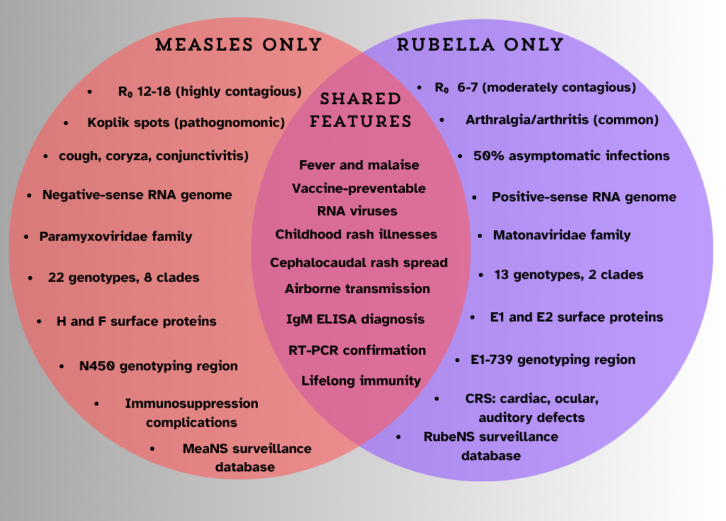
Measles and rubella are highly contagious viral infections with significant public health implications, particularly in low- and middle-income countries. Despite the availability of effective vaccines, these diseases continue to cause periodic outbreaks, contributing to substantial global morbidity, mortality, and economic burden. Immunization programs have drastically abridged disease incidence; however, gaps in vaccination coverage and surveillance systems deter complete elimination. The economic impact of outbreaks includes direct healthcare costs and indirect societal losses, emphasizing the need for robust disease control strategies. Accurate and timely diagnosis is pivotal to measles and rubella elimination efforts. Current diagnostic approaches range from conventional RT-PCR (including multiplex and real-time formats), ELISA, and plaque reduction neutralization test (PRNT), to emerging methods such as isothermal amplification loop-mediated isothermal amplification, recombinase polymerase amplification), CRISPR-Cas systems, next-generation sequencing (NGS), microfluidics, and lateral flow assays. Despite their sensitivity, many of these methods require complex infrastructure and skilled personnel, limiting their utility in field settings. To bridge diagnostic gaps, there is an urgent need for rapid, affordable, and field-deployable nucleic acid-based diagnostics that are simple to use with minimal training. Innovations like CRISPR-Cas and microfluidic platforms hold promise for decentralized testing and real-time surveillance, potentially transforming global measles and rubella elimination programs for the future.