Lebo Emmaculate, Vynnycky Emilia, Alexander James P, Ferrari Matthew J, Winter Amy K, Frey Kurt, Papadopoulos Timoleon, Grant Gavin B, O'Connor Patrick, Reef Susan E, Crowcroft Natasha S, Zimmerman Laura A
MMWR Morb Mortal Wkly Rep. 2025 May 22;74(18):305-311. doi: 10.15585/mmwr.mm7418a3.
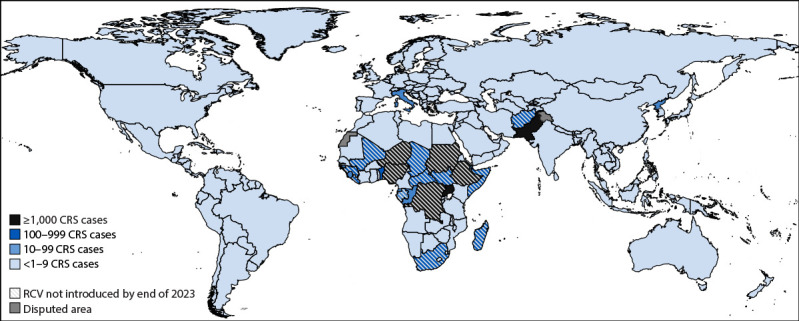
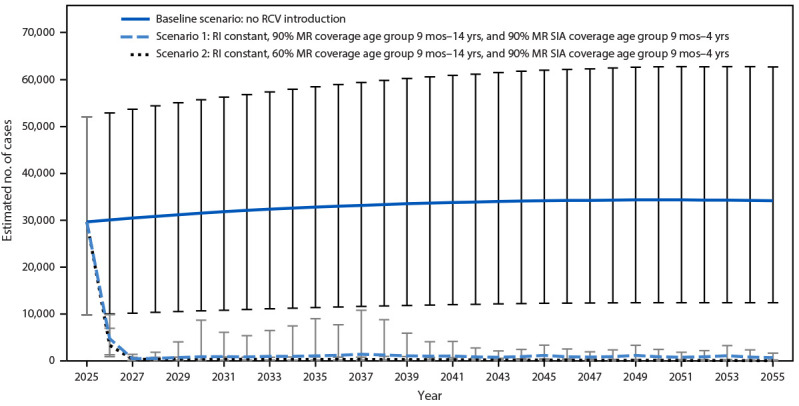
Rubella is a leading cause of vaccine-preventable birth defects. Rubella virus infection during early pregnancy can result in miscarriage, fetal death, stillbirth, or a constellation of birth defects known as congenital rubella syndrome (CRS). This report describes current and future estimated CRS incidence in countries that have not yet introduced rubella-containing vaccine (RCV) into their national childhood immunization schedules and the estimated effect of implementing a recent recommendation to introduce RCV into these programs even if population coverage with measles-containing vaccine is <80%. During 2000-2022, the number of countries that introduced RCV increased from 99 (52%) of 191 in 2000 to 175 (90%) of 194 in 2022. By the end of 2023, 19 lower- and middle-income countries had not yet introduced RCV. In 2019, an estimated 24,000 CRS cases occurred in these countries, representing 75% of the estimated 32,000 cases worldwide. In a modeling study estimating the effect of RCV introduction in these countries during 2025-2055, an estimated 1.03 million CRS cases are projected to occur without RCV. In contrast, fewer than 60,000 cases are estimated if RCV is introduced with catch-up and follow-up supplementary immunization activities, averting more than an estimated 986,000 CRS cases over 30 years. Based in part on these estimates, in September 2024, the World Health Organization Strategic Advisory Group of Experts on Immunization recommended removing the ≥80% coverage threshold and instituting universal RCV introduction in these countries. RCV introduction in these 19 countries during 2025-2030 could rapidly accelerate progress toward rubella and CRS elimination worldwide.
风疹是疫苗可预防的出生缺陷的主要原因。孕期早期感染风疹病毒可导致流产、胎儿死亡、死产或一系列被称为先天性风疹综合征(CRS)的出生缺陷。本报告描述了尚未将含风疹疫苗(RCV)纳入其国家儿童免疫规划的国家当前和未来估计的CRS发病率,以及实施一项近期建议(即即便含麻疹疫苗的人群覆盖率低于80%,也要将RCV纳入这些规划)的估计效果。在2000 - 2022年期间,引入RCV的国家数量从2000年191个国家中的99个(52%)增加到2022年194个国家中的175个(90%)。截至2023年底,有19个低收入和中等收入国家尚未引入RCV。2019年,这些国家估计发生了24000例CRS病例,占全球估计32000例病例的75%。在一项模拟研究中,估计了在2025 - 2055年期间在这些国家引入RCV的效果,预计如果不引入RCV,将发生约103万例CRS病例。相比之下,如果通过开展补种和后续补充免疫活动引入RCV,估计病例数将少于60000例,在30年内可避免估计超过98.6万例CRS病例。部分基于这些估计,2024年9月,世界卫生组织免疫战略咨询专家组建议取消≥80%的覆盖率阈值,并在这些国家推行普遍引入RCV。在2025 - 2030年期间在这19个国家引入RCV可迅速加快全球消除风疹和CRS的进程。