Liu Ru-Yin, Yin Kang-Fu, He Sheng-Yi, Su Wei-Ming, Duan Qing-Qing, Wen Xiang-Jin, Chen Ting, Shen Cong, Li Ju-Rong, Cao Bei, Chen Yong-Ping
Department of Neurology, West China Hospital, Sichuan University, Chengdu, 610041, Sichuan, China.
Department of Geriatrics, Dazhou Central Hospital, Dazhou, 635000, Sichuan, China.
Transl Psychiatry. 2025 Oct 10;15(1):388. doi: 10.1038/s41398-025-03639-2.
Viral infections have been implicated in the pathogenesis of neurodegenerative diseases (NDs); however, evidence linking specific viruses to Alzheimer's disease (AD), Parkinson's disease (PD), and amyotrophic lateral sclerosis (ALS) remains inconclusive. This study conducted a meta-analysis and systematic review to investigate these associations.
Thorough searches were conducted across Embase, PubMed, Cochrane Library, Web of Science and Scopus until May 18, 2025, to identify observational studies investigating the relationship between viral infections and the risk of NDs, including AD, PD, and ALS. Meta-analyses were executed using a random-effects model with Stata MP18.0.
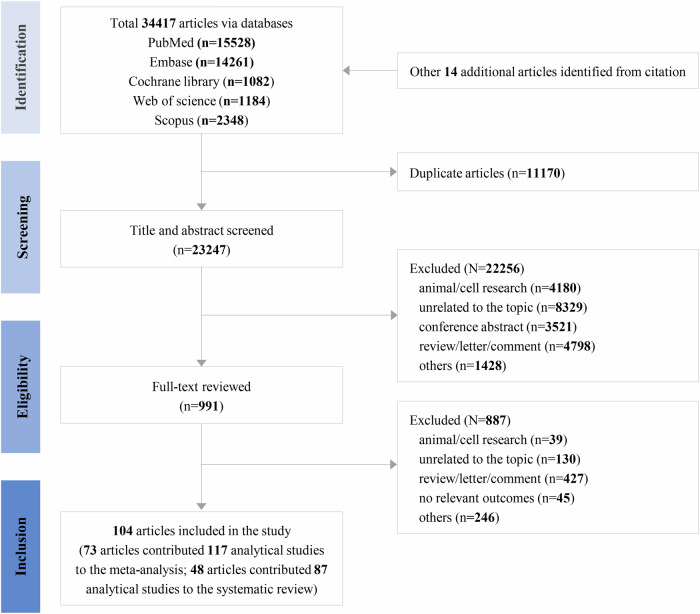
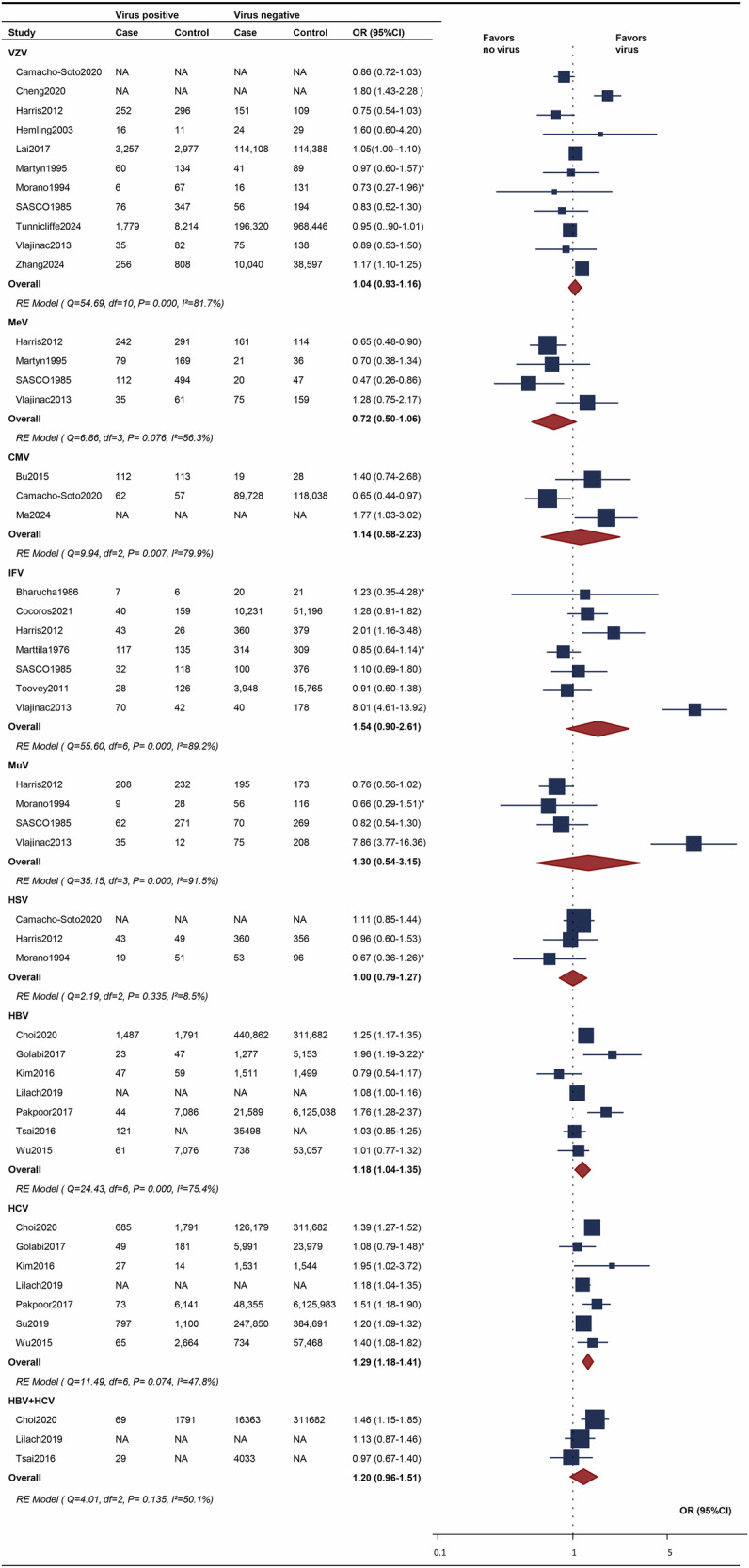
A total of 34,417 articles were identified, of which 73 met the eligibility criteria for inclusion in the meta-analysis, and 48 were included in the systematic review. The analysis demonstrated that infections with cytomegalovirus (CMV) (odds ratio [OR] = 1.41; 95% confidence interval [CI]: 1.03, 1.93), severe acute respiratory syndrome coronavirus 2 (SARS-CoV-2) (OR = 1.88; 95% CI: 1.53, 2.32), hepatitis C virus (HCV) (OR = 1.39; 95% CI: 1.14, 1.69), and human herpesvirus (HHV) (OR = 1.24; 95% CI: 1.02, 1.51) were associated with an increased risk of AD. Regarding PD, infections with hepatitis B virus (HBV) (OR = 1.18; 95% CI: 1.04, 1.35) and HCV (OR = 1.29; 95% CI: 1.18, 1.41) were identified as risk factors. Conversely, no significant correlation was found between any viral infection and the risk of ALS.
This meta-analysis supports the role of select viral infections in AD and PD pathogenesis. However, no association was found between viral infections and ALS, warranting further large, multicenter, and longitudinal studies to elucidate mechanisms and confirm causality.
病毒感染与神经退行性疾病(NDs)的发病机制有关;然而,将特定病毒与阿尔茨海默病(AD)、帕金森病(PD)和肌萎缩侧索硬化症(ALS)联系起来的证据仍不确凿。本研究进行了一项荟萃分析和系统评价,以调查这些关联。
在Embase、PubMed、Cochrane图书馆、科学网和Scopus上进行全面检索,直至2025年5月18日,以确定调查病毒感染与NDs(包括AD、PD和ALS)风险之间关系的观察性研究。使用Stata MP18.0的随机效应模型进行荟萃分析。
共识别出34417篇文章,其中73篇符合纳入荟萃分析的资格标准,48篇纳入系统评价。分析表明,巨细胞病毒(CMV)感染(比值比[OR]=1.41;95%置信区间[CI]:1.03,1.93)、严重急性呼吸综合征冠状病毒2(SARS-CoV-2)感染(OR=1.88;95%CI:1.53,2.32)、丙型肝炎病毒(HCV)感染(OR=1.39;95%CI:1.14,1.69)和人类疱疹病毒(HHV)感染(OR=1.24;95%CI:1.02,1.51)与AD风险增加相关。关于PD,乙型肝炎病毒(HBV)感染(OR=1.18;95%CI:1.04,1.35)和HCV感染(OR=1.29;95%CI:1.18,1.41)被确定为风险因素。相反,未发现任何病毒感染与ALS风险之间存在显著相关性。
这项荟萃分析支持特定病毒感染在AD和PD发病机制中的作用。然而,未发现病毒感染与ALS之间存在关联,需要进一步开展大规模、多中心和纵向研究,以阐明机制并确认因果关系。