Nornes H O, Das G D
Proc Natl Acad Sci U S A. 1972 Jul;69(7):1962-6. doi: 10.1073/pnas.69.7.1962.
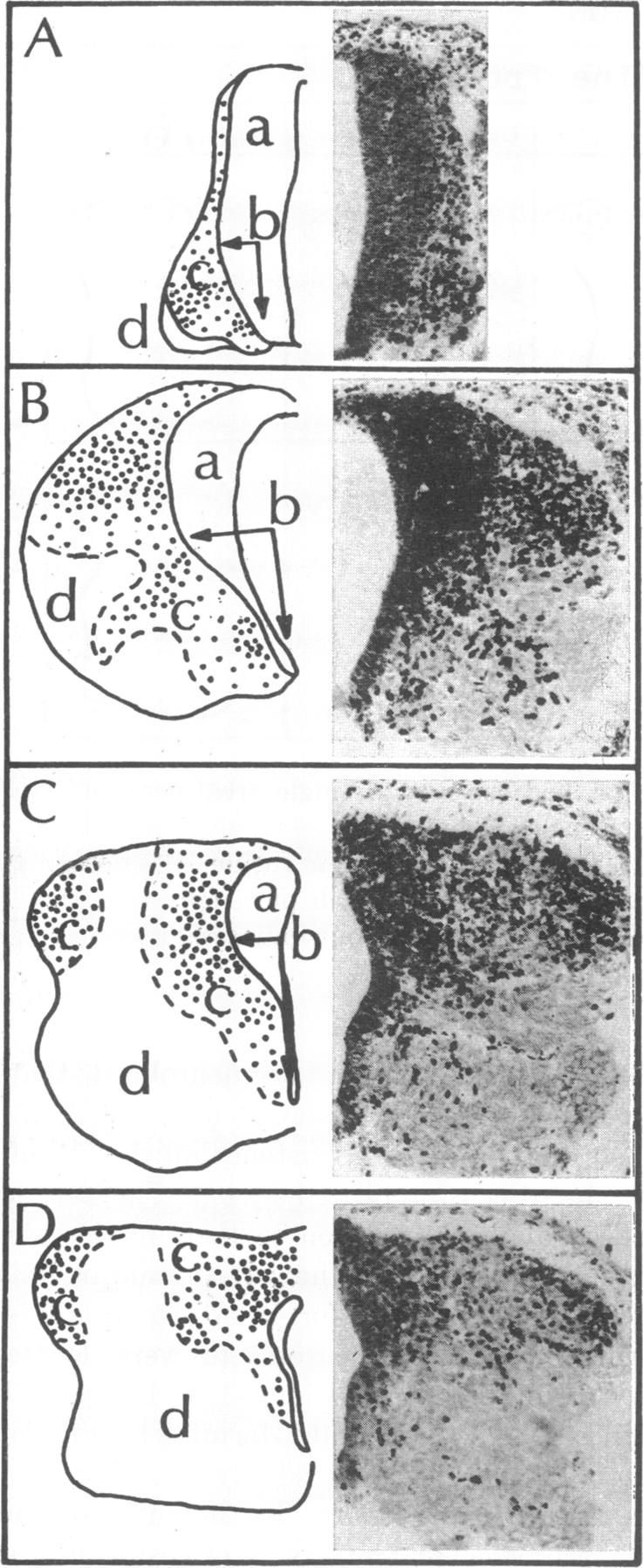
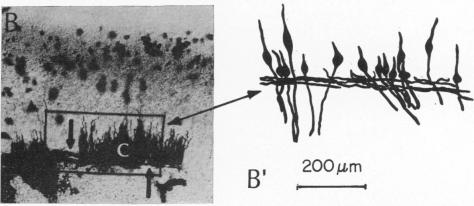
Neurogenesis was studied in rat spinal cord by correlation of the observations from [(3)H]thymidine autoradiography and Golgi techniques. The temporal pattern of the origin of neurons systematically lagged along the ventro-dorsal and rostro-caudal axes. The temporal pattern was correlated with the topographic pattern of the release and segregation of the newly formed neuroblasts from the neuroepithelium. These temporal and topographic patterns of neuroblast genesis imparted an order to the settling of the neuroblasts. Further, the emerging cytoarchitecture of the differentiating neuroblasts resulted in the formation of oriented interfaces along which the axons grew. The "pioneering" fibers grew along the interfaces formed by the regressed neuroepithelium and the assembled neuroblasts. As development progressed, the axons formed later "selectively fasciculated" along the "pioneering" fibers in a staggered pattern as a result of their differential times of origin. These temporal and topographic patterns occurred in a manner such that the preexisting structure served as an "organizing structure" or foundation upon which the axonal processes formed later in the developmental sequence were oriented and assembled.
通过将[(3)H]胸腺嘧啶核苷放射自显影术和高尔基技术的观察结果相关联,对大鼠脊髓中的神经发生进行了研究。神经元起源的时间模式沿腹背轴和头尾轴系统地滞后。这种时间模式与新形成的神经母细胞从神经上皮释放和分离的地形模式相关。神经母细胞发生的这些时间和地形模式为神经母细胞的定居赋予了一种秩序。此外,分化中的神经母细胞出现的细胞结构导致形成轴突生长所沿的定向界面。“先驱”纤维沿着退化的神经上皮和聚集的神经母细胞形成的界面生长。随着发育的进行,由于起源时间不同,后来形成的轴突以交错模式沿着“先驱”纤维“选择性地成束”。这些时间和地形模式以这样一种方式发生,即先前存在的结构充当“组织结构”或基础,发育序列中稍后形成的轴突过程在其上定向和组装。