Whyte W, Shaw B H, Freeman M A
J Hyg (Lond). 1974 Aug;73(1):61-74. doi: 10.1017/s0022172400023858.
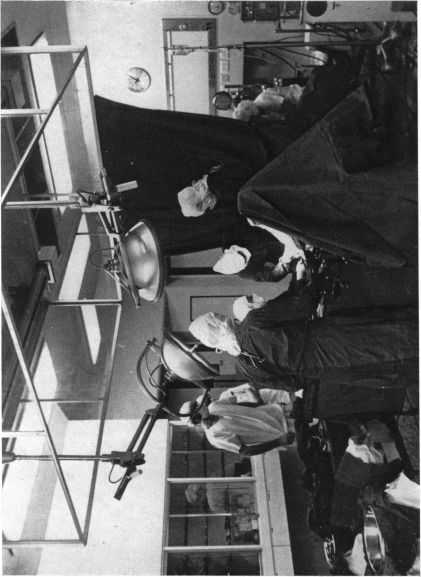
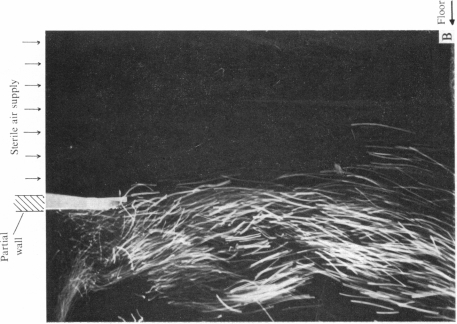
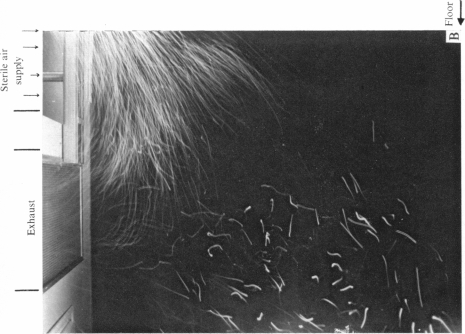
This paper contains an assessment of the physical performance of a permanently installed down-flow laminar-flow operating room at the London Hospital. This system employs partial walls extending 0.76 m (2.5 ft.) from the ceiling, from which the air is allowed to issue freely downwards at an initial velocity of about 0.4 m./sec. (80 ft./min.).The usefulness of the partial wall, as compared with a free issuing system, was demonstrated and a comparison made with a fully walled system. It was shown that a fully walled system would be more efficient than a partial-walled system as there was a loss in air velocity of about 20-25% with the partial wall due to the nonconstrained flow of air. This loss would be reflected in an increase in airborne bacterial count and would mean that an increase of 20-25% in the air volume would be required to obtain the same conditions as with the full-walled system. Entrainment of contaminated air was demonstrated but it was concluded that this would be of little consequence in the centre of the clean area, i.e. at the wound site. Sterile instruments, etc., however, on the outside of the clean area, would be more liable to airborne contamination.Bacterial and dust airborne counts taken during total hip operations gave a very low average figure (0.3 bacteria/ft.(3) or 10.5/m.(3)) from which we conclude that the system was about 30 times cleaner in terms of airborne bacteria than a well ventilated conventional operating-room. We concluded that although the partial-walled system was slightly less efficacious than a normal full-walled system, the freedom of movement and of communication for the operating team could in some circumstances outweigh this disadvantage.Sound levels were such that normal conversation was possible with little or no awareness of background noise.
本文对伦敦医院一个永久安装的下流式层流手术室的物理性能进行了评估。该系统采用从天花板向下延伸0.76米(2.5英尺)的部分隔墙,空气以约0.4米/秒(80英尺/分钟)的初始速度从隔墙自由向下流出。与自由送风系统相比,证明了部分隔墙的实用性,并与全隔墙系统进行了比较。结果表明,全隔墙系统比部分隔墙系统更高效,因为部分隔墙由于空气的无约束流动导致风速损失约20%-25%。这种损失将反映在空气中细菌数量的增加上,这意味着需要增加20%-25%的空气量才能获得与全隔墙系统相同的条件。证明了污染空气的夹带,但得出的结论是,在清洁区域中心,即伤口部位,这不会产生太大影响。然而,在清洁区域外的无菌器械等更容易受到空气传播污染。全髋关节置换手术期间进行的空气细菌和灰尘计数得出的平均数字非常低(0.3个细菌/立方英尺或10.5个/立方米),由此我们得出结论,就空气传播细菌而言,该系统比通风良好的传统手术室清洁约30倍。我们得出结论,虽然部分隔墙系统的效率略低于正常的全隔墙系统,但在某些情况下,手术团队的行动和交流自由可能会超过这一缺点。声音水平使得正常交谈成为可能,几乎或完全没有背景噪音的意识。