Coakham H M, Duchen L W, Scaravilli F
J Neurol Neurosurg Psychiatry. 1979 Apr;42(4):289-97. doi: 10.1136/jnnp.42.4.289.
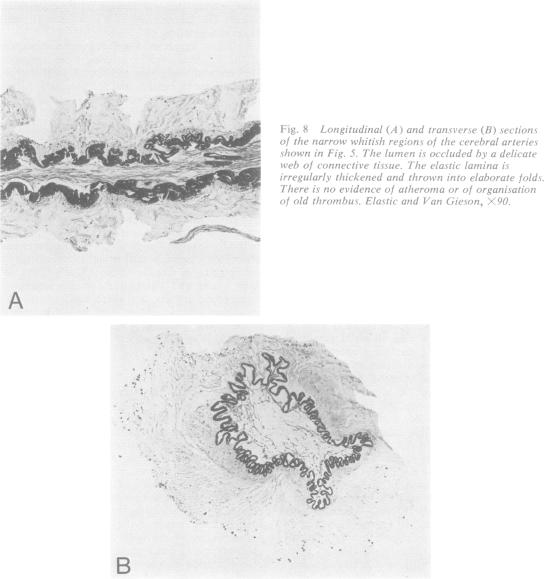
A British born white man, age 51 years, presented with cerebrovascular insuffciency, and was found radiologically to have moya-moya disease. He also suffered from a let onset type of progressive myopathy. Five months after the first signs of cerebrovascular disease he died of massive cerebellar infarction. At necropsy the brain showed multiple old and recent infarctions. The anterior cerebral, middle cerebral, and posterior communicating arteries showed segments of narrowing and occlusion by delicate connective tissue, with marked thickening and folding of the elastic lamina. Many dilated thin-walled vessels without a muscle layer and with a poorly formed elastic lamina were present in the subarachnoid space, these probably being newly formed collateral vessels. The cause of the occlusive lesions affecting the cerebral arteries is not known but the morphological appearances do not fall within any known aetiology. It seems that moya-moya disease could be regarded as a distinct entity.
一名51岁的英国白人男性,因脑血管供血不足就诊,经影像学检查发现患有烟雾病。他还患有左起病型进行性肌病。在出现脑血管疾病的最初症状五个月后,他死于大面积小脑梗死。尸检时,大脑显示有多处新旧梗死灶。大脑前动脉、大脑中动脉和后交通动脉显示出被纤细结缔组织狭窄和闭塞的节段,弹性膜明显增厚和折叠。蛛网膜下腔存在许多无肌层且弹性膜形成不良的扩张薄壁血管,这些可能是新形成的侧支血管。影响脑动脉的闭塞性病变原因尚不清楚,但形态学表现不属于任何已知病因。似乎烟雾病可被视为一种独特的疾病实体。