Parks W P, Melnick J L, Rongey R, Mayor H D
J Virol. 1967 Feb;1(1):171-80. doi: 10.1128/JVI.1.1.171-180.1967.
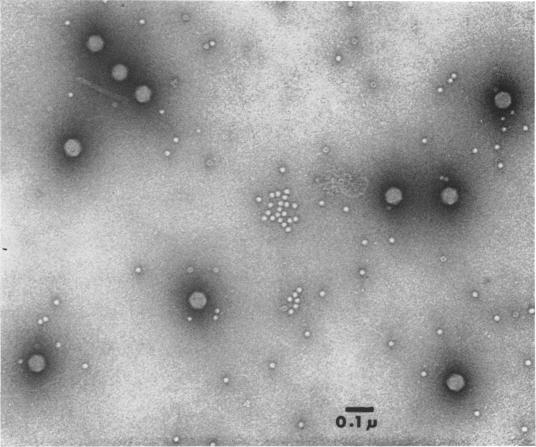
Electron microscopic particle counting of the defective adeno-satellite virus (ASV), by use of pseudoreplication and negative staining with phosphotungstic acid, was shown to be a reproducible quantitative assay procedure. Particles of satellite type 4 that were counted in fluids from infected cultures had the same morphology as particles that banded at a buoyant density of 1.43 g/cc in cesium chloride. Other satellite virus serotypes examined in the same manner had a buoyant density of 1.37 to 1.38 g/cc. A comparison of satellite titers obtained by complement fixation and by particle counting demonstrated that an increase in satellite particles resulted in a corresponding increase in CF titers; however, electron microscopy was at least 10 times more sensitive than complement fixation for detecting satellite virus. Growth cycle studies of satellite virus in cells co-infected with adenovirus, as assayed by particle counting, indicated that the kinetics of satellite virus production closely followed the kinetics of its helper adenovirus production, with an eclipse period of 12 to 16 hr. The eclipse period of the satellite remained the same when cultures were preinfected with satellite 24 hr prior to adenovirus inoculation. However, when cultures were infected with adenovirus 12 hr before satellite virus, the eclipse period of the satellite was shortened to between 4 and 6 hr. Thus, satellite virus replication seems dependent upon a relatively late event in the adenovirus replication cycle. When cells were co-infected with adenovirus and its defective satellite, the yield of adenovirus was markedly reduced from that obtained in cells singly infected with adenovirus.
利用伪复制和磷钨酸负染法对缺陷腺卫星病毒(ASV)进行电子显微镜颗粒计数,结果表明这是一种可重复的定量检测方法。在感染培养物的液体中计数的4型卫星颗粒与在氯化铯中浮力密度为1.43 g/cc处条带化的颗粒具有相同的形态。以同样方式检测的其他卫星病毒血清型的浮力密度为1.37至1.38 g/cc。通过补体结合试验和颗粒计数获得的卫星滴度比较表明,卫星颗粒数量增加会导致补体结合试验滴度相应增加;然而,电子显微镜检测卫星病毒的灵敏度至少比补体结合试验高10倍。通过颗粒计数分析,对与腺病毒共同感染的细胞中卫星病毒的生长周期研究表明,卫星病毒产生的动力学密切跟随其辅助腺病毒产生的动力学,潜伏期为12至16小时。当培养物在接种腺病毒前24小时预先感染卫星时,卫星的潜伏期保持不变。然而,当培养物在感染卫星病毒前12小时感染腺病毒时,卫星的潜伏期缩短至4至6小时。因此,卫星病毒的复制似乎依赖于腺病毒复制周期中相对较晚的事件。当细胞与腺病毒及其缺陷卫星共同感染时,腺病毒的产量比单独感染腺病毒的细胞中获得的产量明显降低。