Lee T H, Mencia-Huerta J M, Shih C, Corey E J, Lewis R A, Austen K F
J Clin Invest. 1984 Dec;74(6):1922-33. doi: 10.1172/JCI111612.
Exogenous eicosapentaenoic acid (EPA) and docosahexaenoic acid (DCHA) have been compared with exogenous arachidonic acid for their capacity to modulate the oxidative metabolism of membrane-derived arachidonic acid by the 5-lipoxygenase pathway in ionophore-activated human neutrophils and for their suitability as parallel substrates in this pathway. The products from specific 14C- or 3H-labeled substrates were isolated by reverse phase high performance liquid chromatography (RP-HPLC) and were identified by elution of radiolabel at the retention times of the appropriate synthetic standards. Each product was also characterized by its ultraviolet (UV) absorption spectrum, and 7-hydroxy-DCHA was defined in addition by analysis of its mass spectrum. The metabolites, 5-hydroxyeicosatetraenoic acid, leukotriene B4 (LTB4), 6-trans-LTB4 diastereoisomers, 5-hydroxyeicosapentaenoic acid, 6-trans-leukotriene B5 diastereoisomers, leukotriene B5 (LTB5), and 7-hydroxy-DCHA were quantitated by integrated UV absorbance during resolution by RP-HPLC. LTB4 and LTB5 were also quantitated by radioimmunoassay of the eluate fractions, and leukotrienes C4 and C5 (LTC4 and LTC5, respectively) were quantitated by radioimmunoassay alone. None of the unlabeled exogenous fatty acids (5-40 micrograms/ml) altered the release of radioactivity from [14C]arachidonic acid-labeled, ionophore-activated neutrophils. The metabolism of 5 and 10 micrograms/ml of exogenous EPA by ionophore-activated, [14C]arachidonic acid-labeled neutrophils not only generated 5-hydroxyeicosapentaenoic acid, 6-trans-LTB5, LTB5, and LTC5, but also stimulated the formation of 5-hydroxyeicosatetraenoic acid, 6-trans-LTB4 diastereoisomers, and LTC4 from membrane-derived arachidonic acid. In contrast, LTB4 production was diminished throughout the EPA dose-response, beginning at 5 micrograms/ml EPA and reaching 50% suppression at 10 micrograms/ml and 84% suppression at 40 micrograms/ml. The selective decrease in extracellular LTB4 concentrations in the presence of EPA was not due to a change in the kinetic appearance of LTB4 or to an increase in conversion to its omega-oxidation metabolites. DCHA was metabolized to 7-hydroxy-DCHA, did not stimulate metabolism of membrane-derived arachidonic acid, did not appreciably inhibit LTB4 formation, and was not a substrate for leukotriene formation. Incremental doses of exogenous arachidonic acid resulted in increased production of 5-hydroxyeicosatetraenoic acid and 6-trans-LTB4 by ionophore-activated, [14C]arachidonic acid-labeled neutrophils without any change in LTB4 production. 5-hydroxyeicosapentaenoic acid and 7-hydroxy DCHA were inactive as chemotactic factors whereas 5-hydroxyeicosatetraenoic acid exhibited 2% of the potency of LBT4. Thus, exogenous DCHA does not appreciably interfere with the metabolism of membrane-derived arachidonic acid by ionophore-activated, [14C]arachidonic acid-labeled neutrophils and is converted only to a monohydroxy derivative. In contrast, exogenous EPA attenuates the generation of LTB4 and is converted to LTB5, which is a weak and partial agonist as compared with LTB4.
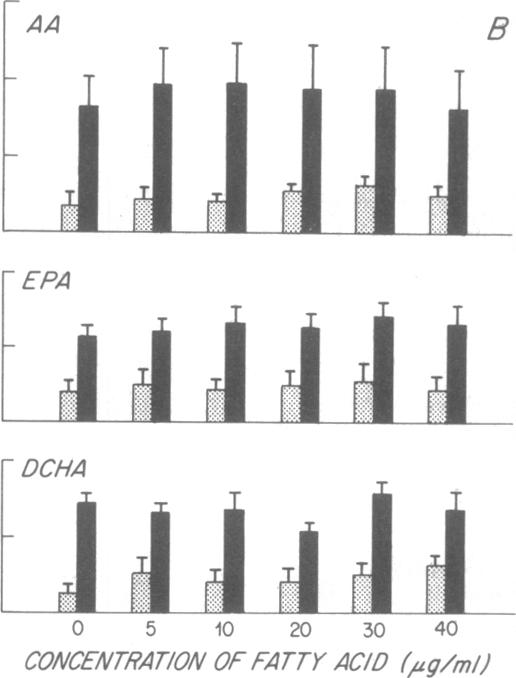
已将外源性二十碳五烯酸(EPA)和二十二碳六烯酸(DCHA)与外源性花生四烯酸进行比较,以研究它们在离子载体激活的人中性粒细胞中通过5-脂氧合酶途径调节膜源性花生四烯酸氧化代谢的能力,以及它们作为该途径平行底物的适用性。通过反相高效液相色谱(RP-HPLC)分离来自特定14C或3H标记底物的产物,并通过在适当合成标准品的保留时间处洗脱放射性标记来鉴定。每种产物还通过其紫外(UV)吸收光谱进行表征,并且7-羟基-DCHA还通过其质谱分析进行定义。在通过RP-HPLC分离过程中,通过积分紫外吸光度对代谢产物5-羟基二十碳四烯酸、白三烯B4(LTB4)、6-反式-LTB4非对映异构体、5-羟基二十碳五烯酸、6-反式-白三烯B5非对映异构体、白三烯B5(LTB5)和7-羟基-DCHA进行定量。LTB4和LTB5也通过对洗脱级分进行放射免疫测定来定量,而白三烯C4和C5(分别为LTC4和LTC5)仅通过放射免疫测定来定量。未标记的外源性脂肪酸(5-40微克/毫升)均未改变[14C]花生四烯酸标记的、离子载体激活的中性粒细胞中放射性的释放。离子载体激活的、[14C]花生四烯酸标记的中性粒细胞对5和10微克/毫升外源性EPA的代谢不仅产生了5-羟基二十碳五烯酸、6-反式-LTB5、LTB5和LTC5,还刺激了膜源性花生四烯酸生成5-羟基二十碳四烯酸、6-反式-LTB4非对映异构体和LTC4。相比之下,在整个EPA剂量反应过程中,LTB4的产生均减少,从5微克/毫升EPA开始,在10微克/毫升时抑制率达到50%,在40微克/毫升时抑制率达到84%。在存在EPA的情况下,细胞外LTB4浓度的选择性降低并非由于LTB4动力学表现的改变或向其ω-氧化代谢产物转化的增加。DCHA被代谢为7-羟基-DCHA,不刺激膜源性花生四烯酸的代谢,对LTB4的形成没有明显抑制作用,且不是白三烯形成的底物。外源性花生四烯酸剂量增加导致离子载体激活的、[14C]花生四烯酸标记的中性粒细胞中5-羟基二十碳四烯酸和6-反式-LTB4的产生增加,而LTB4的产生没有任何变化。5-羟基二十碳五烯酸和7-羟基-DCHA作为趋化因子无活性,而5-羟基二十碳四烯酸表现出LBT4效力的2%。因此,外源性DCHA不会明显干扰离子载体激活的、[14C]花生四烯酸标记的中性粒细胞对膜源性花生四烯酸的代谢,并且仅转化为单羟基衍生物。相比之下,外源性EPA会减弱LTB4的生成,并转化为LTB5,与LTB4相比,LTB5是一种弱的部分激动剂。
