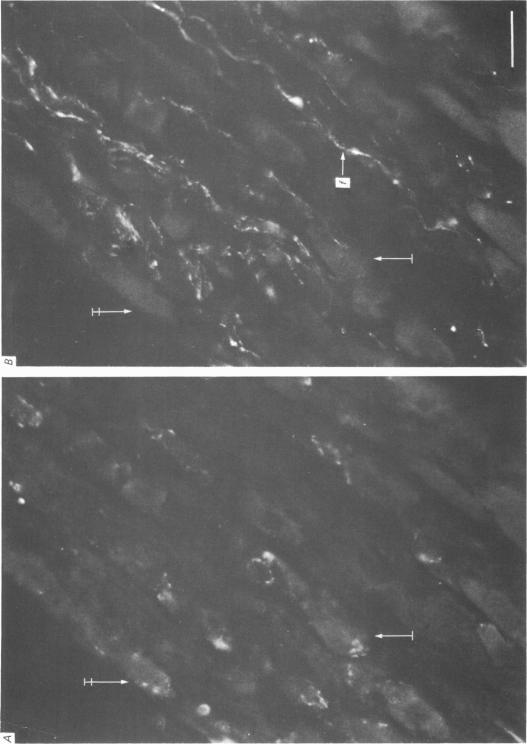
A slow synaptic potential recorded in neurones of sympathetic ganglia of bullfrog, the late slow e.p.s.p., is probably mediated by a peptide resembling luteinizing hormone-releasing hormone (LHRH), because (1). a LHRH-like peptide is contained in preganglionic nerve terminals and is released upon nerve stimulation, (2) application of LHRH to ganglion cells mimics the effects of the natural transmitter for the late slow e.p.s.p., and (3) the pharmacological properties of LHRH and the natural transmitter for the late slow e.p.s.p. are similar. 2. Neurones in frog sympathetic ganglia are also depolarized by substance P. The substance P receptors, unlike the LHRH receptors or the post-synaptic receptors for the late slow e.p.s.p., are not blocked by antagonist of LHRH. No cross-desensitization was found between the substance P-induced response and the LHRH-induced response or the late slow e.p.s.p. 3. Substance P-like immunoreactivity is contained in bundles of axons passing through the ganglia. This distribution is distinct from the distribution of LHRH-like immunoreactivity in preganglionic nerve terminals. Thus, substance P receptors and substance P-containing fibers are distinct from the post-synaptic receptors and preganglionic fibers responsible for the late slow e.p.s.p. 4. Physiological and anatomical evidence is presented which indicates that the peptidergic transmitter for the late slow e.p.s.p. can diffuse for many micrometres before acting on ganglion cells.