Leis J, Duyk G, Johnson S, Longiaru M, Skalka A
J Virol. 1983 Feb;45(2):727-39. doi: 10.1128/JVI.45.2.727-739.1983.
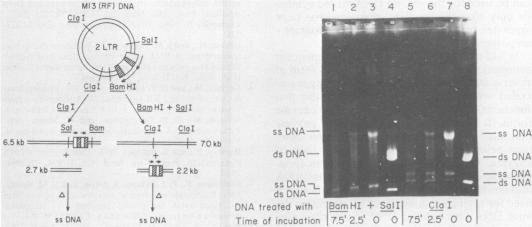
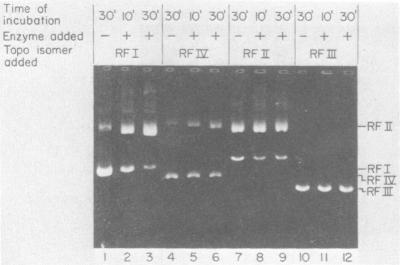
Preparations of the alphabeta and the betabeta forms of reverse transcriptase from the Prague C strain of Rous sarcoma virus grown in chicken embryo fibroblasts, the alphabeta and the betabeta forms of the enzyme from the B77 strain of Rous sarcoma virus grown in duck embryo fibroblasts, and the alphabeta form of reverse transcriptase from avian myeloblastosis virus have been analyzed. All these enzyme preparations contain a Mn(2+) -activated endonuclease activity. The betabeta form of enzyme, in addition, contains a Mg(2+) -dependent endonuclease. Such an activity is barely detectable in the alphabeta form of enzymes. The endonuclease associated with reverse transcriptase introduces single- and double-strand breaks containing 3' OH and 5' P termini into RF I DNA. The conversion of RF I DNA to RF III DNA is more readily catalyzed by the betabeta form of reverse transcriptase. In contrast to a recently published report by Hizi et al. (J. Virol 41:974-981, 1982), we have failed to detect the conversion of RF I DNA to covalently closed relaxed circles (RF IV DNA) by any of the alphabeta form of enzymes tested. RF IV DNA was not produced by the betabeta form of reverse transcriptase either. We conclude that topoisomerization is not an intrinsic activity of reverse transcriptase. Although the conversion of RF I DNA to RF II DNA was found to be rapid, the endonuclease associated with reverse transcriptase acted slowly on RF II, RF III, and RF IV DNAs. Circular and linear single-stranded DNAs were also susceptible to cleavage by the endonuclease at a rate comparable to nicking of RF I DNA. This pattern of activity suggests that the endonuclease cleaves the RF I DNA in the single-stranded regions of the DNA induced by its supercoiling. The preference of the alphabeta and the betabeta forms of the endonuclease for viral DNA was tested with Rous-associated virus type 2 and Rous sarcoma virus transformation-defective Schmidt-Ruppin B strain DNA molecularly cloned in plasmid pBR322 and M13 DNA vectors, respectively. The rate of nicking of RF I DNA containing viral DNA or partial sequences of viral DNA with one or two tandem long terminal repeats was the same as when these sequences were not present in the host vectors. A similar lack of preference was observed with single-stranded M13 DNAs.
对从在鸡胚成纤维细胞中生长的劳氏肉瘤病毒布拉格C株制备的αβ和ββ形式的逆转录酶、从在鸭胚成纤维细胞中生长的劳氏肉瘤病毒B77株制备的该酶的αβ和ββ形式,以及禽成髓细胞瘤病毒的αβ形式的逆转录酶进行了分析。所有这些酶制剂都含有一种Mn(2+)激活的核酸内切酶活性。此外,ββ形式的酶还含有一种Mg(2+)依赖性核酸内切酶。这种活性在αβ形式的酶中几乎检测不到。与逆转录酶相关的核酸内切酶会在RF I DNA中引入含有3' OH和5' P末端的单链和双链断裂。RF I DNA向RF III DNA的转化更容易由ββ形式的逆转录酶催化。与Hizi等人最近发表的报告(《病毒学杂志》41:974 - 981,1982年)相反,我们未能检测到所测试的任何αβ形式的酶将RF I DNA转化为共价闭合松弛环(RF IV DNA)。ββ形式的逆转录酶也不会产生RF IV DNA。我们得出结论,拓扑异构化不是逆转录酶的固有活性。尽管发现RF I DNA向RF II DNA的转化很快,但与逆转录酶相关的核酸内切酶对RF II、RF III和RF IV DNA的作用较慢。环状和线性单链DNA也容易被该核酸内切酶切割,其速率与RF I DNA的切口速率相当。这种活性模式表明,核酸内切酶在由其超螺旋诱导的DNA单链区域切割RF I DNA。分别用分子克隆在质粒pBR322和M13 DNA载体中的2型劳氏相关病毒和劳氏肉瘤病毒转化缺陷型施密特 - 鲁平B株DNA测试了αβ和ββ形式的核酸内切酶对病毒DNA的偏好性。含有病毒DNA或带有一个或两个串联长末端重复序列的病毒DNA部分序列的RF I DNA的切口速率与这些序列不存在于宿主载体时相同。在单链M13 DNA中也观察到类似的无偏好性。