Balkwill D L, Maratea D, Blakemore R P
J Bacteriol. 1980 Mar;141(3):1399-408. doi: 10.1128/jb.141.3.1399-1408.1980.
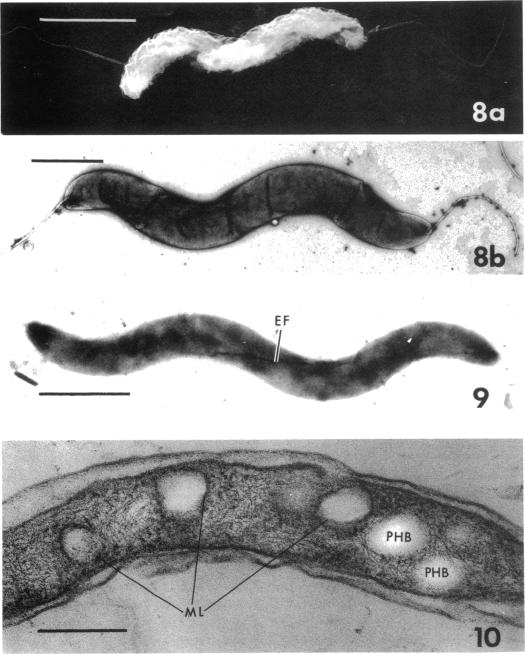
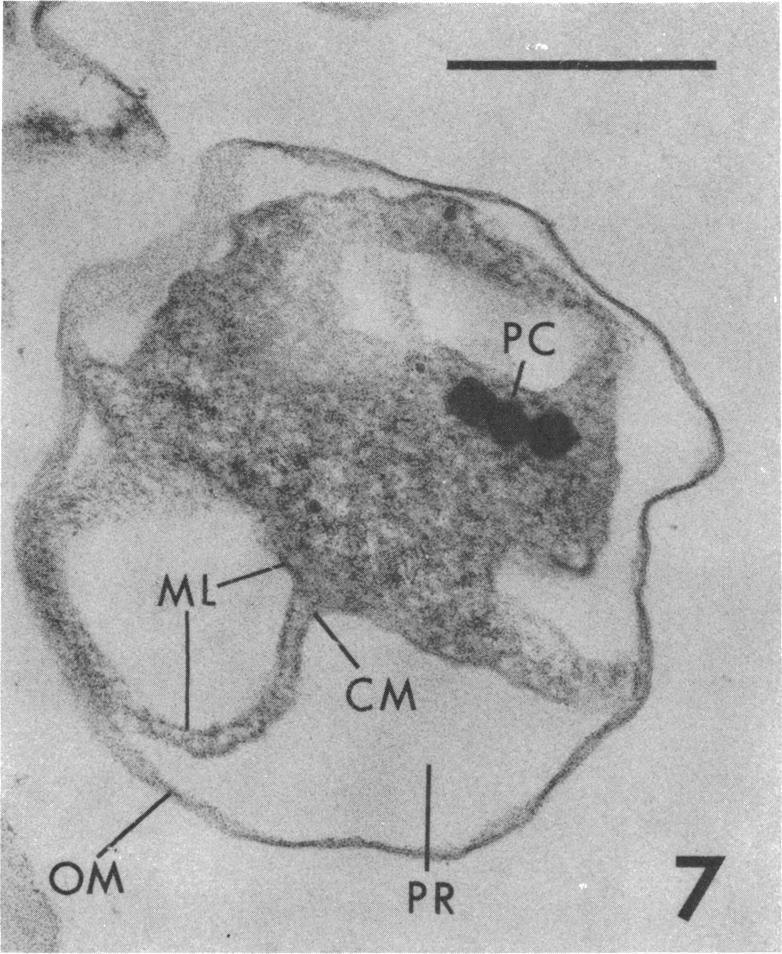
The ultrastructure of a magnetotactic bacterium (strain MS-1) was examined by transmission, scanning, and scanning-transmission electron microscopy. The organism resembled other spirilla in general cell morphology, although some differences were detected at the ultrastructural level. Electron-dense particles within magnetotactic cells were shown by energy-dispersive X-ray analysis to be localizations containing iron. A non-magnetotactic variant of strain MS-1 lacked these novel bacterial inclusion bodies. A chain of these particles traversed each magnetotactic cell in a specific arrangement that was consistent from cell to cell, seemingly associated with the inner surface of the cytoplasmic membrane. Each particle was surrounded by an electron-dense layer separated from the particle surface by an electron-transparent region. The term "magnetosome" is proposed for the electron-dense particles with their enveloping layer(s) as found in this and other magnetotactic bacteria.
利用透射电子显微镜、扫描电子显微镜和扫描透射电子显微镜对趋磁细菌(菌株MS-1)的超微结构进行了研究。该生物体在一般细胞形态上与其他螺旋菌相似,尽管在超微结构水平上检测到了一些差异。通过能量色散X射线分析表明,趋磁细胞内的电子致密颗粒是含铁的区域。菌株MS-1的一个非趋磁变体缺乏这些新型细菌包涵体。这些颗粒链以特定的排列方式穿过每个趋磁细胞,这种排列在细胞之间是一致的,似乎与细胞质膜的内表面相关。每个颗粒被一个电子致密层包围,该电子致密层通过一个电子透明区域与颗粒表面隔开。本文建议将这种在该趋磁细菌及其他趋磁细菌中发现的带有包膜层的电子致密颗粒称为“磁小体”。