Gray O, Chang S
J Bacteriol. 1981 Jan;145(1):422-8. doi: 10.1128/jb.145.1.422-428.1981.
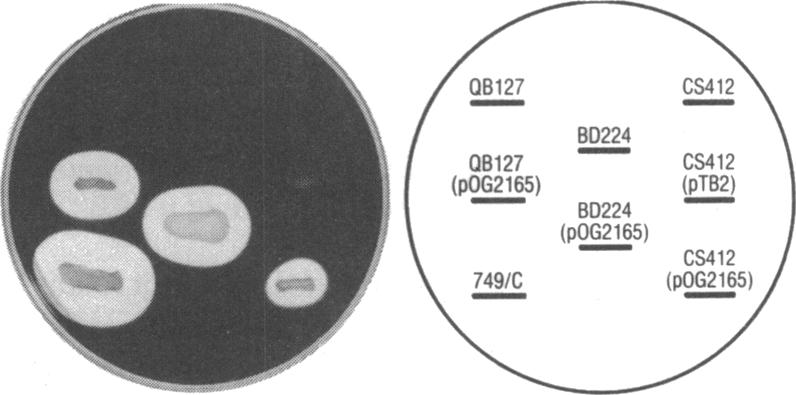
The chromosomal beta-lactamase (penicillinase, penP) gene from Bacillus licheniformis 749/C has been cloned in Escherichia coli. The locations of the target sites for various restriction enzymes on the 4.2-kilobase EcoRI fragment were determined. By matching the restriction mapping data with the potential nucleotide sequences of the penP gene deduced from known protein sequence, we established the exact position of the penP gene on the fragment. A bifunctional plasmid vector carrying the penP gene, plasmid pOG2165, was constructed which directs the synthesis of the heterologous beta-lactamase in both E. coli and Bacillus subtilis hosts. The protein synthesized in E. coli and B. subtilis is similar in size to the processed beta-lactamase made in B. licheniformis. Furthermore, the beta-lactamase made in B. subtilis is efficiently secreted by the host into the culture medium, indicating that B. subtilis is capable of carrying out the post-translational proteolytic cleavage(s) to convert the membrane-bound precursor enzyme into the soluble extracellular form.
地衣芽孢杆菌749/C的染色体β-内酰胺酶(青霉素酶,penP)基因已在大肠杆菌中克隆。确定了4.2千碱基EcoRI片段上各种限制酶的靶位点位置。通过将限制酶切图谱数据与从已知蛋白质序列推导的penP基因潜在核苷酸序列进行匹配,我们确定了penP基因在该片段上的确切位置。构建了携带penP基因的双功能质粒载体,即质粒pOG2165,它能在大肠杆菌和枯草芽孢杆菌宿主中指导异源β-内酰胺酶的合成。在大肠杆菌和枯草芽孢杆菌中合成的蛋白质大小与在地衣芽孢杆菌中加工后的β-内酰胺酶相似。此外,枯草芽孢杆菌中产生的β-内酰胺酶能被宿主有效地分泌到培养基中,这表明枯草芽孢杆菌能够进行翻译后蛋白水解切割,将膜结合的前体酶转化为可溶性细胞外形式。