Llopis R, Stark G R
J Virol. 1982 Dec;44(3):864-70. doi: 10.1128/JVI.44.3.864-870.1982.
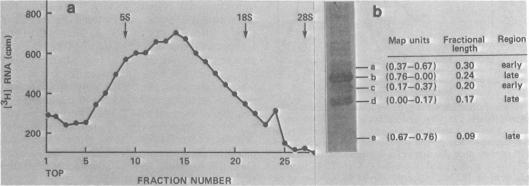
Simian virus 40 (SV40) transcription complexes were labeled in cells with 3-min pulses of [(3)H]uridine 48 h after infection and were extracted from nuclei in isotonic buffer or in a buffer containing Sarkosyl. In sucrose gradients, the labeled complexes sedimented faster than both free RNA and most SV40 nucleoproteins. Most of the pulse-labeled nascent RNA hybridized to the entire late region of SV40, remained bound to viral DNA in Cs(2)SO(4) gradients, and ranged in size from a few nucleotides to about 5,000 nucleotides, with a peak at about 700. In contrast, the SV40-associated RNA polymerase activity in the same preparations sedimented near the major peak of SV40 nucleoproteins and was clearly separated from the transcription complexes bearing pulse-labeled nascent RNA. The two kinds of transcription complexes were released from isolated nuclei at different rates. Complexes bearing pulse-labeled RNA were released immediately when the nuclei were agitated in a Dounce homogenizer in isotonic buffer, whereas most of the complexes bearing RNA polymerase active in vitro were released more slowly, during subsequent incubation of the nuclei at 0 degrees C. Since the complexes bearing pulse-labeled nascent RNA were virtually inactive in vitro, the blocked complexes described by Laub et al. (Proc. Natl. Acad. Sci. U.S.A. 77:3297-3301, 1980) probably account for almost all the SV40-associated RNA polymerase activity studied previously by many investigators. New procedures must be developed to preserve the activity of the pulse-labeled complexes if the many advantages of the SV40 system for studying transcription by nucleoprotein complexes in vitro are to be realized fully.
在感染48小时后,用[³H]尿苷对细胞中的猴病毒40(SV40)转录复合物进行3分钟的脉冲标记,然后在等渗缓冲液或含有十二烷基肌氨酸钠的缓冲液中从细胞核中提取。在蔗糖梯度中,标记的复合物比游离RNA和大多数SV40核蛋白沉降得更快。大多数脉冲标记的新生RNA与SV40的整个晚期区域杂交,在Cs₂SO₄梯度中仍与病毒DNA结合,大小从几个核苷酸到约5000个核苷酸不等,峰值约为700。相比之下,同一制剂中与SV40相关的RNA聚合酶活性在SV40核蛋白的主要峰值附近沉降,并且与带有脉冲标记新生RNA的转录复合物明显分开。两种转录复合物从分离的细胞核中以不同的速率释放。当细胞核在等渗缓冲液中用杜恩斯匀浆器搅拌时,带有脉冲标记RNA的复合物会立即释放,而大多数在体外具有活性的带有RNA聚合酶的复合物在随后将细胞核在0℃孵育期间释放得更慢。由于带有脉冲标记新生RNA的复合物在体外几乎没有活性,因此劳布等人(《美国国家科学院院刊》77:3297 - 3301, 1980)描述的受阻复合物可能几乎占了许多研究人员先前研究的所有与SV40相关的RNA聚合酶活性。如果要充分实现SV40系统在体外研究核蛋白复合物转录的诸多优势,就必须开发新的方法来保留脉冲标记复合物的活性。