Uemura H, Imai M, Ohtsuka E, Ikehara M, Söll D
Nucleic Acids Res. 1982 Oct 25;10(20):6531-9. doi: 10.1093/nar/10.20.6531.
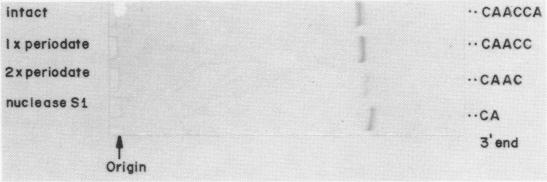
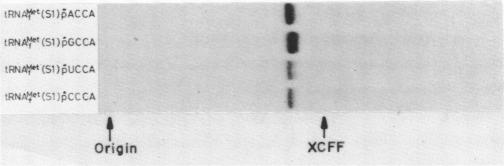
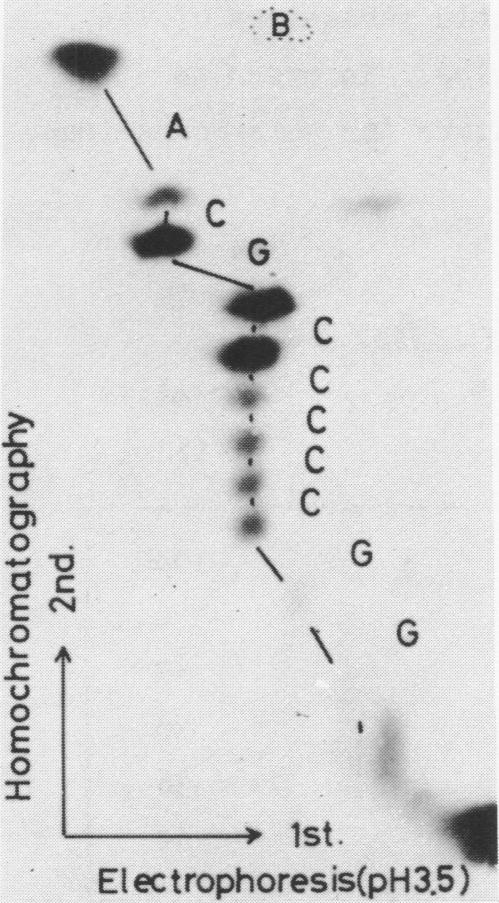
The effect of base changes at the fourth position from the 3'-terminus of Escherichia coli initiator tRNAMet has been studied to test the 'discriminator hypothesis' which proposed that the nucleotide in this position might have a role in the specificity of the aminoacylation reaction. E. coli initiator tRNA lacking the 3'-terminal tetranucleotide was prepared by partial digestion with S1 nuclease. To construct tRNA analogs with different bases in the fourth position this truncated tRNA was joined by RNA ligase to each of four chemically synthesized 2',3'-ethoxy-methylidene tetranucleotides pACCA(em), pCCCA(em), pGCCA(em), and pUCCA(em). In vitro aminoacylation studies showed that all four molecules accepted methionine, albeit with different Vmax values.
研究了大肠杆菌起始tRNAMet 3'末端第四个位置碱基变化的影响,以检验“鉴别假说”,该假说认为此位置的核苷酸可能在氨酰化反应特异性中起作用。用S1核酸酶部分消化制备了缺少3'末端四核苷酸的大肠杆菌起始tRNA。为构建在第四个位置具有不同碱基的tRNA类似物,将这种截短的tRNA通过RNA连接酶与四种化学合成的2',3'-乙氧基亚甲基四核苷酸pACCA(em)、pCCCA(em)、pGCCA(em)和pUCCA(em)中的每一种连接。体外氨酰化研究表明,所有四个分子都能接受甲硫氨酸,尽管Vmax值不同。