Batterson W, Furlong D, Roizman B
J Virol. 1983 Jan;45(1):397-407. doi: 10.1128/JVI.45.1.397-407.1983.
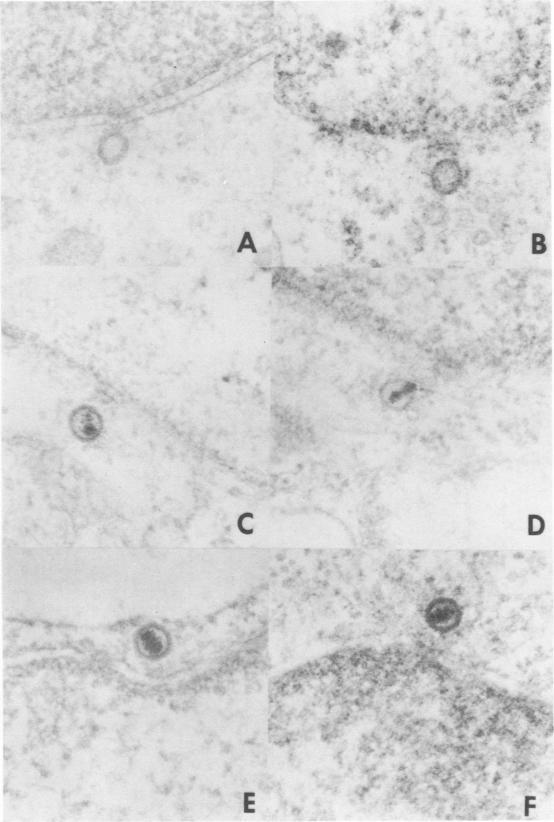
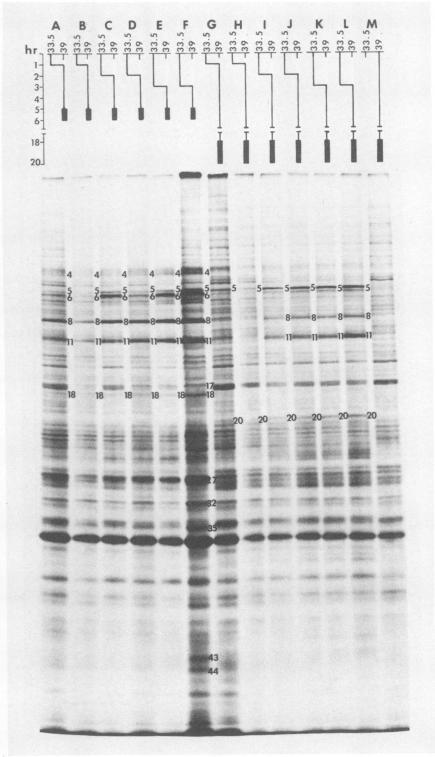
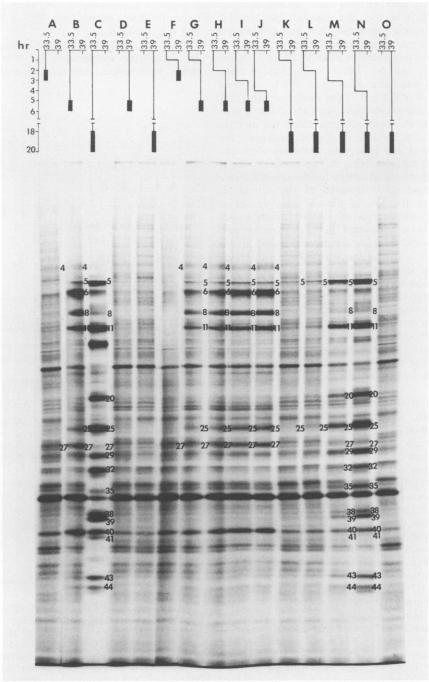
Previous studies have shown that cells infected with the herpes simplex virus 1(HFEM) mutant tsB7 and maintained at the nonpermissive temperature fail to accumulate viral polypeptides. Analyses of intertypic recombinants generated by marker rescue of tsB7 with herpes simplex virus 2 DNA fragments localized the mutation between 0.46 and 0.52 map units on the viral genome (Knipe et al., J. Virol. 38:539-547, 1981). In this paper we report that the mutation in tsB7 affects several aspects of the reproductive cycle of the virus at the nonpermissive temperature. Thus, (i) viral capsids accumulate at the nuclear pores and do not release viral DNA for at least 6 h postinfection at 39 degrees C. The DNA was released within 30 min after a shift to the permissive temperature. (ii) Experiments involving shifts from the permissive to the nonpermissive temperature indicated that viral protein synthesis was not sustained in cells maintained at the permissive temperature for less than 4 h. (iii) Viral DNA synthesis was delayed at the permissive temperature for as long as 8 h. Once initiated, it continued at 39 degrees C. (iv) Marker rescue of tsB7 by transfection with herpes simplex virus 1(F) DNA fragments localized the mutation to between 0.501 and 0.503 map units on the viral genome. These results are consistent with the tsB7 lesion being in a gene coding for a virion component which affects release of viral DNA from capsids and onset of viral DNA synthesis.
先前的研究表明,感染单纯疱疹病毒1(HFEM)突变体tsB7并维持在非允许温度下的细胞无法积累病毒多肽。用单纯疱疹病毒2 DNA片段对tsB7进行标记拯救所产生的型间重组体分析将该突变定位在病毒基因组上0.46至0.52个图距单位之间(Knipe等人,《病毒学杂志》38:539 - 547,1981年)。在本文中,我们报告tsB7中的突变在非允许温度下影响病毒复制周期的几个方面。因此,(i)病毒衣壳在核孔处积累,在39℃感染后至少6小时内不释放病毒DNA。在转移到允许温度后30分钟内DNA被释放。(ii)涉及从允许温度转变为非允许温度的实验表明,在允许温度下维持少于4小时的细胞中病毒蛋白合成不能持续。(iii)病毒DNA合成在允许温度下延迟长达8小时。一旦启动,它在39℃继续进行。(iv)用单纯疱疹病毒1(F)DNA片段转染对tsB7进行标记拯救将该突变定位在病毒基因组上0.501至0.503个图距单位之间。这些结果与tsB7损伤位于编码病毒体成分的基因中一致,该成分影响病毒DNA从衣壳中的释放以及病毒DNA合成的起始。