Even J, Anderson S J, Hampe A, Galibert F, Lowy D, Khoury G, Sherr C J
J Virol. 1983 Mar;45(3):1004-16. doi: 10.1128/JVI.45.3.1004-1016.1983.
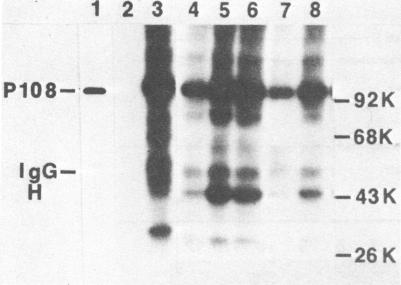
The sequences required for transformation by the Gardner-Arnstein (GA) strain of feline sarcoma virus (GA-FeSV) were defined by site-directed, in vitro mutagenesis of molecularly cloned proviral DNA. Portions of the Ga-FeSV provirus, subcloned in the plasmid pBR322, were mutagenized by deletion or frameshift at XhoI restriction sites flanking the nucleotide sequences presumed to encode the GA-FeSV transforming polyprotein (P108(gag-fes)). The biological activity of subgenomic and reconstructed full-genome-length molecules was assayed by transfection and focus induction in NIH 3T3 cells. Both mutant and wild-type molecules containing the intact P108(gag-fes) coding region induced foci of transformed cells at efficiencies between 10(4) and 10(5) focus-forming units per pmol of DNA; a deletion mutant lacking 3'-terminal v-fes sequences was completely nontransforming in parallel assays. Representative subcloned foci of transformed NIH 3T3 cells synthesized P108(gag-fes) with associated in vitro protein kinase activity. Focus-forming viruses could be rescued from transformed subclones induced by full-length proviral DNA, but not from cells transformed by subgenomic DNA lacking a 3' long terminal repeat (LTR). It was concluded that: (i) nucleotide sequences encoding P108(gag-fes) and its associated kinase activity are responsible for transformation, (ii) the GA-FeSV 3' env and LTR sequences are not required for focus induction, and (iii) the 3' LTR is necessary for rescue of infectious FeSV RNA. A chimeric DNA containing the 5' LTR and P108(gag-fes) coding region of GA-FeSV joined to the 3' LTR of Moloney murine sarcoma virus was both transforming and rescuable at high efficiency. Restriction analysis showed that passaged stocks of rescued transforming virus contained Moloney murine sarcoma virus U3 sequences at both proviral DNA termini, consistent with generally accepted models for LTR formation during reverse transcription. Wild-type GA-FeSV and the chimeric virus (here designated as GAHT), each rescued from NIH 3T3 cells with the same amphotropic murine leukemia virus, yielded approximately equal numbers of foci when titrated on CCL 64 mink cells. By contrast, on mouse NIH 3T3 cells, the focus-forming titer of GAHT was 1 to 2 log higher than that of FeSV. The foci induced on NIH 3T3 cells by GAHT appeared earlier and were reproducibly larger than those induced by GA-FeSV. Differences in transforming activity on NIH 3T3 cells were also found using colony formation in agar, showing that the more rapid appearance and larger size of foci formed in liquid media were not due to virus spread. These data suggest that transcriptional control signals within the viral LTR regulate the levels of the transforming gene product in a species-specific manner.
通过对分子克隆的前病毒DNA进行定点体外诱变,确定了加德纳 - 阿恩斯坦(GA)株猫肉瘤病毒(GA - FeSV)转化所需的序列。亚克隆到质粒pBR322中的部分Ga - FeSV前病毒,在推测编码GA - FeSV转化多蛋白(P108(gag - fes))的核苷酸序列两侧的XhoI限制性位点处,通过缺失或移码进行诱变。通过在NIH 3T3细胞中转染和灶形成诱导来测定亚基因组和重建的全基因组长度分子的生物学活性。含有完整P108(gag - fes)编码区的突变体和野生型分子,以每皮摩尔DNA 10⁴至10⁵个灶形成单位的效率诱导转化细胞灶;在平行试验中,一个缺少3'末端v - fes序列的缺失突变体完全没有转化能力。转化的NIH 3T3细胞的代表性亚克隆灶合成了具有相关体外蛋白激酶活性的P108(gag - fes)。灶形成病毒可以从全长前病毒DNA诱导的转化亚克隆中拯救出来,但不能从缺少3'长末端重复序列(LTR)的亚基因组DNA转化的细胞中拯救出来。得出以下结论:(i)编码P108(gag - fes)及其相关激酶活性的核苷酸序列负责转化,(ii)GA - FeSV 3' env和LTR序列对于灶形成诱导不是必需的,(iii)3' LTR对于感染性FeSV RNA的拯救是必需的。一个包含GA - FeSV的5' LTR和P108(gag - fes)编码区并与莫洛尼鼠肉瘤病毒的3' LTR连接的嵌合DNA既具有转化能力又能高效拯救。限制性分析表明,拯救的转化病毒的传代毒株在两个前病毒DNA末端都含有莫洛尼鼠肉瘤病毒U3序列,这与逆转录过程中LTR形成的普遍接受模型一致。用相同的双嗜性鼠白血病病毒从NIH 3T3细胞中拯救出的野生型GA - FeSV和嵌合病毒(这里称为GAHT),在CCL 64貂细胞上滴定时有大致相等数量的灶。相比之下,在小鼠NIH 3T3细胞上,GAHT的灶形成滴度比FeSV高1至2个对数。GAHT在NIH 3T3细胞上诱导的灶出现得更早,并且可重复地比GA - FeSV诱导的灶更大。在NIH 3T3细胞上使用琼脂中的集落形成也发现了转化活性的差异,表明在液体培养基中形成的灶出现更快和更大尺寸不是由于病毒传播。这些数据表明病毒LTR内的转录控制信号以物种特异性方式调节转化基因产物的水平。