
大肠杆菌丝状细胞中鞭毛的协调作用。
Coordination of flagella on filamentous cells of Escherichia coli.
作者信息
Ishihara A, Segall J E, Block S M, Berg H C
出版信息
J Bacteriol. 1983 Jul;155(1):228-37. doi: 10.1128/jb.155.1.228-237.1983.
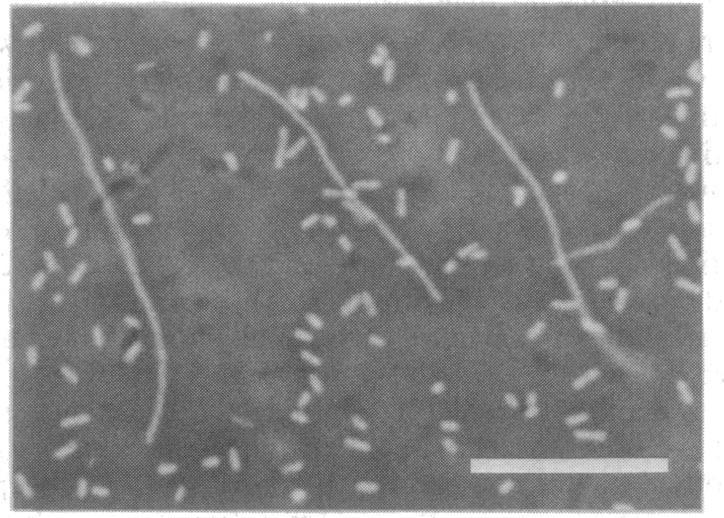
Video techniques were used to study the coordination of different flagella on single filamentous cells of Escherichia coli. Filamentous, nonseptate cells were produced by introducing a cell division mutation into a strain that was polyhook but otherwise wild type for chemotaxis. Markers for its flagellar motors (ordinary polyhook cells that had been fixed with glutaraldehyde) were attached with antihook antibodies. The markers were driven alternately clockwise and counterclockwise, at angular velocities comparable to those observed when wild-type cells are tethered to glass. The directions of rotation of different markers on the same cell were not correlated; reversals of the flagellar motors occurred asynchronously. The bias of the motors (the fraction of time spent spinning counterclockwise) changed with time. Variations in bias were correlated, provided that the motors were within a few micrometers of one another. Thus, although the directions of rotation of flagellar motors are not controlled by a common intracellular signal, their biases are. This signal appears to have a limited range.
运用视频技术研究了大肠杆菌单丝状细胞上不同鞭毛的协调性。通过将细胞分裂突变引入到一个多钩但在趋化性方面其他为野生型的菌株中,产生丝状、无隔膜细胞。用抗钩抗体连接其鞭毛马达的标记物(已用戊二醛固定的普通多钩细胞)。这些标记物以与野生型细胞附着在玻璃上时观察到的角速度交替顺时针和逆时针驱动。同一细胞上不同标记物的旋转方向不相关;鞭毛马达的反转异步发生。马达的偏向(逆时针旋转所花费时间的比例)随时间变化。只要马达彼此在几微米范围内,偏向的变化就是相关的。因此,尽管鞭毛马达的旋转方向不受共同的细胞内信号控制,但它们的偏向是受控制的。这个信号似乎具有有限的范围。
 Zotero 插件