
检眼镜控制的视野计检查
Funduscopically controlled scotometry.
作者信息
Kelley J S
出版信息
Trans Am Ophthalmol Soc. 1983;81:592-629.
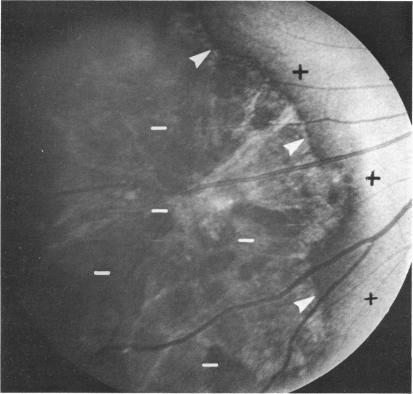
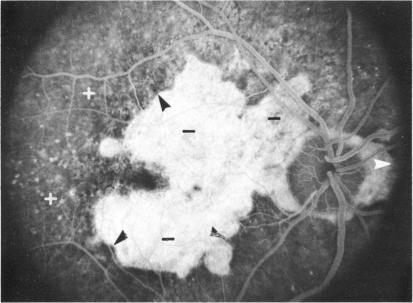
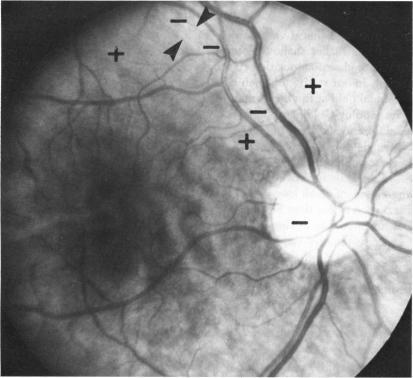
The following is a brief summary of the results in our ten groups of cases. The positive features of laser scotometry are emphasized. The normal response is well defined: there are no uncertain blind spot margins. The peripheral field is probably extended beyond 60 degrees nasally and superiorly. The size and shape of the small central scotomas associated with macular holes are easily defined and correlated directly with the visible edge of the hole. This result is distinct from the intact subjective response with cystoid maculopathy and surface wrinkling retinopathy. Plotting the margins of peripheral abnormalities such as retinal detachments, retinoschisis, and lattice degeneration is easily done. Schisis is distinguished by an absolute scotoma. This scotometry is facilitated by a larger "normal" field with the laser instrument. Lattice degeneration causes a field defect. A branch retinal artery occlusion shows a slightly jagged border, difficult to detect by standard methods. A cotton-wool spot does not show a total nerve-fiber-bundle defect. Small absolute scotomas are correlated with degenerative changes within nevi. Degenerative changes over small melanomas--ie, the orange spots--also produce absolute field defects. "Bear track" lesions have a normal field, whereas dense black isolated lesions are associated with absolute scotomas. In macular degeneration the bright laser test object is usually visible to the patient within detachments of neuroepithelium, detachments of the pigment epithelium, and over recent subretinal neovascularization. Response is absent over sharply-defined zones of pigment atrophy and over late subretinal fibrovascular mounds. In contrast to the degenerative cases, a selection of hereditary cases showed no direct correlation between the zone of pigment atrophy and the zone of absolute scotoma. The scotoma was much larger than the atrophic region, extending to the edge of the cream-colored subretinal spots. The laser target method sharply defines the absolute scotoma associated with papilledema. It also detects a slit-like nerve-fiber-bundle defect, suggesting progressive damage. Small, but possibly not the earliest, scotomas associated with glaucoma can be detected with laser scotometry. In some cases they are detected when the Goldmann perimetric field is normal. Late residual visual fields are easily defined, since fixation can be directly monitored. The vertical border of hemianopic defects can be defined within one degree of accuracy.
以下是我们十组病例结果的简要总结。重点强调了激光扫描视野检查的阳性特征。正常反应定义明确:盲点边缘不存在不确定性。周边视野在鼻侧和上方可能扩展超过60度。与黄斑裂孔相关的小中央暗点的大小和形状易于界定,且与裂孔的可见边缘直接相关。这一结果与黄斑囊样水肿和视网膜表面皱襞病变的完整主观反应不同。绘制周边异常(如视网膜脱离、视网膜劈裂和格子样变性)的边缘很容易。视网膜劈裂以绝对暗点为特征。使用激光仪器时,较大的“正常”视野有助于这种视野检查。格子样变性会导致视野缺损。视网膜分支动脉阻塞显示边界略呈锯齿状,用标准方法难以检测。棉絮斑不显示完全的神经纤维束缺损。小的绝对暗点与痣内的退行性改变相关。小黑色素瘤上的退行性改变——即橙色斑点——也会产生绝对视野缺损。“熊迹”病变视野正常,而密集的黑色孤立病变与绝对暗点相关。在黄斑变性中,明亮的激光测试物体在神经上皮脱离、色素上皮脱离以及近期的视网膜下新生血管形成区域通常对患者可见。在色素萎缩的清晰界定区域和晚期视网膜下纤维血管隆起上方无反应。与退行性病例不同,一些遗传性病例显示色素萎缩区域与绝对暗点区域之间无直接相关性。暗点比萎缩区域大得多,延伸至淡黄色视网膜下斑点的边缘。激光靶点法能清晰界定与视乳头水肿相关的绝对暗点。它还能检测到一条狭缝样的神经纤维束缺损,提示进行性损害。激光扫描视野检查可检测到与青光眼相关的小暗点,但可能不是最早出现的。在某些情况下,当戈德曼视野计检查视野正常时就能检测到它们。晚期残余视野很容易界定,因为可以直接监测注视情况。偏盲缺损的垂直边界可以精确到一度以内界定。











 Zotero 插件