Kroath H, Gross H J, Jungwirth C, Bodo G
Nucleic Acids Res. 1978 Jul;5(7):2441-54. doi: 10.1093/nar/5.7.2441.
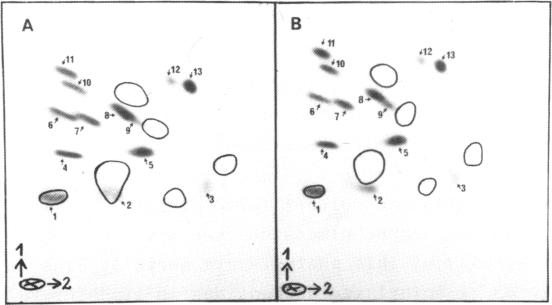
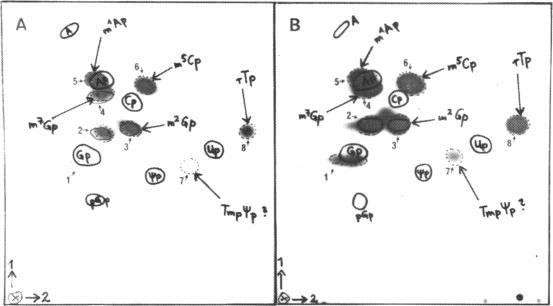
Interferon-pretreatment of vaccinia-infected chick embryo fibroblasts resulted in a greater than 50% decrease in ribose methylation of the penultimate "cap" nucleotide in virus-specific mRNA. However, in contrast to results obtained with cell-free systems, in intact infected cells there was (a) no detectable reduction in methylation of the 5'-ultimate m7G of viral mRNA; (b) a virus specificity of the interferon-induced change in mRNA "CAP"-methylation seems unlikely and (c) analysis of the ribosomal and transfer RNA fractions isolated from interferon-treated and control cells revealed identical patterns of methylated nucleotides. Thus, the interferon-induced change in methylation is specific for mRNA "CAPS".
用干扰素预处理感染痘苗病毒的鸡胚成纤维细胞,会使病毒特异性mRNA中倒数第二个“帽”核苷酸的核糖甲基化减少50%以上。然而,与无细胞系统得到的结果相反,在完整的感染细胞中:(a) 病毒mRNA的5'-末端m7G甲基化没有可检测到的减少;(b) 干扰素诱导的mRNA“帽”甲基化变化似乎没有病毒特异性;(c) 对从干扰素处理组和对照组细胞中分离出的核糖体RNA和转运RNA组分的分析显示,甲基化核苷酸的模式相同。因此,干扰素诱导的甲基化变化对mRNA“帽”是特异性的。