Lindström F D, Hed J, Eneström S
Clin Exp Immunol. 1980 Aug;41(2):196-204.
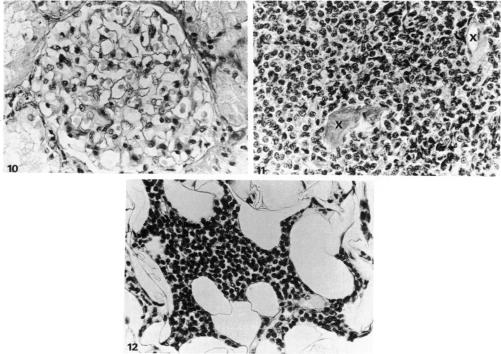
Severe nephrotic syndrome developed suddenly in a 67-year-old man. IgM M-component and bone marrow findings indicated a diagnosis of Waldenström's macroglobulinaemia. High-titre IgM glomerular autoantibodies were found to reside mainly in the M-component. Immunofluorescent (IF) studies on serial kidney biopsies showed extensive IgM deposits that disappeared after treatment. Light microscopy of kidney biopsy appeared only slightly altered, but combined with electron microscopy could demonstrate changes that correlated well with IF findings. The latest biopsy showed interstitial infiltration in the kidney of atypical lympho-histiocytic cells. Morphological and immunological examination indicated that pathogenetic events started with minimal-change glomerulonephritis, causing release of glomerular antigen, that finally triggered a monoclonal IgM response and lymphoproliferative reaction. Intermittent treatment with chlorambucil and corticoids completely abolished the nephrotic syndrome and at the same time the changes in renal morphology largely disappeared.
一名67岁男性突然出现严重肾病综合征。IgM M蛋白成分及骨髓检查结果提示诊断为华氏巨球蛋白血症。发现高滴度IgM肾小球自身抗体主要存在于M蛋白成分中。对系列肾活检组织进行免疫荧光(IF)研究显示有广泛的IgM沉积,治疗后消失。肾活检的光镜检查仅显示轻微改变,但结合电镜检查可发现与IF结果密切相关的变化。最新的活检显示肾脏间质有非典型淋巴组织细胞浸润。形态学和免疫学检查表明,发病过程始于微小病变性肾小球肾炎,导致肾小球抗原释放,最终引发单克隆IgM反应和淋巴增殖反应。用苯丁酸氮芥和皮质激素间歇治疗完全消除了肾病综合征,同时肾脏形态学改变也基本消失。