Adler S G, Wang H, Ward H J, Cohen A H, Border W A
J Clin Invest. 1983 Mar;71(3):487-99. doi: 10.1172/jci110793.
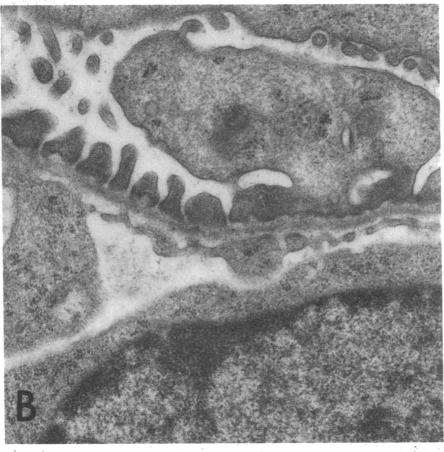
Intravenous cationic bovine serum albumin (BSA, pI > 9.5) induces membranous nephropathy in immunized rabbits. In this study, unimmunized rabbits received intravenous injections of cationic (n = 3) or native (n = 3) or native (n = 3) BSA, followed by ex vivo isolated left renal perfusions with sheep anti-BSA antibody. Capillary wall deposits of IgG and C3 were seen exclusively in the group receiving cationic BSA, confirming an in situ pathogenesis for cationic, BSA-induced membranous nephropathy, and demonstrating the importance of a cationic antigen for its production. We then explored whether membranous nephropathy in this model is prevented by the concomitant injection of protamine sulfate, a filterable, relatively non-immunogenic polycation. An in vitro study demonstrated that protamine sulfate incubated with glomerular basement membrane (GBM) decreased the subsequent binding of radiolabeled cationic BSA (P < 0.05). In vivo, protamine sulfate was shown to bind to anionic sites in the glomerular capillary wall after intravenous injection.Groups of rabbits received 3 wk of daily intravenous injections of cationic BSA alone (n = 15) or cationic BSA and protamine (n = 18). After 2 wk of injection of cationic BSA alone, typical membranous nephropathy developed. Granular deposits of IgG and C3 were present along the GBM associated with subepithelial dense deposits, foot process effacement, and marked albuminuria. Protamine significantly reduced or prevented the formation of deposits (P < 0.001) and in6 of 18 protamine-treated animals, existing deposits decreased or disappeared between 2 and 3 wk of injection. Albuminuria was significantly reduced in protamine-treated animals with a mean of 124+/-55 mg/24 h compared to 632+/-150 mg/24 h in the control group receiving cationic BSA alone. No significant differences between the groups were noted in serum lev9lsof IgG, C3, anti-BSA antibody, or circulating immune complex size. Studies in additional animals (n = 5) given radiolabeled cationic BSA showed that protamine did not alter the clearance of cationic BSA from serum. Control experiments showed that protamine's beneficial effects were not related to its weak anticoagulant property or toits theoretical ability to deplete tissue histamine. The administration of heparin (n = 6) or diphenhydramine (n = 6) had no effect on the development of the epimembranous lesion compared to the group receiving cationic BSA alone. In addition, homogenized whole kidney histamine content was not significantly different in the group receiving cationic BSA alone compared to the group receiving cationic BSA and protamine. This work shows that a cationic BSA-induced glomerular lesion can be produced by a renal perfusion technique involving in situ complex formation and that this process requires a cationic antigen for its development. We believe that the demonstrated beneficial effects of protamine are due to its ability to bind to glomerular anionic sites, and that this electrostatic interaction results in inhibition for the further binding of the cationic antigen, thereby limiting the severity of glomerulonephritis in this model.

静脉注射阳离子牛血清白蛋白(BSA,pI>9.5)可诱导免疫兔发生膜性肾病。在本研究中,未免疫的兔接受静脉注射阳离子型(n = 3)或天然型(n = 3)BSA,然后用羊抗BSA抗体进行离体左肾灌注。仅在接受阳离子型BSA的组中观察到IgG和C3在毛细血管壁的沉积,证实了阳离子型BSA诱导的膜性肾病的原位发病机制,并证明了阳离子抗原在其发生中的重要性。然后,我们探讨了同时注射硫酸鱼精蛋白(一种可过滤的、相对无免疫原性的聚阳离子)是否能预防该模型中的膜性肾病。一项体外研究表明,与肾小球基底膜(GBM)孵育的硫酸鱼精蛋白可降低随后放射性标记的阳离子型BSA的结合(P<0.05)。在体内,静脉注射后硫酸鱼精蛋白显示可与肾小球毛细血管壁的阴离子位点结合。兔分组接受为期3周的每日静脉注射单独的阳离子型BSA(n = 15)或阳离子型BSA与鱼精蛋白(n = 18)。单独注射阳离子型BSA 2周后,出现典型的膜性肾病。IgG和C3的颗粒状沉积沿GBM出现,伴有上皮下致密沉积、足突消失和明显的蛋白尿。鱼精蛋白显著减少或预防了沉积物的形成(P<0.001),在18只接受鱼精蛋白治疗的动物中,有6只在注射2至3周期间现有的沉积物减少或消失。与仅接受阳离子型BSA的对照组相比,接受鱼精蛋白治疗的动物蛋白尿显著减少,平均为124±55 mg/24 h,而对照组为632±150 mg/24 h。在血清IgG、C3、抗BSA抗体水平或循环免疫复合物大小方面,各组之间未观察到显著差异。对另外5只给予放射性标记阳离子型BSA的动物的研究表明,鱼精蛋白不会改变阳离子型BSA从血清中的清除率。对照实验表明,鱼精蛋白的有益作用与其微弱的抗凝特性或其理论上消耗组织组胺的能力无关。与仅接受阳离子型BSA的组相比,给予肝素(n = 6)或苯海拉明(n = 6)对膜性病变的发展没有影响。此外,与接受阳离子型BSA和鱼精蛋白的组相比,仅接受阳离子型BSA的组全肾组胺含量的匀浆没有显著差异。这项工作表明,阳离子型BSA诱导的肾小球病变可通过涉及原位复合物形成的肾灌注技术产生,并且该过程需要阳离子抗原才能发展。我们认为,已证明的鱼精蛋白的有益作用归因于其与肾小球阴离子位点结合的能力,并且这种静电相互作用导致抑制阳离子抗原的进一步结合,从而限制该模型中肾小球肾炎的严重程度。