Osborne T F, Berk A J
J Virol. 1983 Feb;45(2):594-9. doi: 10.1128/JVI.45.2.594-599.1983.
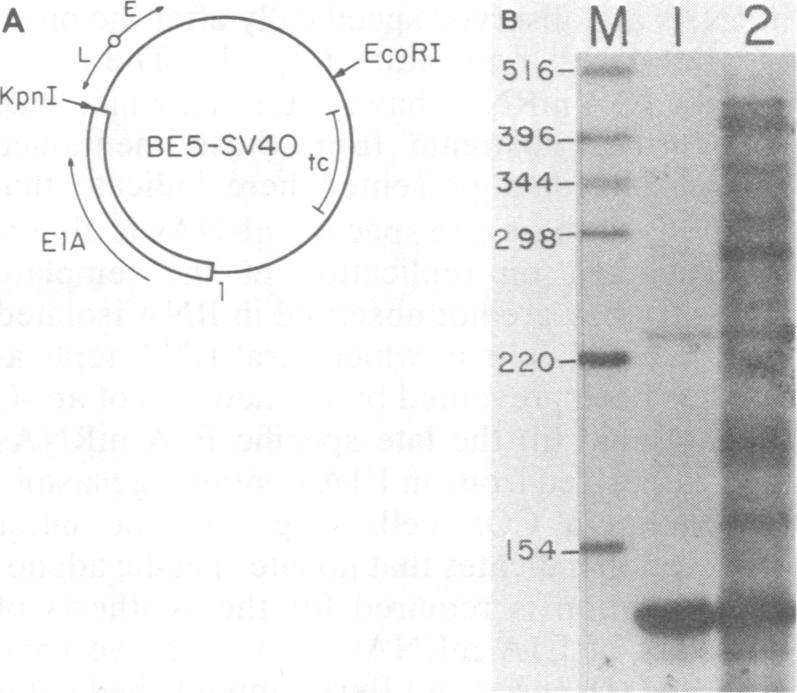
Adenovirus early region 1A (E1A) is the first transcription unit expressed after infection. It encodes a protein which controls the expression of all other early viral genes. The E1A mRNAs have one major capped 5' terminus which maps 31 nucleotides downstream from a T-A-T-A sequence (C. Baker and E. Ziff. J. Mol. Biol. 149:189-221, 1981). In addition, a minor set of E1A mRNAs are observed during the early phase of infection which have 5' termini mapping at approximately -160, -185, and -230 relative to the major cap site (Osborne et al., Cell 29:139-148, 1982). Here we report the occurrence of another set of minor E1A mRNAs which were observed exclusively after the initiation of viral DNA replication. These late specific E1A mRNAs had cap sites which mapped at approximately -300, -325, -360, and -375 relative to the major cap site. The appearance of these minor late E1A mRNAs was blocked by the DNA synthesis inhibitor cytosine arabinoside. These same late specific E1A mRNAs were synthesized from E1A-containing plasmids which replicate in monkey cells. This demonstrated that neither late specific adenovirus proteins nor adenovirus-specific chromatin structure was required for the production of the late specific E1A mRNAs. Adenovirus mutants in which the E1A T-A-T-A box region had been deleted also synthesized the corresponding deleted forms of the late specific mRNAs after initiation of DNA replication. These results indicate that the process of DNA replication alters the specificity of E1A transcription initiation in a promoter region which is at least 375 nucleotides in length.
腺病毒早期区域1A(E1A)是感染后表达的第一个转录单位。它编码一种控制所有其他早期病毒基因表达的蛋白质。E1A mRNA有一个主要的加帽5'末端,其定位在T-A-T-A序列下游31个核苷酸处(C.贝克和E.齐夫,《分子生物学杂志》149:189-221,1981年)。此外,在感染早期观察到一小部分E1A mRNA,其5'末端相对于主要帽位点定位在大约-160、-185和-230处(奥斯本等人,《细胞》29:139-148,1982年)。在此我们报告另一组小的E1A mRNA的出现,它们仅在病毒DNA复制开始后被观察到。这些晚期特异性E1A mRNA的帽位点相对于主要帽位点定位在大约-300、-325、-360和-375处。这些小的晚期E1A mRNA的出现被DNA合成抑制剂阿糖胞苷阻断。这些相同的晚期特异性E1A mRNA是从在猴细胞中复制的含E1A质粒合成的。这表明晚期特异性腺病毒蛋白和腺病毒特异性染色质结构都不是产生晚期特异性E1A mRNA所必需的。E1A T-A-T-A框区域已被删除的腺病毒突变体在DNA复制开始后也合成了相应的缺失形式的晚期特异性mRNA。这些结果表明,DNA复制过程改变了至少375个核苷酸长的启动子区域中E1A转录起始的特异性。