Tamanoi F, Stillman B W
Proc Natl Acad Sci U S A. 1982 Apr;79(7):2221-5. doi: 10.1073/pnas.79.7.2221.
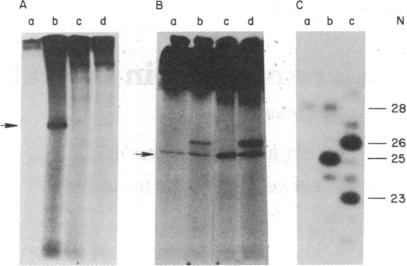
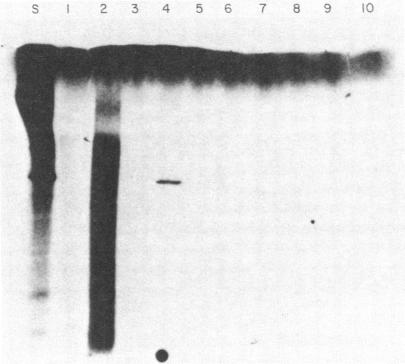
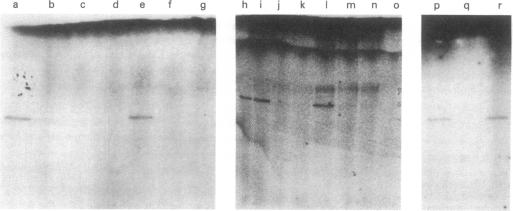
An early event in the initiation of adenovirus DNA replication is the formation of a covalent complex between the 87,000-dalton adenovirus terminal protein precursor and 5'- dCMP (pTP-dCMP complex). Nuclear extracts prepared from adenovirus-infected HeLa cells catalyzed complex formation in the presence of ATP, Mg2+, and adenovirus DNA-protein complex but were not active when Pronase-treated DNA was used as template. The activity has been partially purified by chromatography on denatured DNA-cellulose and used to examine whether the 55,000-dalton terminal protein on adenovirus DNA is required for pTP-dCMP complex formation. Results obtained with either DNA-protein complex or Pronase-treated DNA were identical to those obtained using crude nuclear extracts. However, after treatment with piperidine to remove residual peptides. Pronase-treated DNA supported complex formation with the partially purified activity but not with the crude extracts. In addition, when a plasmid containing an origin of adenovirus DNA replication was used as template, the pTP-dCMP complex was formed provided the plasmid was linearized in such a way that the origin was located at the end of the molecule. Neither linearized plasmid DNA with an internal origin nor supercoiled plasmid DNA supported complex formation. Furthermore, after heat denaturation, the linear plasmid DNA still supported complex formation, again provided that the origin was located at the end of the molecule. The partially purified protein fraction supported a limited amount of DNA chain elongation, which permitted exact positioning of the initiation site. These results suggest that enzymes responsible for complex formation recognize a DNA sequence at the origin and that the terminal protein on the template DNA plays a subordinate role.
腺病毒DNA复制起始的早期事件是87,000道尔顿的腺病毒末端蛋白前体与5'-dCMP之间形成共价复合物(pTP-dCMP复合物)。从腺病毒感染的HeLa细胞制备的核提取物在ATP、Mg2+和腺病毒DNA-蛋白质复合物存在的情况下催化复合物形成,但当用链霉蛋白酶处理的DNA作为模板时则无活性。该活性已通过在变性DNA-纤维素上的色谱法进行了部分纯化,并用于检测腺病毒DNA上55,000道尔顿的末端蛋白是否是pTP-dCMP复合物形成所必需的。用DNA-蛋白质复合物或链霉蛋白酶处理的DNA获得的结果与使用粗核提取物获得的结果相同。然而,在用哌啶处理以去除残留肽后,链霉蛋白酶处理的DNA支持与部分纯化的活性形成复合物,但不支持与粗提取物形成复合物。此外,当使用含有腺病毒DNA复制起点的质粒作为模板时,只要质粒以这样的方式线性化,即起点位于分子末端,就会形成pTP-dCMP复合物。具有内部起点的线性化质粒DNA或超螺旋质粒DNA均不支持复合物形成。此外,热变性后,线性质粒DNA仍然支持复合物形成,同样只要起点位于分子末端。部分纯化的蛋白质组分支持有限量的DNA链延伸,这允许起始位点的精确定位。这些结果表明,负责复合物形成的酶识别起点处的DNA序列,并且模板DNA上的末端蛋白起次要作用。