Morley C A, Perrins E J, Grant P, Chan S L, McBrien D J, Sutton R
Br Heart J. 1982 May;47(5):411-8. doi: 10.1136/hrt.47.5.411.
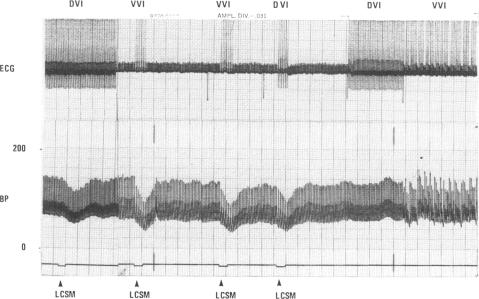
Seventy patients have been paced for carotid sinus syndrome over four years. Twelve patients had persistent symptoms despite adequate ventricular pacing. Patients with persistent symptoms were found to have a significant vasodepressor response, a significant hypotensive response to ventricular pacing (pacemaker effect), and a severe hypotensive response to carotid sinus massage with introduction of ventricular pacing, which reproduced symptoms in all patients. A group of 14 asymptomatic paced carotid sinus patients was found to have a significantly lower vasodepressor response, pacemaker effect, and combined vasodepressor response plus pacemaker effect than the group with persistent symptoms. Atrioventricular sequential pacing was shown to eliminate the hypotensive effect of ventricular pacing and is considered to be the treatment of choice for patients with carotid sinus syndrome who have both cardioinhibitory and significant vasodepressor responses.
在四年时间里,有70名患者因颈动脉窦综合征接受了起搏治疗。尽管心室起搏充分,但仍有12名患者存在持续症状。发现有持续症状的患者具有显著的血管减压反应、对心室起搏的显著低血压反应(起搏器效应)以及在引入心室起搏时对颈动脉窦按摩的严重低血压反应,这在所有患者中都重现了症状。发现一组14名无症状的起搏颈动脉窦患者的血管减压反应、起搏器效应以及血管减压反应加起搏器效应的综合反应明显低于有持续症状的组。房室顺序起搏被证明可消除心室起搏的低血压效应,被认为是对既有心脏抑制又有显著血管减压反应的颈动脉窦综合征患者的首选治疗方法。