
细胞内钠与两栖类胚胎神经元的分化
Intracellular sodium and the differentiation of amphibian embryonic neurones.
作者信息
Breckenridge L J, Warner A E
出版信息
J Physiol. 1982 Nov;332:393-413. doi: 10.1113/jphysiol.1982.sp014420.
- Experiments have been done to examine the mechanism of the inhibition of neural differentiation produced by inhibiting the sodium pump with cardiac glycosides during the mid-neural fold stages of development of the amphibian embryo. Neural differentiation was assessed quantitatively by counting the number of neurones that undergo primary differentiation in tissue culture, as a proportion of the total number of differentiated cells.2. Inhibition of the sodium pump by lowering the extracellular potassium concentration ([K(o)]) to 0 during the mid-neural fold stages inhibited neural differentiation.3. Raising the extracellular calcium concentration to 10 mM during treatment with strophanthidin protected differentiating neurones from the effects of the sodium pump inhibitor. Lowering Ca to 0.05 mM potentiated the effect of low doses of glycoside.4. In the presence of high extracellular calcium and 5 x 10(-6) M-strophanthidin the membrane potential of neural plate cells remained close to the levels recorded at the beginning of neurulation; the normal increase in resting potential was not restored.5. Addition of 10 mM-Sr(2+) to the bathing medium also protected nerve cells against the inhibition produced by strophanthidin; Sr(2+) was less effective than Ca(2+).6. Addition of either 10 mM-Mg(2+) or Mn(2+) had no effect on the inhibition of differentiation produced by strophanthidin.7. Addition of Mn(2+) along with high Ca(2+) prevented calcium from exerting its protective effect.8. The eyes of embryos treated with high Ca(2+) together with strophanthidin during neurulation and then allowed to grow into tadpoles developed normally. When Mn(2+) was present together with Ca(2+) and strophanthidin the eyes were disrupted similarly to those of embryos treated with strophanthidin alone.9. Replacement of extracellular sodium with equimolar amounts of choline or lithium prevented the cardiac glycoside from inhibiting neural differentiaion.10. The protection afforded by lowering Na was abolished when Ca was simultaneously lowered to 0.05 mM.11. Tadpoles from embryos treated with low extracellular sodium together with strophanthidin during neurulation had normal eyes compared to those treated with strophanthidin alone.12. Measurement of the intracellular sodium concentration (Na) with sodium-sensitive micro-electrodes put Na at about 30 mM before the neural folds lift. As the sodium pump is activated (stages 14(1/2)-15)Na in the neural plate falls; by the end of the mid-neural fold stage it is less than 10 mM.13. Addition of 5 x 10(-6)M-strophanthidin to the bathing fluid before activation of the sodium pump prevented the fall in Na; in embryos where Na had begun to drop strophanthidin produced a rise to about 30 mM.14. When 10 mM-calcium was present along with strophanthidin Na fell to about 17 mM during neurulation, despite inhibition of the sodium pump.15. It is concluded that it is unlikely that either abolition of the normal increase in resting potential or a fall in gap junction permeability is responsible for the reduction in neural differentiation produced by blocking the sodium pump during neurulation.16. The results are consistent with the view that strophanthidin achieves its effect by preventing the fall in Na that occurs during normal neurulation because of activation of the sodium pump. They are discussed in the light of this suggestion.
已经开展了实验,以研究在两栖类胚胎神经褶形成中期,用强心苷抑制钠泵从而抑制神经分化的机制。通过计算组织培养中经历初级分化的神经元数量占分化细胞总数的比例,对神经分化进行定量评估。
在神经褶形成中期,将细胞外钾离子浓度([K(o)])降至0来抑制钠泵,会抑制神经分化。
在毒毛花苷处理期间,将细胞外钙浓度提高到10 mM可保护分化中的神经元免受钠泵抑制剂的影响。将Ca降至0.05 mM会增强低剂量糖苷的作用。
在高细胞外钙和5×10(-6) M毒毛花苷存在的情况下,神经板细胞的膜电位保持在神经胚形成开始时记录的水平附近;静息电位的正常升高未恢复。
向浴液中添加10 mM Sr(2+)也可保护神经细胞免受毒毛花苷产生的抑制作用;Sr(2+)的效果不如Ca(2+)。
添加10 mM Mg(2+)或Mn(2+)对毒毛花苷产生的分化抑制作用没有影响。
同时添加Mn(2+)和高浓度Ca(2+)会阻止钙发挥其保护作用。
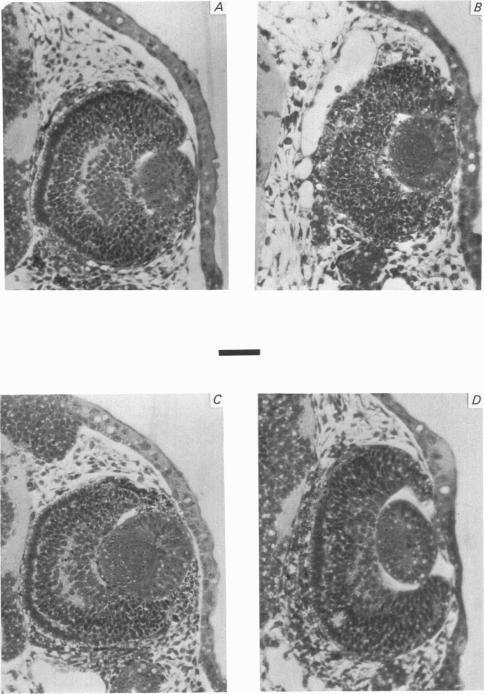
在神经胚形成期间用高浓度Ca(2+)和毒毛花苷处理胚胎,然后让其发育成蝌蚪,其眼睛发育正常。当Mn(2+)与Ca(2+)和毒毛花苷同时存在时,眼睛受到的破坏与仅用毒毛花苷处理的胚胎相似。
用等摩尔量的胆碱或锂替代细胞外钠可防止强心苷抑制神经分化。
与仅用毒毛花苷处理的胚胎相比,在神经胚形成期间用低细胞外钠和毒毛花苷处理的胚胎发育出的蝌蚪眼睛正常。
用钠敏感微电极测量细胞内钠浓度(Na),发现在神经褶抬起之前Na约为30 mM。随着钠泵被激活(第14(1/2)-15阶段),神经板中的Na下降;到神经褶形成中期结束时,它小于10 mM。
在钠泵激活之前向浴液中添加5×10(-6)M毒毛花苷可防止Na下降;在Na已经开始下降的胚胎中,如果添加毒毛花苷,Na会上升到约30 mM。
当10 mM钙与毒毛花苷同时存在时,尽管钠泵受到抑制,但在神经胚形成期间Na仍会降至约17 mM。
得出的结论是,在神经胚形成期间,静息电位正常升高的消除或缝隙连接通透性的降低都不太可能是阻断钠泵导致神经分化减少的原因。
结果与以下观点一致,即毒毛花苷通过防止在正常神经胚形成期间由于钠泵激活而发生的Na下降来发挥其作用。将根据这一观点进行讨论。

 Zotero 插件