McDowell R S, Elias K A, Stanley M S, Burdick D J, Burnier J P, Chan K S, Fairbrother W J, Hammonds R G, Ingle G S, Jacobsen N E, Mortensen D L, Rawson T E, Won W B, Clark R G, Somers T C
Department of Bioorganic Chemistry, Genentech, Inc., South San Francisco, CA 94080, USA.
Proc Natl Acad Sci U S A. 1995 Nov 21;92(24):11165-9. doi: 10.1073/pnas.92.24.11165.
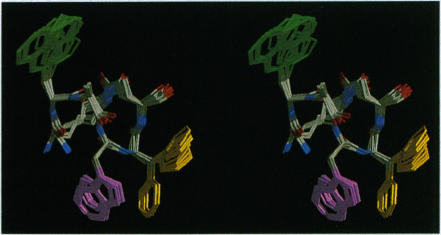
Another class of growth hormone (GH) secretagogues has been discovered by altering the backbone structure of a flexible linear GH-releasing peptide (GHRP). In vitro and in vivo characterization confirms these GH secretagogues as the most potent and smallest (M(r) < 500) reported. Anabolic efficacy is demonstrated in rodents with intermittent delivery. A convergent model of the bioactive conformation of GHRPs is developed and is supported by the NMR structure of a highly potent cyclic analog of GHRP-2. The model and functional data provide a logical framework for the further design of low-molecular weight secretagogues and illustrate the utility of an interdisciplinary approach to elucidating potential bound-state conformations of flexible peptide ligands.
通过改变柔性线性生长激素释放肽(GHRP)的主链结构,发现了另一类生长激素(GH)促分泌剂。体外和体内特性证实这些GH促分泌剂是已报道的最有效且最小(相对分子质量<500)的。在啮齿动物中通过间歇性给药证明了其合成代谢功效。构建了GHRP生物活性构象的收敛模型,该模型得到了GHRP-2高效环类似物的NMR结构的支持。该模型和功能数据为进一步设计低分子量促分泌剂提供了逻辑框架,并说明了跨学科方法在阐明柔性肽配体潜在结合态构象方面的实用性。