Chapman A J, Farrell H E, Thomas J A, Papadimitriou J M, Garlepp M J, Scalzo A A, Shellam G R
Department of Microbiology, University of Western Australia, Nedlands.
Immunology. 1994 Mar;81(3):435-43.
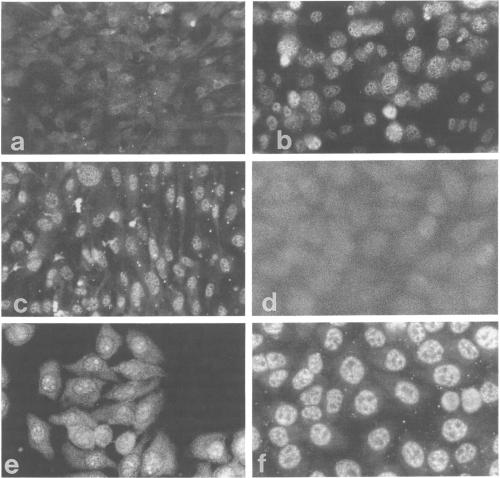
The autoreactivity of murine cytomegalovirus (MCMV)-neutralizing monoclonal antibody (mAb) AC1 was examined in vitro and in vivo. Both mAb AC1 and a human antiserum reactive with U1-small nuclear ribonucleoprotein (U1-snRNP) stained uninfected mouse embryo fibroblasts (MEF) in a speckled nuclear pattern and reacted with 70,000 molecular weight (MW) MEF nuclear antigens by immunoblotting, suggesting that mAb AC1 cross-reacted with the 70,000 MW component of U1-snRNP. However, only mAb AC1 cross-reacted with an additional epithelial cytoplasmic autoantigen present in cultured HEp2 cells. On tissue sections from uninfected mice, mAb AC1 predominantly reacted with a component of central and peripheral nervous systems, although cross-reactivity with the stratum spinosum of the skin and the outer sheath of hair follicles was also observed. Immunoblotting revealed that mAb AC1 reacted with phosphorylated epitopes present on a 98,000 MW MCMV structural protein and the 200,000 MW mouse neurofilament protein (NFP). Treatment of uninfected mice with mAb AC1 resulted in a severe interstitial pneumonia with greatly thickened and congested alveolar septa. Severe oedema of the hypodermis and a mild mesangial proliferative glomerulonephritis were also observed. These results demonstrate that a mAb reacting with a MCMV structural phosphoprotein which can protect mice against the dissemination of MCMV, can also promote the development of autoimmune disease. Therefore, the production of such cross-reactive antibodies may be an important mechanism in the development of autoimmunity following viral infection.
对鼠巨细胞病毒(MCMV)中和单克隆抗体(mAb)AC1的自身反应性进行了体外和体内检测。mAb AC1和与人抗U1 - 小核糖核蛋白(U1 - snRNP)反应的人抗血清均以斑点状核模式对未感染的小鼠胚胎成纤维细胞(MEF)进行染色,并通过免疫印迹与70,000分子量(MW)的MEF核抗原发生反应,这表明mAb AC1与U1 - snRNP的70,000 MW成分发生交叉反应。然而,只有mAb AC1与培养的HEp2细胞中存在的另一种上皮细胞质自身抗原发生交叉反应。在未感染小鼠的组织切片上,mAb AC1主要与中枢和外周神经系统的一种成分发生反应,尽管也观察到与皮肤棘层和毛囊外鞘的交叉反应。免疫印迹显示mAb AC1与存在于98,000 MW的MCMV结构蛋白和200,000 MW的小鼠神经丝蛋白(NFP)上的磷酸化表位发生反应。用mAb AC1处理未感染的小鼠导致严重的间质性肺炎,肺泡隔显著增厚和充血。还观察到皮下严重水肿和轻度系膜增生性肾小球肾炎。这些结果表明,一种与MCMV结构磷蛋白反应且能保护小鼠免受MCMV传播的单克隆抗体,也可促进自身免疫性疾病的发展。因此,产生这种交叉反应性抗体可能是病毒感染后自身免疫发展的一个重要机制。