Anderson M T, Staal F J, Gitler C, Herzenberg L A, Herzenberg L A
Department of Genetics, Stanford University School of Medicine, CA 94305.
Proc Natl Acad Sci U S A. 1994 Nov 22;91(24):11527-31. doi: 10.1073/pnas.91.24.11527.
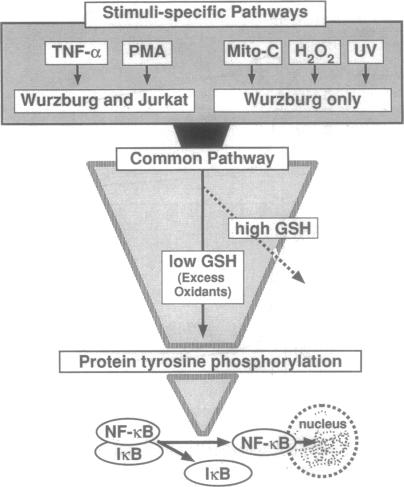
Studies presented here show that overall NF-kappa B signal transduction begins with a parallel series of stimuli-specific pathways through which cytokines (tumor necrosis factor alpha), oxidants (hydrogen peroxide and mitomycin C), and phorbol ester (phorbol 12-myristate 13-acetate) individually initiate signaling. These initial pathways culminate in a common pathway through which all of the stimulating agents ultimately signal NF-kappa B activation. We distinguish the stimuli-specific pathways by showing that the oxidative stimuli trigger NF-kappa B activation in only one of two human T-cell lines (Wurzburg but not Jurkat), whereas tumor necrosis factor alpha and phorbol 12-myristate 13-acetate readily stimulate in both lines. We propose the common pathway as the simplest way of accounting for the common requirements and properties of the signaling pathway. We include a redox-regulatory mechanism(s) in this common pathway to account for the previously demonstrated redox regulation of NF-kappa B activation in Jurkat cells (in which oxidants don't activate NF-kappa B); we put tyrosine phosphorylation in the common pathway by showing that kinase activity (inhibitable by herbimycin A and tyrphostin 47) is required for NF-kappa B activation by all stimuli tested in both cell lines. Since internal sites of oxidant production have been shown to play a key role in the cytokine-stimulated activation of NF-kappa B, and since tyrosine kinase and phosphatase activities are known to be altered by oxidants, these findings suggest that intracellular redox status controls NF-kappa B activation by regulating tyrosine phosphorylation event(s) within the common step of the NF-kappa B signal transduction pathway.
此处展示的研究表明,总体而言,核因子-κB信号转导始于一系列平行的、特定刺激的途径,细胞因子(肿瘤坏死因子α)、氧化剂(过氧化氢和丝裂霉素C)以及佛波酯(佛波醇12-肉豆蔻酸酯13-乙酸酯)通过这些途径分别启动信号传导。这些初始途径最终汇聚成一条共同途径,所有刺激剂最终都通过这条共同途径发出核因子-κB激活的信号。我们通过以下方式区分特定刺激途径:氧化刺激仅在两种人类T细胞系之一(维尔茨堡细胞系而非Jurkat细胞系)中触发核因子-κB激活,而肿瘤坏死因子α和佛波醇12-肉豆蔻酸酯13-乙酸酯在两种细胞系中均能轻易刺激激活。我们提出共同途径是解释信号传导途径的共同需求和特性的最简单方式。我们在这条共同途径中纳入了一种氧化还原调节机制,以解释先前在Jurkat细胞中证实的核因子-κB激活的氧化还原调节(在该细胞系中氧化剂不会激活核因子-κB);我们通过表明激酶活性(可被除莠霉素A和 tyrphostin 47抑制)是两种细胞系中所有测试刺激激活核因子-κB所必需的,从而将酪氨酸磷酸化置于共同途径中。由于已表明氧化剂产生的内部位点在细胞因子刺激的核因子-κB激活中起关键作用,并且由于已知酪氨酸激酶和磷酸酶活性会被氧化剂改变,这些发现表明细胞内氧化还原状态通过调节核因子-κB信号转导途径共同步骤中的酪氨酸磷酸化事件来控制核因子-κB激活。